
What Is Specific IgE Testing?
Specific IgE testing is a blood test that measures how much of a certain type of antibody - immunoglobulin E, or IgE - your body has made in response to a particular allergen. This isn’t just a general allergy check. It tells you whether your immune system is reacting to specific triggers like peanuts, cat dander, ragweed, or shellfish. The test doesn’t cause a reaction - it just measures what’s already in your blood.
Back in the 1970s, this kind of testing was called RAST, short for radioallergosorbent test. It gave doctors a yes-or-no answer: either you had IgE antibodies to something or you didn’t. Today, we use far more precise tools like ImmunoCAP, which can measure the exact amount of IgE in your blood, down to fractions of a unit. The results come back in kUA/L - kiloUnits per liter - and range from 0 to 6. A result under 0.35 kUA/L is considered negative. Anything above that means your body has made some IgE against that allergen.
Why Do Doctors Order This Test?
Not everyone with allergies needs a blood test. If you break out in hives after eating shrimp, or your nose runs every spring, your doctor might already have a good idea what’s causing it. But sometimes, symptoms are unclear. Maybe you get stomach pain after meals, but it’s not always the same food. Or you have asthma that flares up randomly. That’s when specific IgE testing helps.
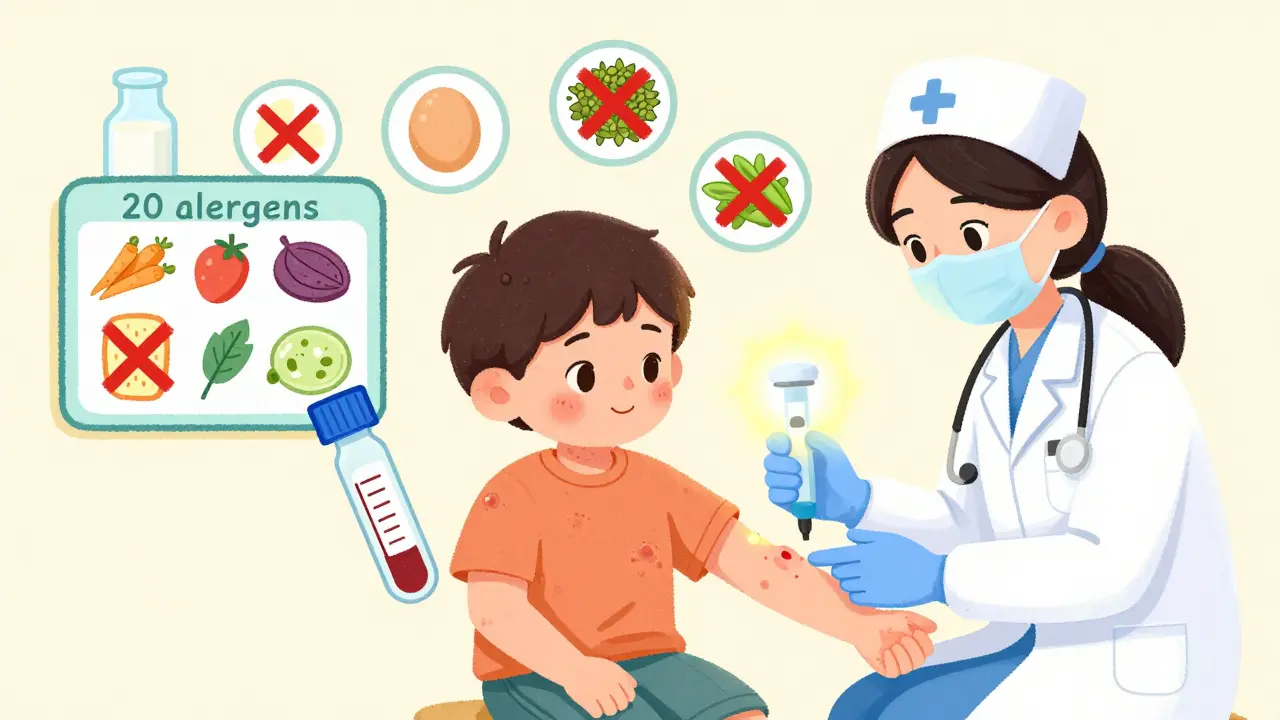
The test is especially useful when skin testing isn’t an option. If you have severe eczema covering most of your skin, or if you’re taking antihistamines, antidepressants, or other meds that interfere with skin tests, blood testing is the next best step. In children with widespread eczema, it’s often the only practical choice. Around 27% of pediatric allergy cases in the UK rely on blood tests because skin testing isn’t possible.
Doctors also use it to plan immunotherapy - those allergy shots or tablets that slowly train your immune system to stop overreacting. You can’t start treatment without knowing what you’re allergic to. And if you’ve had a near-fatal reaction to something like peanuts or bee stings, knowing the exact trigger helps prevent future emergencies.
How the Test Works - From Blood Draw to Results
The process is simple. A nurse draws about 2 milliliters of blood - less than half a teaspoon - into a yellow-top tube. That’s it. No fasting, no special prep. You can eat, drink, and take your regular meds before the test.
The lab then uses a method called Fluorescence Enzyme Immunoassay (FEIA), most commonly on the ImmunoCAP platform. This system traps the allergen on a tiny capsule, adds your blood sample, and then uses a fluorescent signal to count how many IgE antibodies stick to it. The result? A number. Not a guess. Not a category. A precise measurement in kUA/L.
Most labs run these tests daily. You’ll usually get results in three business days. Some rare allergens - like certain insect venoms or obscure foods - need to be sent to specialist labs, which can take longer. In the UK, 85% of labs use ImmunoCAP. The rest use similar systems like HyCor’s HYTEC 288.
How to Read Your Results
Don’t assume a higher number means a worse allergy. That’s a common mistake. A result of 0.5 kUA/L to milk might mean nothing if you’ve eaten cheese every day for years without issue. But if you’ve never had milk and your result is 15 kUA/L? That’s a strong signal.
The key is understanding what the number means in context. Here’s how the grades work:
- 0: <0.35 kUA/L - negative
- 1: 0.35-0.70 kUA/L - low
- 2: 0.71-3.50 kUA/L - moderate
- 3: 3.51-17.50 kUA/L - high
- 4: 17.51-50.00 kUA/L - very high
- 5: 50.01-100.00 kUA/L - extremely high
- 6: >100.00 kUA/L - very extremely high
But here’s the catch: a result of 0.5 kUA/L means something very different depending on your total IgE. If your total IgE is 1 kUA/L, then 0.5 is half your body’s entire allergy antibody output. But if your total IgE is 100 kUA/L, that same 0.5 is barely noticeable. That’s why labs now automatically test total IgE when a specific IgE comes back positive. It helps put the number in perspective.
What the Numbers Really Tell You
Specific IgE levels don’t predict how bad your reaction will be. They predict how likely you are to react at all. For example, a peanut IgE level of 0.35 kUA/L gives you about a 50% chance of reacting if you eat peanut. At 15 kUA/L? That jumps to 95%. That’s why doctors don’t just look at whether you’re positive - they look at how positive you are.
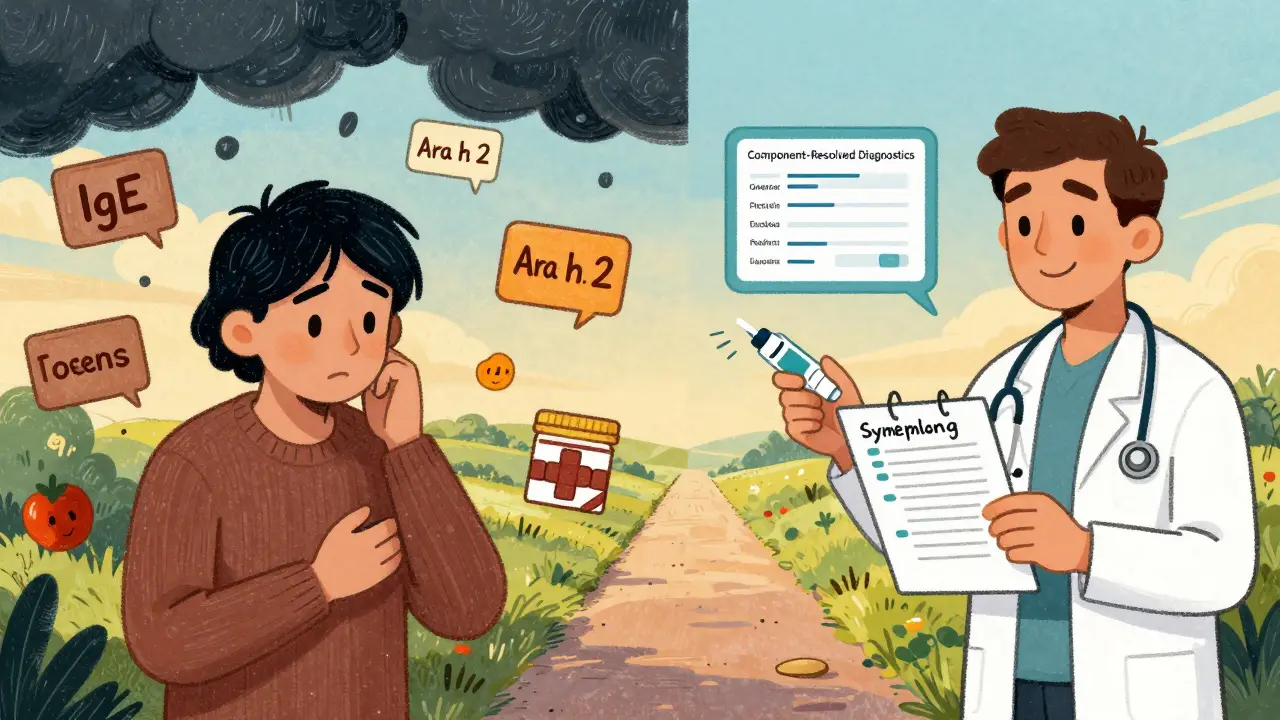
For some allergens, the thresholds are well-established. With egg, milk, and wheat, levels above 5-7 kUA/L usually mean you’re likely to have a reaction. With peanut, 14 kUA/L or higher is a strong indicator of true allergy, not just cross-reactivity. Newer tests called component-resolved diagnostics go even further. Instead of testing for whole peanut protein, they test for specific parts like Ara h 2 - the protein most linked to severe reactions. This cuts down false positives from cross-reactivity with birch pollen, which can trick older tests.
One study showed that using component testing improved accuracy for cashew nut allergy from 70% to 92%. That’s a huge difference when you’re deciding whether to carry an epinephrine auto-injector.
When Not to Test - And Why
Not every allergy test is helpful. In fact, too many tests can be misleading. Testing for 20 allergens at once? That’s a recipe for false positives. Research shows that when labs test for more than 12 allergens without clear clinical reason, up to 60% of the results are wrong - just by chance. A positive result doesn’t mean you’re allergic. It just means your immune system noticed the allergen.
That’s why guidelines now say: test only when the result will change your treatment. If you’ve never eaten shellfish and have no symptoms, don’t test for it. If you’ve eaten peanuts your whole life without a problem, don’t test for peanut unless you’re having a new reaction. And never, ever use food mix panels. They’re unreliable. A test that mixes peanut, tree nuts, and sesame together? It’s useless. You won’t know which one triggered the reaction.
One UK study found that 38% of inappropriate tests happened because doctors retested allergens the patient had already proven they tolerated. If you know you can eat eggs, don’t test for eggs again. That’s not medicine - that’s waste.
How It Compares to Skin Prick Testing
Many people assume blood tests are better than skin tests. They’re not. Skin prick testing is still the gold standard when it’s safe to do. Why? Because it shows real-time reaction. A tiny drop of allergen goes on your skin. If you’re allergic, you get a red, itchy bump within 15 minutes. That’s not just a number - it’s your body reacting right there, in real time.
Studies show skin tests are 15-20% more sensitive than blood tests for common allergens like pollen or dust mites. But blood tests have their place. They’re the only option for people with severe eczema, those on antihistamines, or those at risk of anaphylaxis from skin testing. They’re also better for infants with very sensitive skin.
The bottom line: if you can do skin testing, do it. If you can’t, blood testing is a solid alternative. But both need to be interpreted by someone who understands allergy - not just a lab tech or a general practitioner without training.
What’s New in Allergy Testing?
The future of allergy testing is getting smarter. Multiplex platforms like ISAC can test for 112 different allergen components from just one tiny drop of blood. That’s powerful - but also complex. These tests are only used in specialist allergy centers because interpreting them requires deep expertise. A positive result for a birch pollen component might mean you’re allergic to apples (due to cross-reactivity), not birch itself.
Right now, these advanced tests are not recommended for routine use. They’re expensive, overkill for most people, and can cause more confusion than clarity. But for complex cases - like someone with multiple food allergies and asthma - they’re becoming invaluable.
One thing’s clear: we’re moving away from broad panels and toward precision. Instead of testing for everything, we’re testing for the right thing - based on your history, your symptoms, and your risk.
What to Do After Getting Your Results
Don’t panic if you see a positive result. Don’t eliminate foods or avoid pets based on a number alone. Talk to an allergist. Bring your results, your symptom diary, and your questions.
If your test shows a high IgE to a food you’ve eaten safely before, the test might be wrong - or you might be developing a new allergy. If you’ve never eaten shellfish and your test is positive, your doctor might suggest a supervised food challenge - the only way to be 100% sure.
Remember: specific IgE testing is a tool. It’s not a diagnosis. Your symptoms, your history, and your doctor’s judgment are the real diagnosis. The test just helps confirm what you already suspect.
Common Myths About IgE Testing
- Myth: A positive test means you’re allergic. Truth: It means your body made antibodies. You might still eat it safely.
- Myth: Higher numbers = worse reactions. Truth: Higher numbers mean higher likelihood of reaction - not severity.
- Myth: Allergy tests can predict anaphylaxis. Truth: No test can predict how bad a reaction will be. Only your history can.
- Myth: You need to test for everything. Truth: Testing more than 12 allergens without reason increases false positives dramatically.
- Myth: Blood tests are better than skin tests. Truth: Skin tests are more sensitive and cheaper - if you can do them.
When to See an Allergist
You don’t need to see an allergist just because your test is positive. But you should if:
- You’ve had a reaction that involved trouble breathing, swelling, or dizziness.
- You’re considering allergy shots or oral immunotherapy.
- Your symptoms are getting worse or spreading to new foods or environments.
- You’ve had a positive test but no clear symptoms - and you’re unsure what to do next.
Most people who get tested for allergies don’t need specialist care. But if your results are confusing, or your symptoms don’t match your test, that’s when an allergist makes the difference.
8 Responses
Just read this through and honestly? This is one of the clearest breakdowns of IgE testing I’ve seen in years. The part about component-resolved diagnostics changing cashew accuracy from 70% to 92%? That’s game-changing for parents of kids with tree nut allergies. I work in a pediatric clinic in Manchester, and we’ve started pushing for component testing when skin tests aren’t feasible - it’s cut down unnecessary epinephrine prescriptions by nearly 40% in our cohort. Don’t let the kUA/L number scare you; context is everything.
So let me get this straight - you’re telling me a person can have a 15 kUA/L result for peanut and still eat it without issue? That’s not a test, that’s a lottery ticket. Why do labs even bother with these numbers if they’re this unreliable? I’ve seen patients eliminate entire food groups based on this junk. This isn’t medicine - it’s guesswork with a fancy label.
Heather, I hear you - the numbers can feel overwhelming, but don’t throw the baby out with the bathwater. IgE testing isn’t perfect, but it’s a roadmap, not a destination. My daughter had a 0.8 kUA/L to milk at age 3 - we kept giving her yogurt, monitored her closely, and now at 7 she eats cheese without a hiccup. The test didn’t lie - it just showed potential, not prognosis. That’s why you need an allergist who’ll look at the whole picture, not just the lab sheet. It’s not magic, but it’s not nonsense either.
Okay but like… 🤯 I just got my results back and I’m 0.5 kUA/L for shellfish?? I’ve eaten shrimp since I was 5 and never even sneezed. So… am I allergic or just… weirdly immune? 🤔 Also can we talk about how wild it is that one tiny drop of blood can tell you this much? 🧪✨ #AllergyScienceIsMagic
This is why Western medicine is so broken. You test for everything, get false positives, then panic and eliminate foods. In India, we’ve known for centuries that if you eat something without symptoms, you’re not allergic - no blood test needed. Why are we trusting machines over lived experience? This is fear-mongering disguised as science.
Let’s deconstruct the epistemological framework underpinning IgE quantification. The kUA/L metric, derived from Fluorescence Enzyme Immunoassay, is a probabilistic proxy for immune sensitization - not clinical reactivity. The conflation of sensitization with allergy represents a category error rooted in reductionist biomedical paradigms. Component-resolved diagnostics, while statistically superior, still operate within a binary logic that ignores the microbiome-immune axis. We’re measuring antibodies, not phenotypes. Until we integrate transcriptomic and metabolomic data, we’re engaging in epistemic overreach masked as precision medicine.
As an American, I find it embarrassing that the UK is leading in allergy diagnostics while we’re still ordering 20-panel food tests in primary care. This isn’t innovation - it’s negligence. We’re overtesting, misinterpreting, and then billing Medicare for it. The guidelines are clear: test only when it changes management. If your GP doesn’t know that, they shouldn’t be ordering the test. This post should be mandatory reading for every med student in the States.
Thank you for this. I’ve been an allergist for 22 years and still see patients who come in with printouts of 15 positive IgE results - all from a single broad panel. I always say the same thing: ‘A positive test doesn’t mean you’re allergic. It means your immune system noticed something. Now let’s talk about what you’ve actually eaten - and what happened.’ This article nails it. Please share it with every ER doc and pediatrician you know.