
Imagine your body's security system-the immune system-suddenly deciding that your own liver is a dangerous intruder. That is exactly what happens with Autoimmune Hepatitis is a chronic liver disease where the immune system attacks healthy liver cells, causing inflammation and progressive damage. While it sounds frightening, catching it early transforms a potentially fatal condition into a manageable chronic illness. Without treatment, the outlook is grim, but with the right medical approach, most people live a near-normal life expectancy.
Quick Facts on AIH
- Who is affected: Predominantly women (up to 8:1 ratio in some types).
- Main goal: Stop the immune system from destroying liver tissue.
- Success rate: 65-80% of patients achieve remission with standard therapy.
- Key risk: Untreated cases can lead to liver failure or cirrhosis.
What Exactly is Happening in the Liver?
In a healthy body, your immune system fights off viruses and bacteria. In someone with AIH, the system malfunctions. This leads to a process called interface hepatitis, where inflammation occurs at the boundary between the liver lobule and the portal tract. Over time, this "piecemeal necrosis" destroys liver cells, leaving behind scar tissue.
If this process isn't stopped, the liver progresses through different stages of fibrosis. Doctors use the METAVIR scoring system to track this, ranging from F0 (no scarring) to F4, which is full cirrhosis, where the liver is heavily scarred and cannot function properly. The danger here is that once a liver reaches F4, the damage is often irreversible, though the inflammation can still be controlled.
The Two Main Types of AIH
Not all cases of autoimmune hepatitis are the same. Doctors generally split them into two categories based on who they affect and the specific antibodies found in the blood.
Type 1 Autoimmune Hepatitis (AIH-1) is the most common form, making up 80-90% of cases in North America and Europe. It usually hits adolescents and young adults. If you're testing for this, doctors look for antinuclear antibodies (ANA) or anti-smooth muscle antibodies (ASMA).
Type 2 Autoimmune Hepatitis (AIH-2) is rarer and primarily affects children between the ages of 2 and 14. It's more aggressive and is identified by different markers, specifically anti-liver kidney microsomal type 1 (LKM-1) or anti-liver cytosol type 1 (LC-1) antibodies.
| Feature | Type 1 (AIH-1) | Type 2 (AIH-2) |
|---|---|---|
| Prevalence | Common (80-90%) | Rare |
| Typical Age | Adolescents / Young Adults | Children (2-14 years) |
| Key Antibodies | ANA, ASMA | LKM-1, LC-1 |
| Gender Ratio (F:M) | ~3.6 : 1 | ~8 : 1 |
Spotting the Signs: From Silent to Sudden
The tricky thing about AIH is that it doesn't always announce itself with a bang. Some people feel perfectly fine until a routine blood test reveals their liver enzymes are skyrocketing. In fact, about 15-20% of patients are asymptomatic at first.
Others experience a slow burn. You might notice persistent, crushing fatigue-this is the most reported symptom, affecting nearly 80% of patients-along with joint pain that makes daily chores feel like a marathon. Then there are those who hit a "crisis" point where they develop acute symptoms that look exactly like viral hepatitis: jaundice (yellowing of the skin and eyes), dark urine, and nausea.
When you visit a doctor, they'll look for a few specific red flags in your bloodwork:
- Elevated Transaminases: ALT and AST levels that are 5 to 10 times higher than normal.
- Hypergammaglobulinemia: High levels of IgG antibodies (usually more than 1.5 times the normal limit).
- Bilirubin: High levels, which usually indicate the liver is struggling to clear waste from the blood.
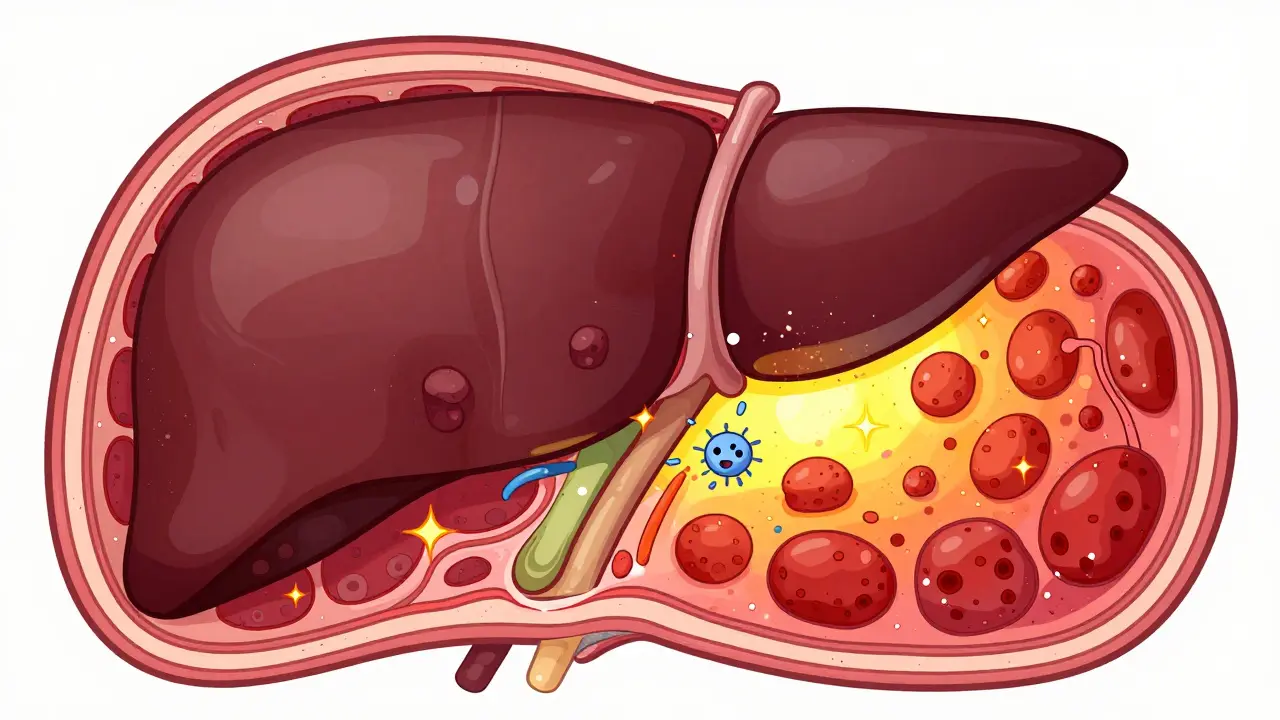
The Path to Diagnosis
Diagnosing AIH is like putting together a puzzle. A doctor can't just rely on one test because AIH often mimics other conditions. For example, it's frequently mistaken for Drug-Induced Liver Injury (DILI), where a medication causes liver stress. Around 15-20% of AIH cases are initially misdiagnosed as DILI.
To get it right, hepatologists use the Revised International AIH Group Scoring System. This involves a combination of your antibody profile, your IgG levels, and a liver biopsy. The biopsy is the gold standard; it allows doctors to see the "rosette formation" of hepatocytes and the specific inflammatory patterns that prove it's an autoimmune attack rather than a viral infection like Hepatitis B or C.
Managing the Disease: Treatment and Trade-offs
Once diagnosed, the goal is simple: quiet the immune system so the liver can heal. This is achieved through Immunosuppressive Therapy. The standard "starter pack" usually involves a combination of prednisone (a corticosteroid) and azathioprine.
The process typically follows this path:
- Induction: High doses of prednisone are used to bring the inflammation down quickly. You'll likely have blood tests every 2-4 weeks during this phase.
- Maintenance: As your liver enzymes normalize, the doctor slowly tapers the steroids over 6 to 12 months.
- Monitoring: You'll need liver function tests and IgG checks every 3 months to ensure the disease isn't returning.
However, these meds aren't without costs. Steroids can cause significant weight gain, insomnia, and mood swings. If someone can't tolerate azathioprine, doctors might switch them to Mycophenolate Mofetil, which works effectively for about 70-80% of those who fail the first-line therapy.

Living with AIH: The Patient Experience
Living with AIH is as much a mental battle as a physical one. Many patients report a heavy burden of anxiety regarding whether the disease will progress to end-stage liver failure. There is also the daily grind of medication adherence. Taking azathioprine at the same time every day is crucial for keeping the disease in check.
Because immunosuppressants leave you more vulnerable to infections, you have to be more vigilant than the average person. You'll need to recognize the early signs of a fever or infection and act quickly. Additionally, long-term steroid use can thin your bones, so supplements like calcium and vitamin D are often non-negotiable parts of the routine.
The Future: Precision Medicine and New Hope
We are moving away from a "one size fits all" approach. The next frontier is genetic profiling. By looking at specific alleles like HLA-DRB1*03:01, doctors hope to predict which patients will respond best to which drugs, potentially pushing remission rates up to 90%.
New drugs are also on the horizon. Biologics like rituximab are being tested in clinical trials to provide a more targeted way to stop the immune attack without the broad side effects of steroids. For the small percentage of patients-about 10%-who are treatment-refractory, a liver transplant remains the final, life-saving option.
Can I ever be fully cured of Autoimmune Hepatitis?
While "cure" isn't typically the term used, many patients achieve complete remission. This is defined as the normalization of liver enzymes and IgG levels for at least two years. Some patients can eventually stop medication under strict supervision, but many require low-dose maintenance therapy for life to prevent a relapse.
What is the difference between AIH and Viral Hepatitis?
Viral hepatitis is caused by an external virus (like Hepatitis A, B, or C) attacking the liver. Autoimmune Hepatitis is an internal malfunction where your own antibodies attack your liver. Because the cause is different, the treatment is entirely different: viral hepatitis requires antivirals, while AIH requires immunosuppressants.
Are the side effects of prednisone permanent?
Most side effects, such as weight gain and mood disturbances, improve as the dose is tapered down. However, some effects like bone density loss can be long-term if not managed with calcium, vitamin D, and weight-bearing exercise.
How often do I need blood tests once in remission?
Even in remission, regular monitoring is key. Most guidelines suggest checking transaminases and IgG levels every 3 to 6 months to catch any biochemical relapse before it causes physical damage to the liver.
Can diet help manage Autoimmune Hepatitis?
Diet cannot cure AIH, but a liver-friendly diet (low in processed sugars and saturated fats) helps reduce overall liver stress. The primary focus must always be the medical immunosuppressive therapy, as diet alone cannot stop the autoimmune attack.
10 Responses
Obviously, the biopsy is the only thing that matters here, but the way this is written makes it sound like those blood tests are actually useful. Like, please. If you aren't looking at the histology for rosette formations, you're basically just guessing. Also, the section on prednisone is way too vague because it doesn't even mention the moon face effect in enough detail. Typical of these kinds of summaries to gloss over the actual misery of the side effects while pretending the 'success rate' is the only thing that counts.
diet can do way more than just reduce stress
Exactly! 🙄 People just blindly follow the 'standard therapy' without realizing that the pharmaceutical industry pushes these steroids because they're easy to prescribe, not because they're the most holistic approach to liver health. We should be talking about gut health and the microbiome instead of just suppressing the immune system 💉💊
I think it's worth keeping in mind that everyone's journey is different. While diet might help some, we should probably stick to the medical guidelines to keep things safe for everyone involved.
One must ponder the curious nature of these so-called 'antibodies.' It is quite fascinating how the medical establishment insists on these specific markers as the sole arbiters of truth. I suspect there is a much more clandestine reason why the HLA-DRB1 alleles are only now being highlighted, perhaps to facilitate a more systemic form of biological surveillance under the guise of 'precision medicine.' It is simply an elegant facade for a much more complex and perhaps more sinister agenda regarding our genetic sovereignty.
The mention of the METAVIR scoring system is a great touch. I've always found the transition from F2 to F3 to be the most critical window for aggressive intervention to prevent the irreversible architectural distortion seen in F4. It would be interesting to see more data on whether Mycophenolate Mofetil actually slows the progression of fibrosis more effectively than Azathioprine in the long term, or if the primary benefit is just the avoidance of steroid-induced comorbidities.
Honestly, the mental battle mentioned at the end is such an understatement because nobody ever talks about the sheer spiritual exhaustion of feeling your own body betray you every single morning you wake up and wonder if your liver is just giving up. I remember when I first started on prednisone and I felt like I was losing my entire identity to this chemical cloud of rage and insomnia, and yet here we are with these 'quick facts' that make it sound like a simple checklist at a drive-thru pharmacy. It's almost insulting to pretend that a 65-80% success rate means you're just 'fine' when you're actually fighting for your sanity while your skin turns a shade of yellow that doesn't even exist in nature.
The hypergammaglobulinemia aspect is absolutely... staggering!!! The sheer audacity of the IgG levels to spike like that is just... cinematic!!! Total biological chaos!!!
There is a certain poetic irony in the immune system, designed to protect the vessel, becoming the very agent of its destruction. From a phenomenological perspective, the struggle to balance immunosuppression with the risk of opportunistic infections represents a precarious equilibrium. We must approach the treatment of the liver not just as a mechanical repair of the hepatocytes, but as a holistic attempt to restore harmony to a discordant biological system, recognizing that the pathology is as much a systemic failure as it is a localized hepatic event.
I really appreciate the clear breakdown of the two types here. It helps put things into perspective for those of us who are just starting to navigate these diagnoses.