What Is Thyroid Storm?
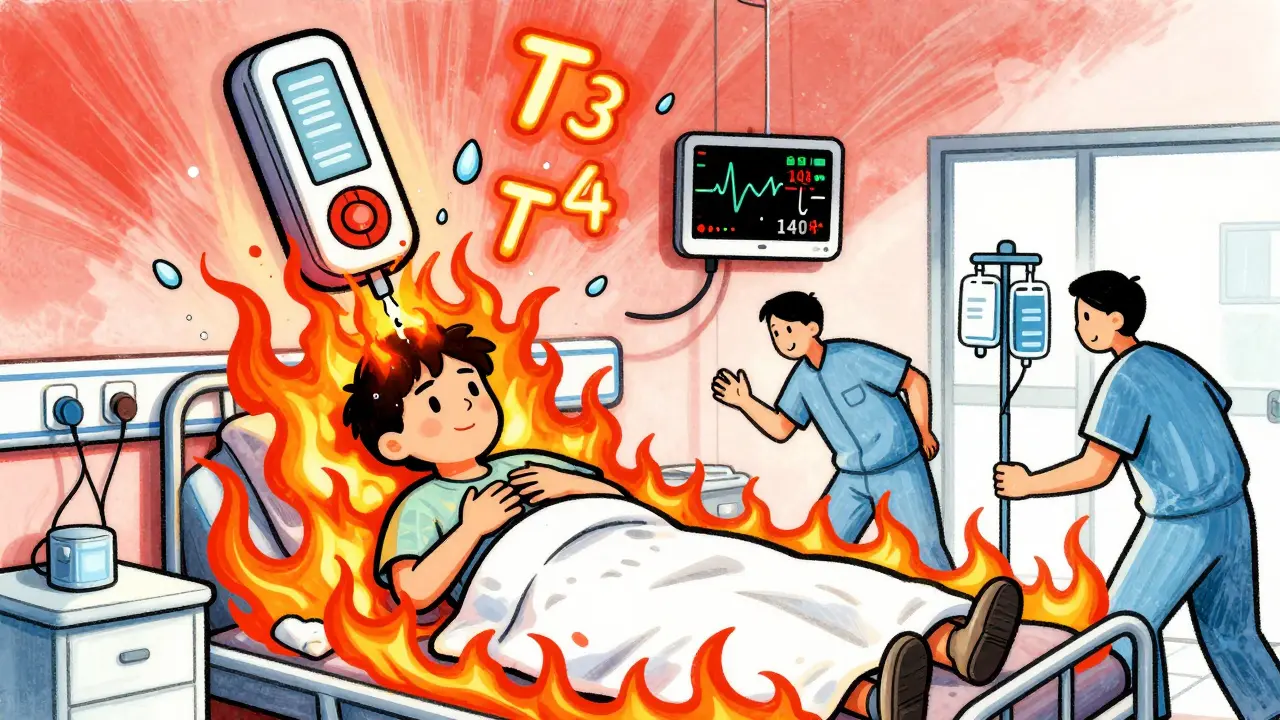
Thyroid storm isn’t just a bad day with hyperthyroidism. It’s a full-body meltdown caused by a sudden, massive surge of thyroid hormones. Think of your thyroid as a thermostat for your metabolism. In thyroid storm, that thermostat breaks and cranks up to 110°F-nonstop. Your heart races, your body overheats, your brain gets foggy, and your organs start to shut down. Without immediate treatment, it’s fatal.
This isn’t common. Only about 0.2 out of every 100,000 people experience it each year. But among people already diagnosed with hyperthyroidism-especially Graves’ disease-it’s the most dangerous complication. And it doesn’t creep up. It hits like a freight train, often within hours. Fever spikes to 104°F or higher. Heart rates blast past 140 beats per minute. People become confused, agitated, or slip into coma. Diarrhea, vomiting, jaundice, and extreme sweating are normal signs. This isn’t flu. This is a medical emergency that demands an ICU.
What Triggers a Thyroid Storm?
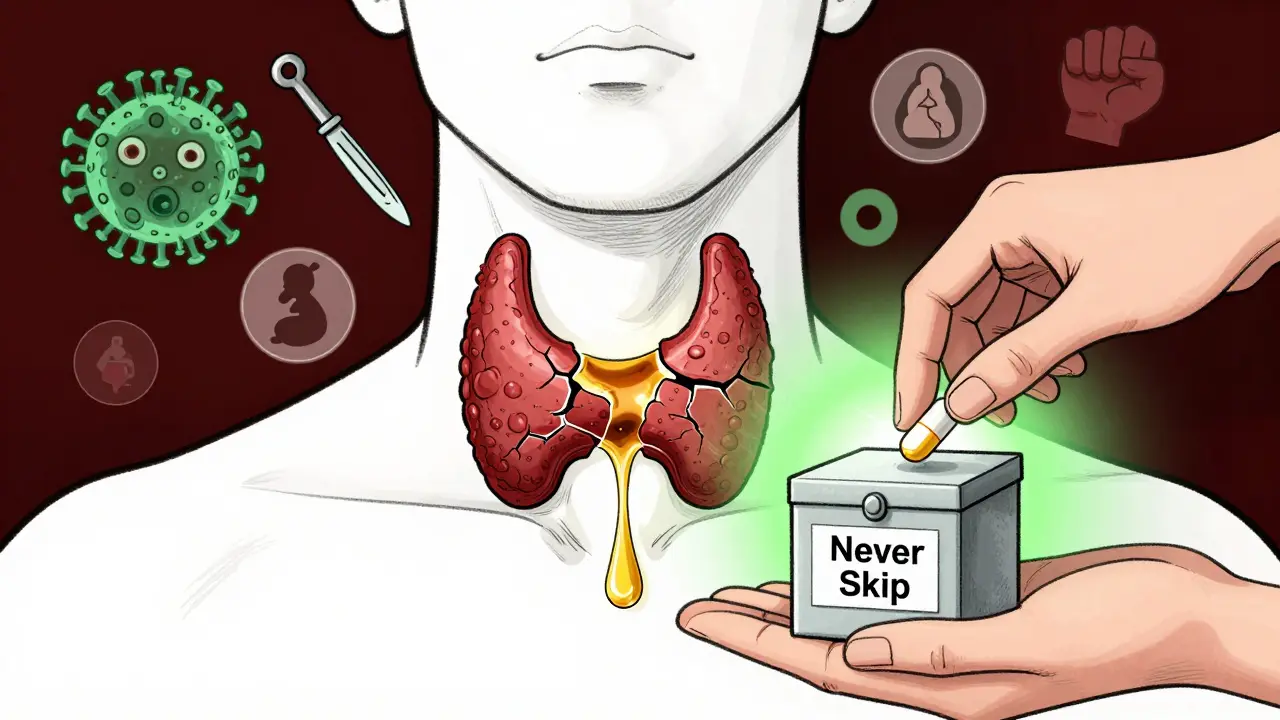
Most people who suffer thyroid storm already have untreated or poorly controlled hyperthyroidism. But something pushes them over the edge. The most common trigger? Not taking medication. About 60-70% of cases happen because someone stopped their anti-thyroid pills, skipped doses, or didn’t follow up with their doctor.
Other triggers are physical shocks to the body: infections like pneumonia or the flu, major surgery (especially thyroid surgery), trauma like a blow to the neck, or even a heart attack. Stressful events-stroke, diabetic ketoacidosis, or pulmonary embolism-can also set it off. Even rare cases have been linked to radioactive iodine treatment for Graves’ disease, sometimes a week after the procedure.
Pregnancy is another key risk. Postpartum thyroiditis can flare up violently in the weeks after delivery. And yes, there are documented cases of thyroid storm triggered by someone getting punched in the throat. The thyroid is sensitive. Any sudden stress to it can be enough.
How Doctors Diagnose It
There’s no single test for thyroid storm. Diagnosis is based on symptoms, lab results, and a scoring system called the Burch-Wartofsky Point Scale. If your score hits 45 or higher, it’s thyroid storm.
Doctors look for:
- Fever: 104°F to 106°F (40°C-41.1°C), with heavy sweating
- Heart rate: Over 140 bpm, often with irregular rhythm
- CNS changes: Agitation, delirium, seizures, or coma-present in 90% of cases
- Gastrointestinal issues: Severe diarrhea in 50-60% of patients
- Heart failure: Fluid backing up in the lungs, low blood pressure
- Liver trouble: Jaundice, bilirubin over 3 mg/dL
Lab tests confirm the storm: free T4 levels more than 2.5 times the normal upper limit, free T3 over 3 times normal. Blood counts, liver enzymes, and kidney function are checked too. Arterial blood gases show if the body is in acidosis. It’s not just about hormone levels-it’s about how the whole body is reacting.
ICU Treatment: The 5-Step Protocol
Time is everything. The sooner treatment starts, the better the chance of survival. If you wait more than 24 hours, survival drops to 20%. Start within 6 hours, and it jumps to 75-80%.
Step 1: Block hormone production
Methimazole is the first-line drug. A 60-80 mg loading dose shuts down new hormone production. If methimazole isn’t available, propylthiouracil (PTU) is used at 600-1,000 mg initially. Both stop the thyroid from making more T3 and T4.
Step 2: Block hormone release
One hour after the antithyroid drug, doctors give iodine-either potassium iodide (500 mg every 6 hours) or sodium iodide (1 g daily). This stops the thyroid from dumping stored hormones into the blood. Don’t give iodine too early-it can make things worse.
Step 3: Block the effects of hormones
Beta-blockers like propranolol are critical. They don’t lower hormone levels, but they calm the body’s response. A typical dose is 60-80 mg every 4-6 hours, or IV doses of 1-2 mg every 5 minutes if heart rate is above 140. This brings down heart rate, reduces tremors, and eases anxiety.
Step 4: Reduce inflammation and hormone conversion
Corticosteroids like hydrocortisone (100 mg IV every 8 hours) do two things: prevent adrenal failure (common in extreme stress) and block the conversion of T4 into the more powerful T3 hormone.
Step 5: Support the body
Fever? Use acetaminophen. No NSAIDs-they can harm the liver, which is already stressed. Cooling blankets, fans, and ice packs help. Fluids? You’ll need 2-3 liters of IV saline to fix dehydration from sweating and diarrhea. If breathing is shallow or confused, you’ll be put on a ventilator. Blood pressure support with vasopressors is common. Continuous heart monitoring is mandatory.
What Happens After the Storm?
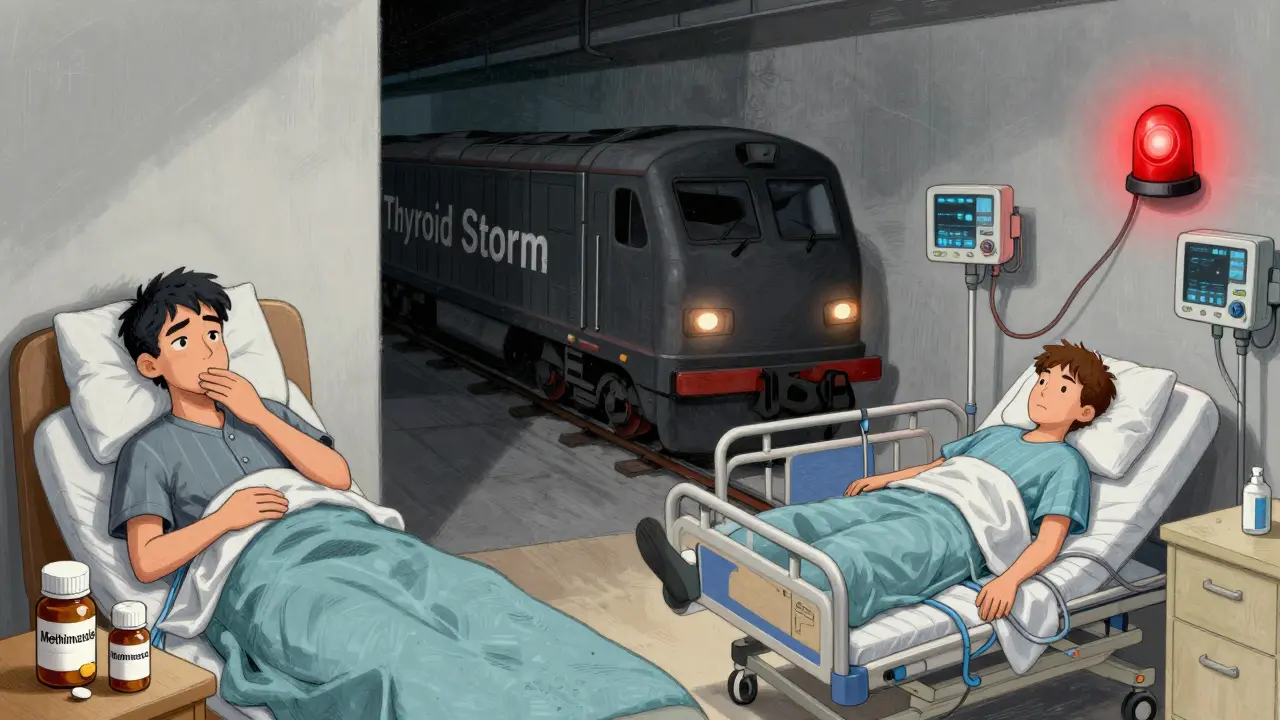
Survivors don’t just walk out of the ICU. Recovery takes time. Most need mechanical ventilation for about 5 days. Nearly half require drugs to keep blood pressure up. Average ICU stay is 8 days. Total hospital stay? Around two weeks.
Neurological recovery follows a pattern. Agitation fades in 24-48 hours. Confusion clears by day 3. Full mental clarity can take up to two weeks. Liver function and heart rhythm usually normalize within a week.
But here’s the hard truth: 85% of survivors will need lifelong thyroid hormone replacement. Why? Because the treatment for the root cause-Graves’ disease or toxic nodules-is usually radioactive iodine or surgery. These destroy the overactive thyroid. So even if you survive the storm, you’ll be on thyroid pills for the rest of your life.
Who’s at Highest Risk of Dying?
Even with modern care, 8-25% of thyroid storm patients die. That number jumps to 30% in older adults. Certain signs tell doctors who’s in the most danger:
- Systolic blood pressure below 90 mmHg → 50% mortality
- Temperature above 105.8°F (41°C) → 40% mortality
- Coma or severe CNS depression → 35% mortality
- Pre-existing heart disease → 2.3 times higher risk of death
Age matters. Older patients often have hidden heart problems. Their bodies can’t handle the metabolic overload. Delayed diagnosis is the biggest killer. If treatment doesn’t start within 6 hours, survival plummets.
Can It Happen Again?
Recurrence is rare-if you follow up. If you take your meds, get regular blood tests, and avoid triggers, your risk of another storm is just 2-3%. But if you stop treatment, miss appointments, or ignore symptoms, recurrence jumps to 25-30%.
That’s why education matters. Programs like the American Association of Clinical Endocrinologists’ Thyroid Storm Awareness initiative have already cut delayed diagnoses by 18% since 2020. Patients who know the signs-fever, racing heart, confusion-can get help before it’s too late.
What’s New in Treatment?
Standard care works-but not for everyone. About 5-10% of patients don’t respond to drugs. For them, doctors now turn to plasmapheresis. This is a blood-filtering procedure that removes excess thyroid hormones directly from the bloodstream. A 2021 study showed a 78% success rate in patients who didn’t improve with meds alone.
Researchers are also testing IL-6 inhibitors-drugs used for cytokine storms in severe infections-to calm the body’s overactive immune response in thyroid storm. It’s still experimental, but early results are promising.
Final Takeaway
Thyroid storm is rare, but deadly. It doesn’t care if you’re young or old, rich or poor. It only cares if your thyroid is out of control and you’re under stress. If you have hyperthyroidism and suddenly feel like you’re burning up, your heart is pounding out of your chest, and you can’t think straight-go to the ER. Don’t wait. Don’t call your doctor tomorrow. Call 911. Your life depends on speed.
What to Do If You Have Hyperthyroidism
- Never skip your anti-thyroid medication
- Get blood tests every 6-8 weeks until stable
- Watch for fever, rapid heartbeat, or confusion-call your endocrinologist immediately
- Get vaccinated for flu and pneumonia
- Avoid extreme stress, trauma, or skipping medical appointments
- Know your trigger points: infection, surgery, pregnancy, or missed pills
Thyroid storm is preventable. But only if you treat the underlying disease seriously.
12 Responses
Let me tell you something - this isn’t some academic exercise. I’ve seen this in the ER. Guy, 32, thought he had the flu. Missed his methimazole for three days after a breakup. Showed up with a temp of 106, HR 168, and was talking incoherently about aliens controlling his thyroid. Got intubated by 3 AM. Survived. But now he’s on levothyroxine for life. Don’t be that guy.
yo so like… thyroid storm is basically your body going full anime villain mode? like ‘i am the storm’ but also your heart is gonna explode and your brain is melting? i’ve been on PTU for 5 years and i still forget to take it sometimes bc life. but now i’m scared. like, real scared. maybe i’ll start setting alarms. or just yell ‘I AM THE THYROID’ every morning. 🤪
Ugh. I hate when people treat this like it’s just ‘bad thyroid’. No. It’s not. I lost my cousin to this. She was 28. Had Graves’. Took her meds. Then got the flu. Thought she’d bounce back. Didn’t. They found her in her apartment with a temp of 107. No one knew she’d stopped her meds. She was supposed to have her bloodwork done that week. But she was ‘too tired’. Too tired to live. Don’t be too tired. Take the damn pill.
As a clinical endocrinology nurse for 18 years, I’ve seen this unfold too many times. The Burch-Wartofsky scale is gold standard - but the real diagnostic tool is the look in the patient’s eyes. That terrified, hypermetabolic panic. It’s not anxiety. It’s metabolic chaos. And yes - plasmapheresis is a game-changer for refractory cases. We’ve had 3 patients in the last year who didn’t respond to meds, and plasmapheresis stabilized them within 12 hours. Also - postpartum thyroid storm is massively underdiagnosed. New moms are told ‘it’s just baby blues’. It’s not. If she’s tachycardic, febrile, and agitated after delivery - treat it like a code.
Why are we even talking about this? If you’re too lazy to take your thyroid meds, you deserve what you get. This isn’t a tragedy. It’s negligence. And now we’re giving you a 5-step protocol like you’re a NASA engineer? No. You broke the rules. You ignored warnings. Now you’re in the ICU. Stop romanticizing self-inflicted crises. Just take your pills.
Stop skipping meds. Get bloodwork. Don’t wait. Go to the ER. Now.
As someone who lives with Graves’ disease, I want to say: thank you for writing this with such clarity. But I also want to say - this isn’t just about medication. It’s about access. My sister couldn’t afford her labs for six months. She got sick. They sent her home with a prescription. She didn’t have insurance to refill it. She died. This isn’t just personal responsibility. It’s systemic failure. We need better healthcare for people with chronic autoimmune disease. Not just ‘take your pills’.
My mom had thyroid storm after her C-section. She was fine until day 5 postpartum. Then - boom. Fever, shaking, couldn’t speak. They thought it was sepsis. Took 18 hours to diagnose. She survived, but it took months to recover. I didn’t know anything about thyroid until then. Now I make sure every new mom I know knows the signs. And I remind my doctor every time I go in: ‘Check my TSH. Please.’ I’m not paranoid. I’m prepared.
Let’s be honest - this is why I hate modern medicine. We’re so obsessed with ‘protocols’ and ‘scoring systems’ that we forget: this is a human being screaming in a hospital bed. You don’t need a Burch-Wartofsky scale to know someone is dying. You need to listen. And yet - we still have people dismissing this as ‘just thyroid’. No. It’s a war. And the thyroid is the battlefield. And if you’re not fighting it like your life depends on it - you’re already dead.
so i read this and im like wow but also… why is everything capitalized in the title? and why is the post 1000 words but only 3 sentences actually matter? like… take your meds. duh. also why is the author so dramatic? its a medical condition not a disney villain origin story
Interesting how this mirrors cytokine storms in sepsis - same metabolic chaos, same organ failure cascade. But here’s the twist: in thyroid storm, the body’s own hormones are the toxin. That’s poetic in a horrifying way. Also, plasmapheresis? That’s basically a blood cleanse. Like a detox for your endocrine system. I wonder if we’ll see CRISPR-based thyroid modulation in 20 years. Probably. But until then - take your damn pills. And maybe stop watching TikTok at 3 a.m. while your cortisol spikes. Stress matters.
I’ve been managing my Graves’ for 12 years - and I’ve never met someone who actually understands what this disease does to your soul. It’s not just fatigue. It’s the anxiety that creeps in when you skip a dose. It’s the guilt when you cancel plans because your heart is racing. It’s the fear that your body is a ticking bomb. And yes - I take my methimazole every single day. Even on vacation. Even when I’m mad at my doctor. Even when I’m tired. Because I’ve seen what happens when you stop. And I won’t let it win. If you’re reading this and you’re struggling - you’re not alone. But you’re also not powerless. Take the pill. Show up. Live.