Akathisia vs. Restless Legs Syndrome (RLS) Symptom Checker
This tool helps identify if your symptoms are more likely akathisia or restless legs syndrome
Based on clinical research, this tool evaluates key differences between akathisia and RLS. Remember, this is not a diagnosis. Consult your doctor for proper evaluation.
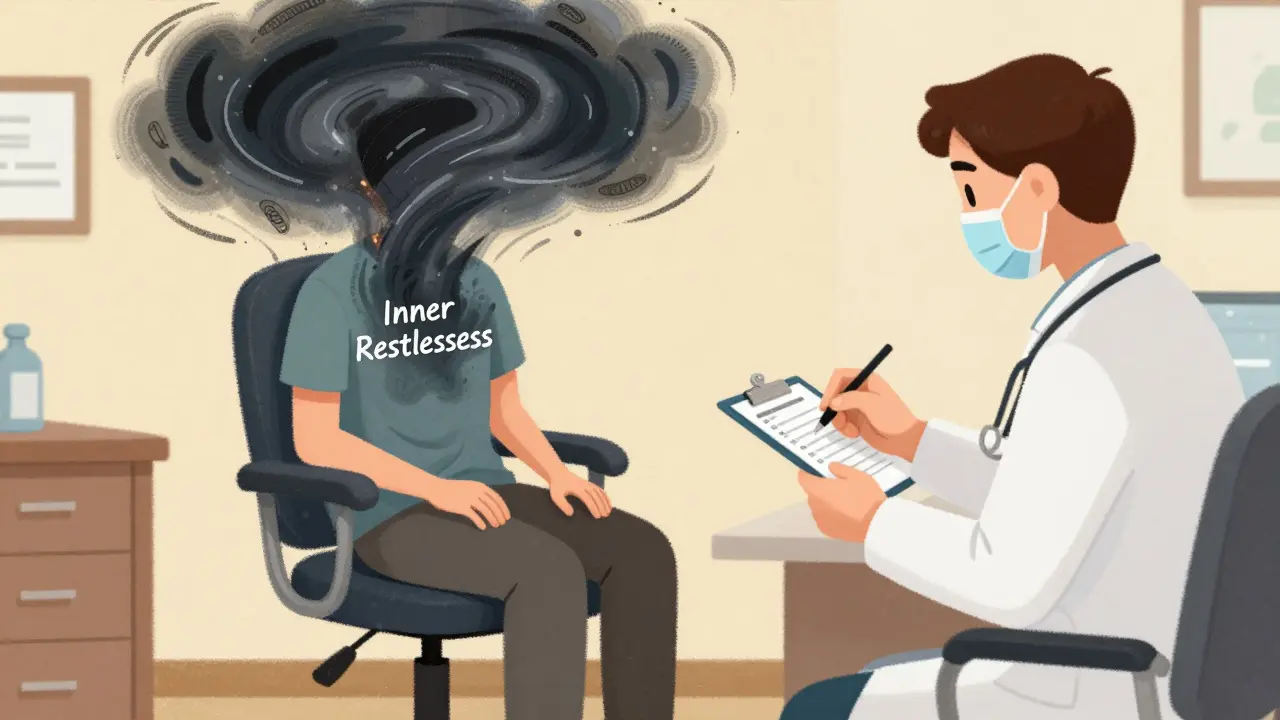
Imagine taking a medication to calm your mind, only to feel like your body is screaming to move. You can’t sit still. Your legs ache. You pace the room. Your doctor says it’s anxiety-so they increase your dose. And it gets worse. This isn’t anxiety. It’s akathisia, and it’s being missed every day in clinics across the UK and beyond.
What Exactly Is Akathisia?
Akathisia isn’t just fidgeting. It’s an unbearable, internal urge to move-often described as feeling like your skin is crawling or you’re about to jump out of your own body. It’s caused by medications, most commonly antipsychotics like haloperidol, risperidone, or even metoclopramide used for nausea. The condition usually shows up within days or weeks of starting or increasing the dose. It’s not rare: up to 40% of people on older antipsychotics develop it. Even newer ones carry a risk-5% to 15% of users.The problem? Most doctors don’t recognize it. They see pacing, leg crossing, rocking, or constant shifting in the chair and assume it’s agitation, anxiety, or even a sign the psychosis is worsening. So they give more medication. And the person spirals. In extreme cases, akathisia triggers suicidal thoughts, aggression, or violent outbursts. A 2017 case study in the RACGP journal showed a patient on haloperidol developed acute suicidal ideation-only to vanish completely after stopping the drug.
Akathisia vs. Restless Legs Syndrome: The Key Difference
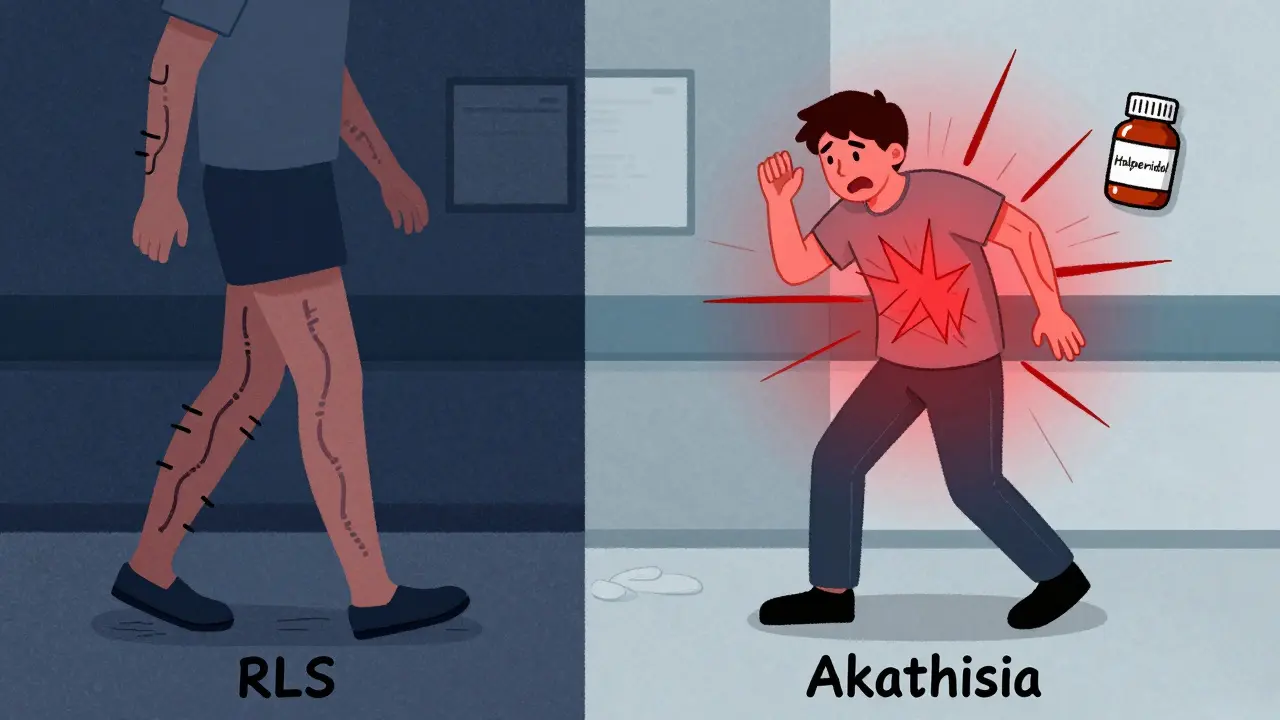
People often confuse akathisia with restless legs syndrome (RLS). Both involve leg discomfort and the need to move. But they’re not the same.RLS happens mostly at night or when you’re resting. It feels like a creepy, crawling, or pulling sensation deep in the legs. Moving helps-walking around eases the itch. It’s often linked to low iron, genetics, or pregnancy. Treatment? Iron supplements, dopamine-boosting drugs like pramipexole.
Akathisia is different. It hits while you’re sitting or standing still. The urge to move isn’t just in the legs-it’s full-body. You feel an intense, anxious restlessness in your chest, arms, torso. You can’t sit. You can’t stand still. You pace. You cross and uncross your legs. You shift your weight constantly. And movement doesn’t relieve it-it just distracts you for a moment. The distress is emotional, too. People describe it as "torture" or "being trapped in a body that won’t stop shaking."
And here’s the critical flip: drugs that help RLS-like levodopa-can make akathisia worse. Meanwhile, akathisia often responds to beta-blockers like propranolol or benzodiazepines like clonazepam, which do nothing for RLS.
Why Misdiagnosis Is Dangerous
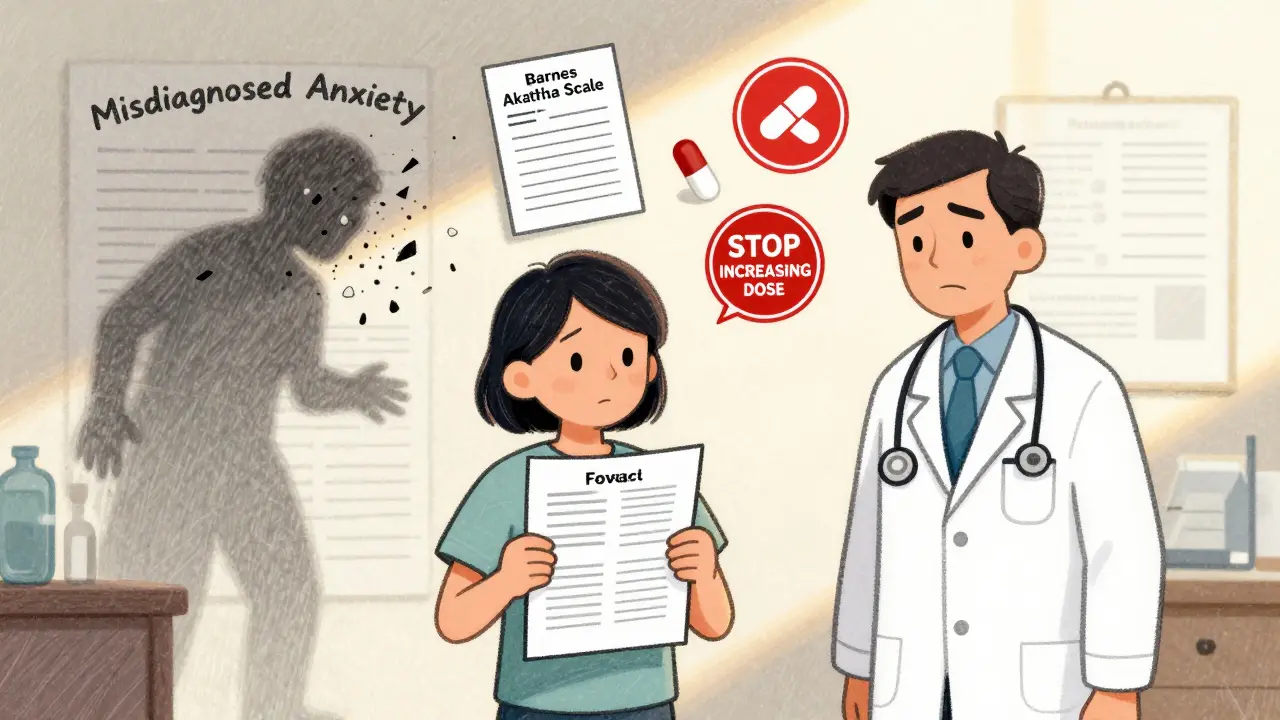
A 2022 survey by NAMI of over 1,200 people on antipsychotics found that 68% of those with akathisia were first told they had anxiety. Nearly half had their medication increased-making their symptoms worse. One Reddit user wrote: "My doctor doubled my Seroquel because I was "too restless." I felt like I was going to explode. I only found out it was akathisia when I Googled my symptoms at 3 a.m."Dr. Jonathan M. Meyer from UC San Diego calls this a "tragedy." When akathisia is misdiagnosed as psychiatric worsening, patients are put on higher doses of the very drug causing the problem. That’s not treatment-it’s escalation. And it’s deadly. Studies show akathisia contributes to 15% of antipsychotic non-adherence. Some patients would rather live with hallucinations than endure the torment of akathisia.
How to Recognize It in Practice
There’s no blood test. No scan. Diagnosis is clinical. Here’s what to look for:- Timing: Did symptoms start within 4 weeks of starting or increasing a medication?
- Movement: Is the person pacing, rocking, shifting weight, or constantly crossing/uncrossing legs while seated?
- Subjective report: Ask: "Do you feel an inner restlessness that makes you feel like you have to move-even when you don’t want to?"
- Distress level: Is the person visibly agitated, tearful, or describing unbearable discomfort?
Doctors can use the Barnes Akathisia Rating Scale (BARS)-a simple 5-minute tool that rates both inner restlessness and observable movements. It’s not used often enough. But if you’re on antipsychotics and feel this way, ask for it.
What to Do If You Have It
The first rule: Don’t increase the medication. That’s the most common mistake.Step one: Reduce or stop the offending drug. For haloperidol, tapering over 3 days can lead to full recovery within days. One patient in a 2017 case study said she was "back to myself" after stopping haloperidol and starting clonazepam.
If stopping isn’t possible-because the psychiatric condition is severe-add a treatment that helps akathisia:
- Propranolol: Start at 10 mg twice daily. Often works within days.
- Clonazepam: 0.5 mg at night. Helps with both restlessness and anxiety.
- Cyproheptadine: 4 mg daily. An antihistamine that can reduce movement symptoms.
These aren’t perfect. But they’re safer than doubling the antipsychotic dose. Newer drugs like pimavanserin (Nuplazid) are being tested for akathisia and show promise in early trials-reducing symptoms by over 60%.
What’s Changing in 2026?
Awareness is slowly improving. The FDA has required akathisia warnings on antipsychotic labels since 2008. In 2023, the International Parkinson and Movement Disorder Society launched a free app that helps clinicians diagnose akathisia using video and symptom checklists. Stanford University’s 2024 pilot study showed AI can detect akathisia in telehealth videos with 89% accuracy by analyzing tiny movements.Pharmaceutical companies are also designing newer antipsychotics with lower risk. Lumateperone (Caplyta) has an akathisia rate of just 3.6%-compared to 14.3% for risperidone. That’s a big step forward.
But education is still lagging. A 2022 report found only 37% of U.S. psychiatric clinics screen routinely for akathisia. In the UK, it’s likely similar. Until doctors are trained to see it, patients will keep being misdiagnosed.
What You Can Do Right Now
If you’re on an antipsychotic and feel this inner restlessness:- Write down when the symptoms started and what meds you’re on.
- Describe the feeling: "I feel like I have to move, even when I’m exhausted. It’s not laziness. It’s torture."
- Ask your doctor: "Could this be akathisia?"
- Request the Barnes Akathisia Rating Scale.
- Don’t accept "it’s just anxiety" as an answer.
Bring this article. Print it. Highlight the parts. You’re not overreacting. You’re not crazy. You’re experiencing a real, documented, treatable side effect-and you deserve to be heard.
The good news? If caught early, akathisia often disappears completely once the trigger is removed. No lifelong disability. No brain damage. Just a wrong medication-and the courage to speak up.
Can akathisia be caused by antidepressants?
Yes. While antipsychotics are the most common cause, certain antidepressants-especially SSRIs like fluoxetine or sertraline-can also trigger akathisia, especially at high doses or when started abruptly. It’s less frequent than with antipsychotics, but still well-documented. If you’ve recently started or increased an SSRI and feel an unbearable urge to move, akathisia should be considered.
Is akathisia permanent?
Usually not. Most cases of acute akathisia resolve within days or weeks after stopping or reducing the medication. Chronic akathisia-lasting more than 6 months-can occur, especially if the drug was taken for a long time or if the person has other neurological vulnerabilities. Tardive akathisia, which appears after months or years of use, can be harder to reverse but still often improves with treatment. Early recognition is the best way to avoid long-term issues.
Can I treat akathisia with over-the-counter supplements?
There’s no strong evidence that OTC supplements like magnesium, vitamin B6, or melatonin reliably treat akathisia. While they might help with sleep or general restlessness, they won’t fix the root cause: medication-induced dopamine disruption. In fact, some supplements can interact with psychiatric drugs. Always talk to your doctor before trying anything new. Prescription treatments like propranolol or clonazepam are far more effective and proven.
Why don’t doctors know about akathisia?
Medical training often focuses on diagnosing psychiatric conditions, not their side effects. Akathisia isn’t tested on most licensing exams. Many doctors haven’t seen a case, or they’ve seen one and mistook it for anxiety. Electronic health records rarely have prompts to screen for it. And patients often don’t describe it accurately-they say "I’m anxious" or "I can’t sit still," not "I feel like I’m being eaten alive from the inside." It’s a perfect storm of ignorance, miscommunication, and systemic oversight.
What should I do if my doctor won’t believe me?
Get a second opinion. Go to a psychiatrist who specializes in movement disorders or psychopharmacology. Bring your medication list, symptom timeline, and this article. Ask specifically for the Barnes Akathisia Rating Scale. If your current doctor dismisses you, it’s not your fault-it’s their gap in knowledge. You’re not being dramatic. You’re not "hysterical." You’re experiencing a real neurological side effect that’s been documented for over 60 years. Keep pushing. Your life depends on it.
8 Responses
So let me get this straight… we’re giving people drugs that make them feel like their skin is crawling out of their bones, then doubling the dose because they ‘seem anxious’? 🤦♀️
Let’s be honest-this isn’t medical negligence. It’s systemic laziness. Doctors don’t want to admit they misdiagnosed something because it means admitting they didn’t learn enough in med school. Akathisia isn’t rare-it’s just ignored. And until the pharmaceutical industry stops funding half the training programs, nothing will change. Stop blaming patients. Start blaming the system.
This is one of the most important posts I’ve read this year. 🙏 As someone who’s seen a loved one spiral after being told ‘it’s just anxiety’-I can’t stress enough how vital this info is. Thank you for writing it. I’ve shared it with three psychiatrists in my network. Let’s get this into every residency program. We owe it to every patient who’s ever been told they’re ‘too much.’ You’re not too much. You’re being poisoned by a pill.
I read this and immediately thought-this is why I stopped taking SSRIs. I felt like I was being stuffed into a vibrating cage. My therapist said I was ‘resisting change.’ Turns out, I was being tortured by my own medication. Why is this not common knowledge? Why do we still treat people like broken machines instead of humans with nervous systems?
OMG I felt this so hard. I was on Zoloft and I couldn't stop pacing. I'd walk in circles for hours. My mom said I was just being dramatic. I cried every night. Then I found this article and realized I wasn't crazy. I just needed someone to LISTEN. Thank you for writing this. I'm telling my doctor tomorrow. I'm not afraid anymore.
It’s heartbreaking how often the very tools meant to heal end up harming. The fact that akathisia is so poorly understood speaks to a deeper issue in psychiatry: we prioritize symptom suppression over patient experience. A person’s discomfort isn’t noise-it’s data. If we trained clinicians to listen more and prescribe less, we’d see far fewer tragedies. This article should be mandatory reading.
As someone from a culture where mental health is still stigmatized, I’ve seen too many people suffer silently because they were told to ‘just calm down.’ This post is a lifeline. 🙌 I’m translating it into Hindi and sharing it in my community. No one should feel like they’re losing their mind because a doctor didn’t know the difference between anxiety and akathisia. Knowledge is power-and this is power we need to spread.
Let me be perfectly clear: this is not a ‘personal struggle.’ This is a systemic failure of medical education, pharmaceutical lobbying, and institutional arrogance. The Barnes Scale has existed since 1989. It’s simple. It’s validated. And yet-still ignored. You want change? Demand it. Refuse to accept ‘anxiety’ as a catch-all diagnosis. Cite the literature. Name the drugs. Insist on the scale. If your doctor resists? Find a new one. Your life is not a clinical trial for their ignorance.