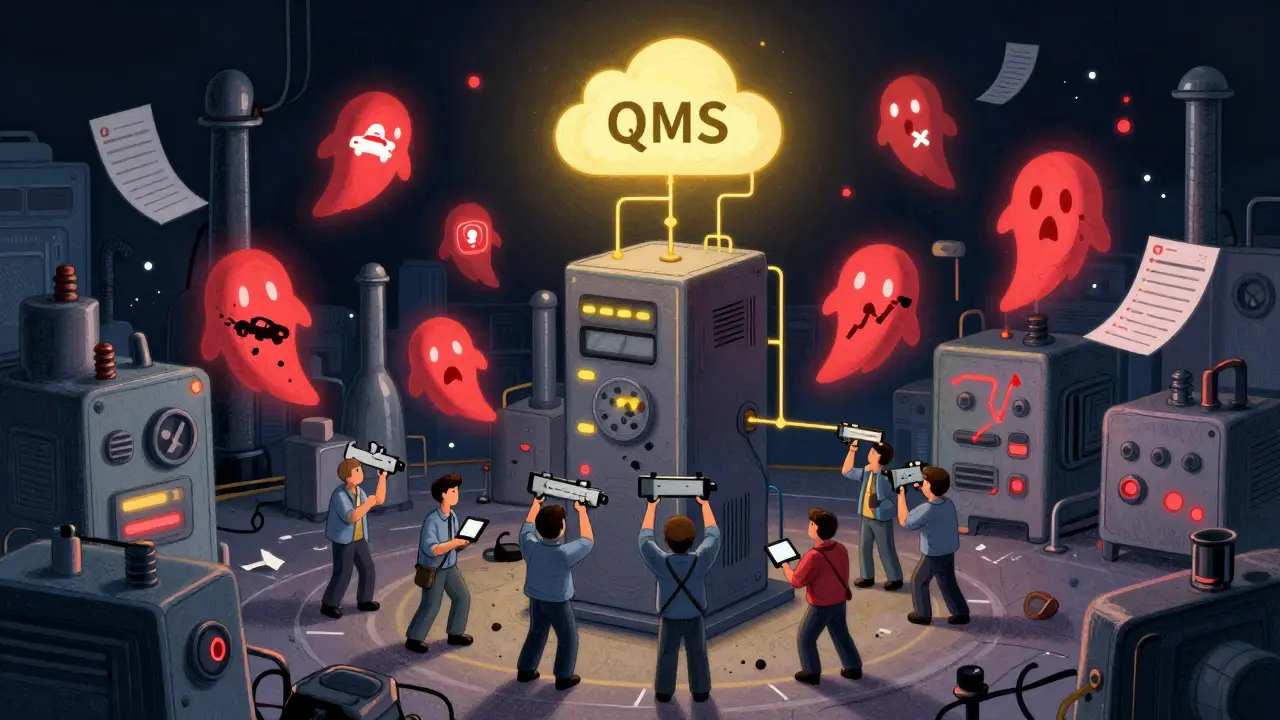
Manufacturers aren’t just worried about broken machines or late shipments anymore. They’re scared that their entire business could collapse because of something invisible - a tiny defect, a missed measurement, a data gap between departments. In 2025, quality assurance isn’t a back-office task. It’s the line between survival and failure.
Quality isn’t a cost - it’s the only thing keeping you alive
Think back to 2019. A faulty sensor in a car’s brake system meant a recall. Today, that same sensor failure could mean a lawsuit, a shattered brand reputation, and a 20% drop in orders. In aerospace, medical devices, and electric vehicles, quality isn’t about avoiding complaints - it’s about avoiding deaths. A 2025 ZEISS report found that 95% of manufacturing executives now call quality assurance mission-critical. Not important. Not nice to have. Mission-critical.
Why? Because products are getting more complex. An electric vehicle doesn’t just have an engine. It has dozens of sensors, battery modules that must stay within 0.1°C of each other, software that communicates with charging stations, and safety systems that activate in milliseconds. One wrong screw. One misaligned wire. One corrupted data point. And the whole thing becomes a liability.
The real cost isn’t rework - it’s trust
Manufacturers talk about rework costs. They say $38% of quality issues come from repeated fixes. But the real number? It’s not on the balance sheet. It’s in the silence after a customer stops calling.
One medical device maker in Ohio cut rework costs by $1.2 million a year by switching to precise metrology systems that caught errors before materials were even cut. That’s money saved. But the real win? They kept their FDA certifications. They kept their hospital contracts. They kept their employees from quitting in frustration.
On the flip side, an electronics company in Michigan spent $2.3 million on automated inspection robots - but didn’t train a single operator. The robots flagged false errors 40% of the time. Production stopped. Workers lost confidence. The defect rate went up. They lost a major client. That’s not a tech failure. That’s a leadership failure.
The skills gap is bigger than the budget gap
Here’s the brutal truth: 47% of manufacturers say the biggest obstacle to quality isn’t money - it’s people. There aren’t enough workers who understand both old-school calipers and new AI-powered inspection tools.
Quality engineers used to be the ones who measured parts with micrometers. Now they’re expected to read heat maps from machine learning models, interpret real-time vibration data, and explain why a 0.002mm deviation in a titanium implant matters to a surgeon.
Salaries for these hybrid roles hit $98,500 in mid-2025 - 22% higher than traditional quality jobs. But even at that pay, companies can’t find them. The Manufacturing Institute predicts a shortage of 2.1 million workers by 2030 - and 37% of those will be in quality roles. That’s not a hiring problem. That’s a training crisis.
Technology without integration is just noise
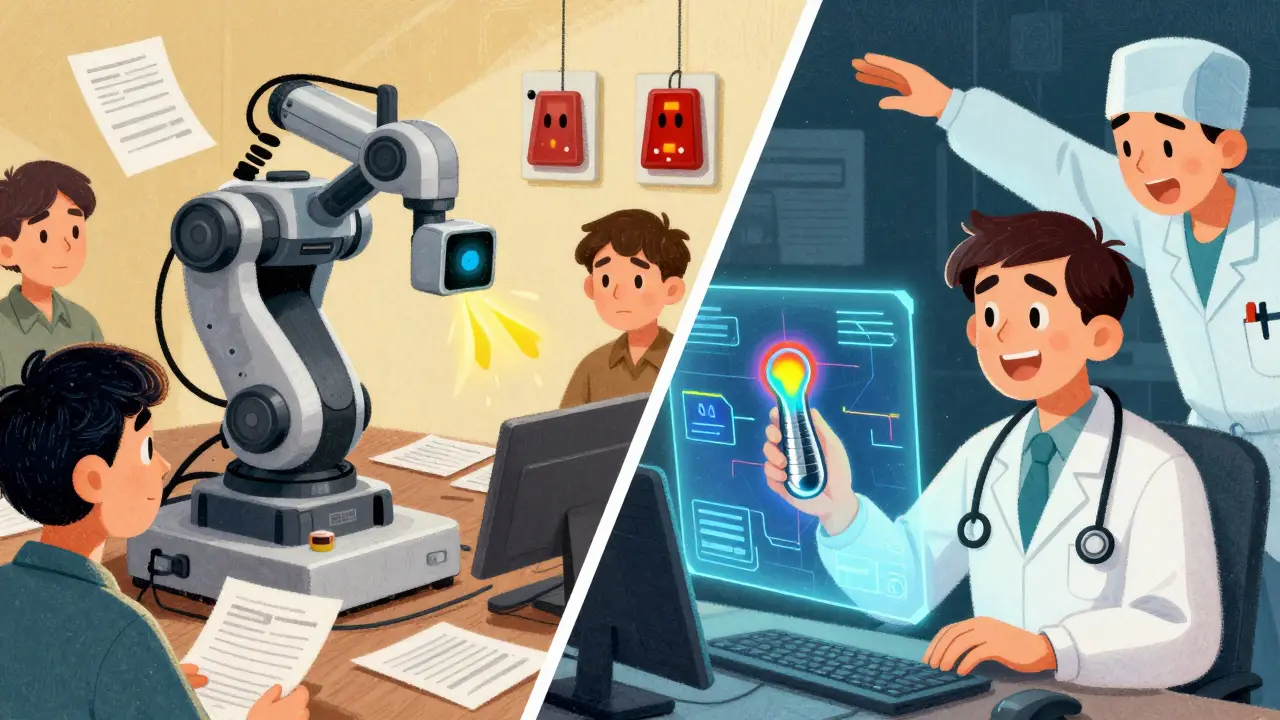
Every vendor is selling the next big thing: AI-powered cameras, cloud-based QMS, real-time metrology sensors. But 61% of manufacturers say their biggest headache is getting these systems to talk to each other.
You can have a robot that scans parts. You can have software that tracks defects. You can have a dashboard that shows supplier performance. But if they’re all on different servers, using different logins, with no shared data - you don’t have a quality system. You have a mess.
Companies that integrated their tools saw 22% lower rework costs and 18% faster time-to-market. Those with disconnected systems? They’re still printing paper checklists and emailing spreadsheets. In 2025, that’s not just inefficient - it’s dangerous.
Cloud QMS isn’t optional anymore
Cloud-based Quality Management Systems (QMS) were a nice-to-have in 2023. Now they’re the baseline. Why? Because manufacturers don’t just make products in one factory anymore. They make them in Mexico, ship parts from Vietnam, assemble in Ohio, and sell to Germany.
Without a cloud QMS, you can’t track compliance across borders. You can’t audit suppliers in real time. You can’t respond when the EU changes its REACH regulations or the FDA updates its ISO 13485 standards. In 2025, 68% of new enterprise deployments are cloud-based. The ones still on local servers? They’re already behind.
The winners are thinking like customers
The most forward-thinking manufacturers aren’t just measuring parts. They’re measuring feelings.
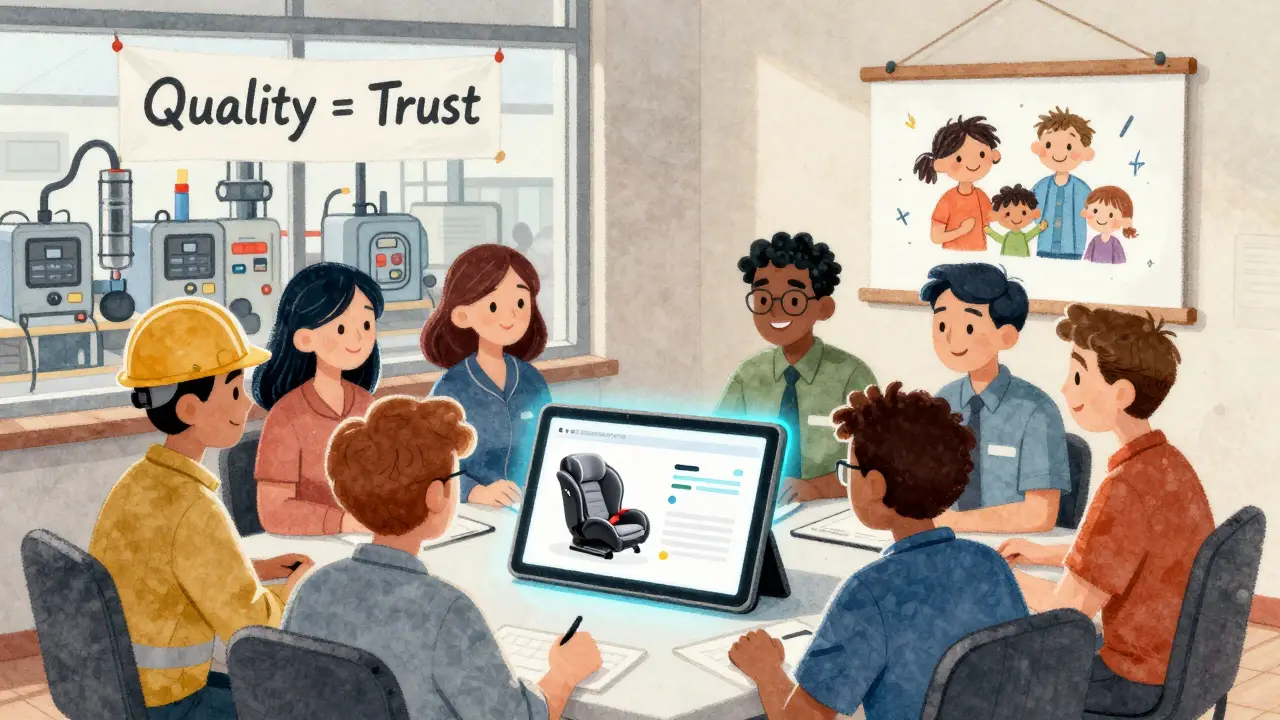
QualityZe’s 2025 report found that companies linking quality metrics to customer feedback - like return rates, support tickets, and Net Promoter Scores - saw 31% higher customer retention. One automotive supplier started tagging every defect with the customer’s name who reported it. Suddenly, engineers weren’t just fixing a crack in a bracket. They were fixing a mom’s fear that her kid’s car seat might fail.
That shift - from compliance to connection - is what separates the companies thriving from those just surviving.
What happens if you do nothing?
Forrester’s 2025 forecast is clear: manufacturers who delay investing in predictive quality analytics will see 23% higher defect rates by 2027. That doesn’t mean more returns. It means lost contracts. Lost licenses. Lost trust.
And it’s not just about technology. It’s about culture. Robert Jenkins, CEO of a Midwest manufacturing group, put it bluntly: “Companies are throwing money at shiny tech while their workforce is drowning in outdated processes.”
Meanwhile, the market is moving fast. The global quality assurance tech market hit $14.7 billion in Q2 2025. North America leads with 38% of that spend. But if you’re not in the top 20% of adopters? You’re not just falling behind. You’re becoming irrelevant.
The path forward isn’t about buying more tools - it’s about building better teams
Successful manufacturers in 2025 don’t just buy AI software. They build cross-functional teams - quality engineers, IT specialists, production leads - working together from day one. They invest in training that bridges the analog-digital divide. They start small: one line, one product, one sensor. They measure what matters: not just defect rates, but how fast they fix them, how often customers complain, how many employees stay.
It’s not about being perfect. It’s about being consistent. About knowing, with certainty, that every part leaving your plant meets the standard - not because you checked it once, but because your whole system was built to never let it slip.
That’s the new quality. Not a department. Not a checklist. A mindset. And if you’re still treating it like a cost center? You’re already losing.
Why is quality assurance more important in 2025 than it was 5 years ago?
Because products are far more complex - electric vehicles, connected medical devices, and smart electronics now require precision at microscopic levels. A single defect can trigger recalls, regulatory fines, or even lawsuits. Consumers and regulators expect flawless performance, and manufacturers can no longer afford to treat quality as a post-production check. It’s now embedded in every step of design, sourcing, and production.
What’s the biggest mistake manufacturers make with quality systems?
Buying technology without training people. Many companies spend millions on AI inspection tools or cloud QMS but skip staff training. The result? Workers don’t trust the system, misinterpret alerts, or ignore alerts altogether. One electronics manufacturer invested $2.3 million in automation and saw defect rates rise 40% because operators didn’t understand how to respond to the new data.
Can small manufacturers afford modern quality assurance?
Yes - but not by buying enterprise systems. The best approach is phased adoption: start with one critical product line, use affordable cloud-based QMS tools, and focus on training one team. Many small manufacturers save money by partnering with suppliers who share quality data in real time. The goal isn’t to replicate Apple’s system - it’s to build one that’s reliable, traceable, and scalable for your size.
How does AI actually improve quality control?
AI doesn’t replace inspectors - it makes them faster and smarter. Instead of manually checking 500 parts a day, an AI system scans 10,000 and flags only the anomalies. It learns from past defects to spot patterns humans miss - like a tiny scratch that correlates with a specific machine setting. One automotive supplier reduced false positives by 29% and caught 37% more real defects after implementing AI inspection software.
Is cloud-based QMS secure for sensitive manufacturing data?
Modern cloud QMS platforms use military-grade encryption, multi-factor authentication, and regular audits. Many comply with ISO 27001 and NIST standards. In fact, cloud systems are often more secure than on-premise servers, which many small manufacturers don’t update or back up. The bigger risk isn’t hacking - it’s using outdated, unpatched local software that’s vulnerable to ransomware.
What’s the fastest way to see results from a quality improvement plan?
Start with one high-value product line. Measure defect rates, rework time, and customer complaints before and after. Then implement one change - like switching to real-time metrology or training a small team on AI tools. Within 3-6 months, you’ll see clear trends. Most manufacturers report cost savings within 8 months. Speed comes from focus, not scale.
How do trade policies affect quality assurance?
Trade uncertainty forces manufacturers to source materials from multiple countries, each with different standards. A part made in China might meet local specs but fail U.S. FDA requirements. This increases inspection needs and documentation burdens. In 2025, 63% of manufacturers reported higher compliance demands due to shifting global trade rules. Quality systems must now track origin, certification, and testing history for every component - not just the final product.
What’s the future of quality assurance in manufacturing?
By 2027, 89% of leading manufacturers will use AI to predict defects before they happen - not just detect them. Quality will be tied directly to customer experience: if a product fails, the system automatically links it to the customer’s feedback and triggers a design fix. The goal isn’t just to avoid mistakes - it’s to anticipate them. The winners will be those who treat quality as a competitive advantage, not a compliance checkbox.
11 Responses
It's not about the tools. It's about whether we still believe in craftsmanship.
Let’s be real-this whole ‘quality is survival’ nonsense is just corporate propaganda to justify outsourcing to India. Your ‘mission-critical’ sensors? Made in Shenzhen. Your ‘AI-powered metrology’? Powered by underpaid engineers in Bangalore. Wake up. Quality isn’t a buzzword-it’s a privilege of the West, and we’re giving it away for cheap labor.
One step at a time. Pick one line. Train one person. Fix one thing. Momentum beats perfection every time.
Wait-so you’re telling me that companies are spending MILLIONS on robots… but NOT training the humans who operate them?!?!? This isn’t innovation-it’s negligence! It’s arrogance! It’s a recipe for disaster-and someone’s going to die because a manager thought automation was cheaper than a $50k salary. And now we’re supposed to applaud this?!
Bro, I’ve seen this in my cousin’s factory in Pune. They started small-just one machine, one sensor, one guy learning how to read the numbers. Now they’re exporting to Germany. You don’t need Apple-level budgets. You need people who care. And trust me, in India, we’ve been doing quality with half the tech and twice the grit.
It is imperative to recognize that the integration of quality assurance systems is not merely a technical endeavor, but a cultural transformation. Organizations that treat quality as a siloed function will inevitably encounter systemic failure. The data is unequivocal: cross-functional collaboration, coupled with continuous learning, yields measurable reductions in rework and increases in operational resilience. Furthermore, the alignment of quality metrics with customer experience indicators-such as Net Promoter Score and return rates-is not optional; it is foundational to sustainable competitive advantage.
people forget that tech is just a tool. if the team doesn’t trust it, it’s just expensive paperweights. i’ve seen plants with 10k cameras and zero morale. it’s sad.
AI quality systems are a distraction. The real problem? The government and big pharma are forcing impossible standards so they can control the supply chain. They want you dependent on their cloud QMS so they can shut you down with a click. You think your data’s secure? They’re watching every screw you tighten.
Let’s zoom out. What we’re really seeing here isn’t a quality crisis-it’s the collapse of the industrial myth that progress is linear. We used to build things to last. Now we build things to be monitored, patched, updated, recalled. Quality used to be about durability. Now it’s about data trails. And that shift? It’s not technical. It’s existential. We’ve outsourced trust to algorithms, and now we’re terrified when the algorithm blinks. But here’s the uncomfortable truth: the machines don’t lie. We do. We lie when we say we care about people. We lie when we say we value craftsmanship. We lie when we think a $98,500 salary fixes a culture that stopped listening to its workers. The defect isn’t in the part. It’s in the story we told ourselves about what manufacturing means.
It is imperative that manufacturers adopt a holistic, enterprise-wide approach to quality assurance, leveraging cloud-based platforms to ensure real-time compliance across global supply chains. Failure to do so constitutes a material risk to operational continuity and regulatory standing. The data is unequivocal: organizations that delay integration will face escalating liability exposure. Strategic investment in workforce upskilling must precede technological procurement. This is not a recommendation-it is a mandate.
AI-driven QMS? Please. The real threat is the NSA using these systems to track every bolt, every weld, every worker’s biometrics under the guise of ‘predictive quality.’ They’re building a digital factory surveillance state. You think your cloud QMS is secure? It’s a backdoor. Every defect flagged? Logged. Every operator’s hesitation? Tracked. The ‘22% faster time-to-market’? That’s just the speed at which they’re profiling you. Wake up. This isn’t quality-it’s control.