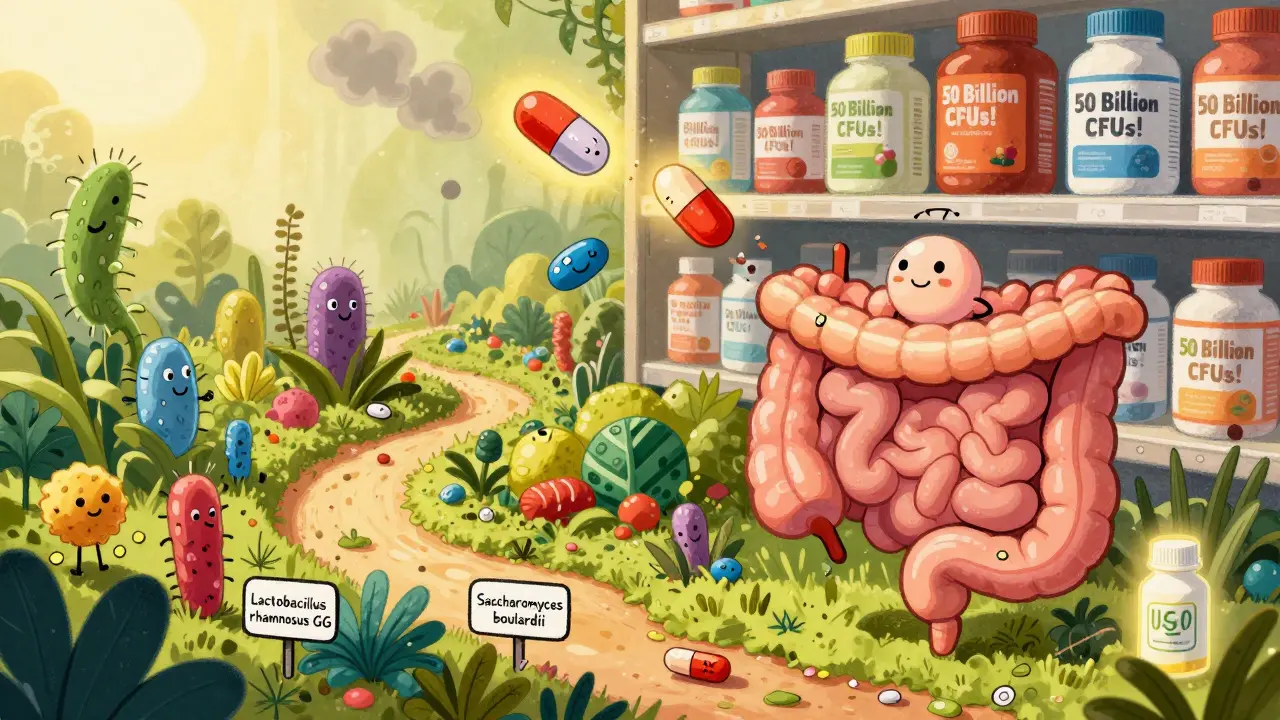
When you hear the word probiotics, you might think of yogurt commercials or a shelf full of colorful bottles at the grocery store. But here’s the truth: not all probiotics are the same, and not everyone benefits from them the same way. If you’re considering a probiotic supplement to help with bloating, diarrhea, or just to feel better overall, you need to know what actually works - and what’s just marketing.
What Probiotics Really Are (And What They’re Not)
Probiotics are live bacteria and yeasts that, when taken in the right amount, can help your gut stay balanced. This isn’t new science. Back in the early 1900s, scientist Élie Metchnikoff noticed that Bulgarian villagers who ate fermented milk lived longer. He linked it to the lactic acid bacteria in their diet. Today, we call those bacteria probiotics - and we’ve spent decades trying to figure out which ones do what.
The key word here is live. If the bacteria are dead by the time you swallow the pill, they won’t help. That’s why storage matters. Some probiotics need refrigeration; others don’t. Some brands claim 50 billion CFUs (colony-forming units) on the label, but a 2019 ConsumerLab test found 30% of them had far fewer live organisms than advertised. That’s why third-party verification - like USP or NSF International - matters more than fancy packaging.
Probiotics aren’t magic pills. They don’t cure diseases. But for specific conditions, the evidence is strong.
When Probiotics Actually Work - And Which Strains to Look For
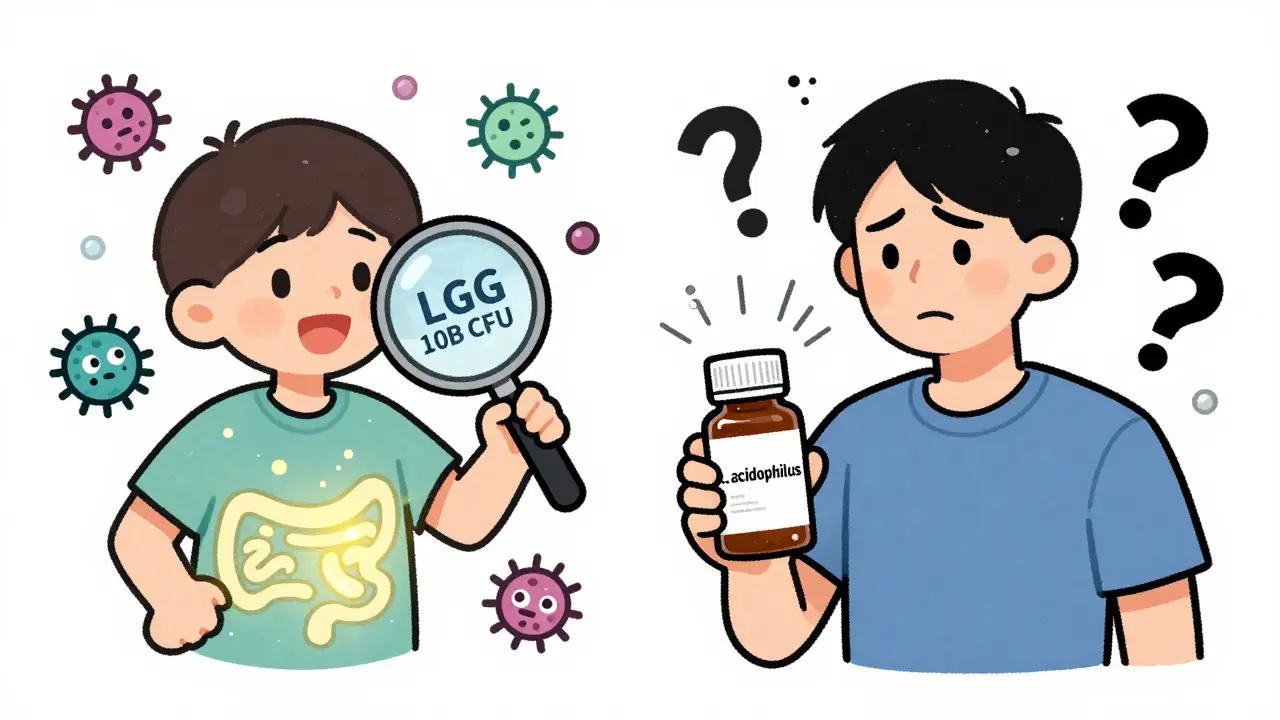
Not all probiotics are created equal. A strain of Lactobacillus rhamnosus GG (LGG) is not the same as another strain of Lactobacillus acidophilus, even if they’re from the same species. The difference matters.
For acute infectious diarrhea - especially in kids - LGG and Saccharomyces boulardii have solid backing. A 2020 Cochrane Review of over 12,000 participants found probiotics reduced the risk of diarrhea lasting 48 hours or more by 36%. That’s not small. In one study, kids on LGG recovered about a day faster than those on placebo.
For antibiotic-associated diarrhea (AAD), the numbers are even clearer. When adults or children take antibiotics, they often get diarrhea as a side effect. Studies show that taking LGG or S. boulardii during and after antibiotics cuts the risk from 22.4% down to 12.3%. That’s nearly half. The trick? Take the probiotic at least two hours after the antibiotic. And keep taking it for one to two weeks after you finish the antibiotics.
For ulcerative colitis, a type of inflammatory bowel disease, some probiotics show modest benefit. The American Gastroenterological Association reviewed 17 trials and found that certain strains - like E. coli Nissle 1917 and VSL#3 (a multi-strain blend) - can help maintain remission. But for Crohn’s disease? No consistent benefit. And for irritable bowel syndrome (IBS)? Results are mixed. Some people swear by it; others feel nothing. The strain matters: Lactobacillus plantarum DSM 9843 reduced bloating and pain in one study, but other strains didn’t.
And here’s the catch: Lactobacillus acidophilus isn’t one thing. There are at least five different strains - LA-1, LA-5, NCFM, DDS-1, SBT-2026 - and each behaves differently. If your supplement just says “L. acidophilus” without listing the strain, you’re flying blind.
What Doesn’t Work - And Why So Many People Are Disappointed
Not everyone benefits. On Reddit’s r/Probiotics community, one user said LGG completely resolved their toddler’s antibiotic diarrhea. Another said they tried five brands over six months and felt nothing. That’s not unusual.
Why? Because your gut microbiome is unique. Like fingerprints, no two are exactly alike. What works for your neighbor might do nothing for you. Dr. Purna Kashyap from Mayo Clinic puts it simply: “Probiotics are not a one-size-fits-all solution.”
Also, many products are underdosed. For LGG to help with diarrhea, you need at least 10 billion CFUs per day. Many cheap supplements give you 1 or 2 billion. That’s not enough. And if you’re taking a probiotic for general “digestive health” without a specific problem? The evidence is weak. The European Food Safety Authority (EFSA) has rejected health claims for almost all probiotics - except for yogurt cultures that help people digest lactose.
And then there’s the side effect: gas. Around 37% of people who report negative experiences say they got bloated or gassy at first. That’s usually temporary - your gut adjusts in 3 to 7 days. But if it lasts longer, the strain might not be right for you.
How to Choose a Probiotic That Actually Works
If you’re going to spend money on a probiotic, here’s how to pick one that might actually help:
- Know your goal. Are you trying to prevent diarrhea after antibiotics? Treat IBS? Support general digestion? Your goal determines the strain.
- Look for the strain name. Don’t settle for “Lactobacillus.” Look for “Lactobacillus rhamnosus GG” or “Saccharomyces boulardii CNCM I-745.”
- Check the CFU count. For diarrhea, aim for 10 billion CFU or more per dose. For maintenance, 1-5 billion may be enough.
- Verify quality. Look for USP, NSF, or ConsumerLab certification. These mean the product was tested for what’s on the label.
- Check storage. If it needs refrigeration, make sure it was kept cold. If it’s shelf-stable, that’s fine - but make sure the strain is known to survive at room temperature (like S. boulardii).
- Don’t expect miracles. Probiotics take time. Benefits often show up after 2-8 weeks. If you stop after 3 days and feel nothing, that’s normal.
For antibiotic-associated diarrhea, stick with LGG or S. boulardii. For ulcerative colitis, VSL#3 or E. coli Nissle 1917 are the most studied. For general bloating? Try L. plantarum DSM 9843.
The Bigger Picture: Probiotics in the Real World
The global probiotics market hit $50.2 billion in 2022 and is expected to grow to $89.1 billion by 2030. That’s a lot of money - and a lot of products. North America and Europe lead the market. Companies like Chr. Hansen, DuPont, and Danone dominate because they invest in real science, not just hype.
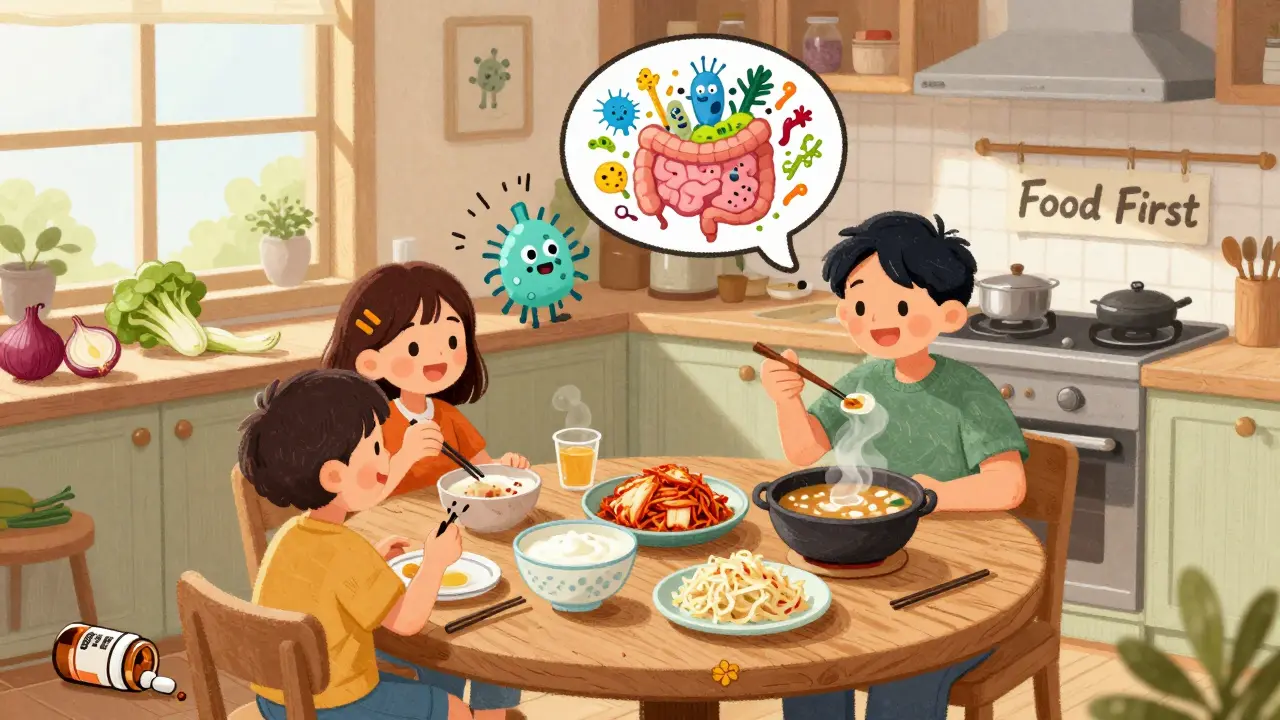
But here’s what most people don’t realize: probiotics are not the only way to support gut health. Diet matters more. Fiber feeds your good bacteria. Fermented foods - like kimchi, kefir, sauerkraut, and miso - naturally contain live cultures. You don’t need a pill to get them.
And the future? It’s getting personal. Companies like Viome and Thryve now offer microbiome tests and custom probiotic blends based on your gut bacteria profile. It’s expensive, but it’s the direction science is heading.
Who Should Avoid Probiotics?
Most healthy people can take probiotics safely. But if you’re immunocompromised - say, from chemotherapy, an organ transplant, or severe illness - probiotics can be dangerous. There are documented cases of bacteremia (bacteria in the bloodstream) from probiotic use in these patients. Talk to your doctor first.
Also, avoid probiotics if you have a central line, severe pancreatitis, or are critically ill. The risk isn’t high for most, but it’s real for some.
Final Takeaway: Probiotics Are Tools, Not Cures
Probiotics aren’t a cure-all. They’re not a replacement for good food, sleep, or medical care. But for specific problems - like antibiotic diarrhea or ulcerative colitis - they’re backed by real science. The key is matching the right strain to your condition, using the right dose, and choosing a product you can trust.
If you’re just feeling a little bloated and want to try something, start with a well-researched strain like L. plantarum or LGG. Give it 4-6 weeks. If nothing changes, it’s probably not for you. And that’s okay. Your gut doesn’t need a probiotic to be healthy - it just needs the right fuel, rest, and care.
Do probiotics help with bloating and gas?
Yes, but only for some people and only with specific strains. Studies show Lactobacillus plantarum DSM 9843 reduced bloating and abdominal pain in IBS patients after four weeks. Other strains like Bifidobacterium infantis have also shown promise. However, many probiotics have no effect on bloating, and some can make it worse at first. If you’re trying probiotics for bloating, choose a strain with clinical evidence and give it at least 4-6 weeks.
Can I get probiotics from food instead of supplements?
Absolutely. Fermented foods like yogurt (with live cultures), kefir, sauerkraut, kimchi, miso, and kombucha naturally contain probiotics. In fact, these foods often have a wider variety of strains than supplements. The benefit? You’re also getting fiber, vitamins, and other nutrients. For general gut health, food sources are often better than pills - unless you need a targeted, high-dose strain for a specific condition like antibiotic diarrhea.
How long should I take a probiotic before seeing results?
It depends on the goal. For antibiotic-associated diarrhea, you may see improvement within a few days. For IBS symptoms like bloating or irregular bowel movements, it typically takes 2-8 weeks. Clinical trials usually run for 4-12 weeks to measure results. Don’t give up after a week. Your gut microbiome needs time to adjust. If you don’t notice any change after 8 weeks, the probiotic likely isn’t helping you - and you can stop.
Are probiotics safe for children?
Yes, for most children. Lactobacillus rhamnosus GG and Saccharomyces boulardii are well-studied and safe for kids. They’re commonly used to reduce the duration of infectious diarrhea and prevent antibiotic-associated diarrhea. Doses are usually lower than for adults - often 5-10 billion CFU per day. Always check with your pediatrician before giving probiotics to infants or children with chronic illnesses or weakened immune systems.
Do probiotics help with weight loss or blood sugar?
There’s early research suggesting certain strains might influence metabolism and insulin sensitivity - for example, Lactobacillus johnsonii has shown potential in animal and small human studies. But these are preliminary findings. No probiotic is currently approved or proven for weight loss or diabetes management. Don’t buy a probiotic for weight loss unless it’s part of a broader, doctor-approved plan. Diet and exercise still matter far more than any supplement.
What’s the difference between probiotics and prebiotics?
Probiotics are the live bacteria themselves. Prebiotics are the food those bacteria eat - mostly fiber and complex carbohydrates. Think of probiotics as the workers and prebiotics as their lunch. Foods like onions, garlic, bananas, oats, and asparagus are rich in prebiotics. Many supplements combine both - called synbiotics. But you don’t need a supplement to get prebiotics. Eating more whole plant foods naturally feeds your good gut bacteria.
Can probiotics cause harm?
For healthy people, probiotics are generally safe. Side effects are usually mild - like temporary gas or bloating. But for people with weakened immune systems, severe illness, or central lines, probiotics can cause serious infections like bacteremia. There are documented cases of this happening. If you’re critically ill, on chemotherapy, or have a gut disorder like short bowel syndrome, talk to your doctor before taking probiotics. Never self-treat serious conditions with supplements.
What to Do Next
If you’re dealing with antibiotic diarrhea, start with LGG or S. boulardii - 10 billion CFU daily, taken 2 hours after your antibiotic. Keep going for two weeks after the antibiotics end.
If you have IBS and bloating, try a product with L. plantarum DSM 9843 or B. infantis. Give it 6 weeks. Track your symptoms.
If you’re just curious and want to try something, go for a reputable brand with third-party testing and a strain you can look up in published studies. Skip the ones that just say “10 strains!” without naming them.
And remember: your best tool for gut health isn’t a pill. It’s food. Eat more vegetables, whole grains, legumes, and fermented foods. Probiotics might help - but they’re not a replacement for a healthy diet.
12 Responses
Probiotics are just Big Pharma’s way of making you buy yogurt pills so they can charge $40 for something that’s been in your grandma’s kitchen for centuries
Have you ever stopped to think… that maybe your gut isn’t broken… but your life is? Probiotics won’t fix your stress, your sleep, your 3 a.m. scrolling, your sugar addiction… but you’ll keep buying them anyway, won’t you? Because it’s easier than changing.
Oh sweet mercy, another American trying to sell fermented milk as a miracle cure. In India, we’ve been eating dahi and kanji for millennia without needing a 50-billion-CFU capsule labeled in Latin. Your ‘science’ is just capitalism with a lab coat.
Let me be blunt: the entire probiotic industry is a Rorschach test for the gullible. You see ‘live cultures’ and you think ‘healing’-but what you’re really seeing is your own desperation dressed up in scientific jargon. The fact that EFSA rejected 97% of health claims should be a red flag, not a footnote.
And don’t get me started on ‘strain specificity.’ If you can’t pronounce ‘DSM 9843,’ you shouldn’t be spending $50 on it. You’re not optimizing your microbiome-you’re optimizing your credit card balance.
And yes, I’ve tried them all. LGG? Felt like a ghost in my gut. B. infantis? Nothing. The only thing that worked? Cutting out processed food and eating real meals. But that’s not sexy. It doesn’t come in a bottle with a QR code.
Probiotics are the spiritual equivalent of feng shui for your intestines: a placebo with a patent. You feel better because you believe you’re doing something. Not because the bacteria are doing anything.
And yet… here we are. Still buying. Still hoping. Still blaming our guts for our poor choices.
It’s not the microbiome that’s imbalanced-it’s our relationship with food, with time, with ourselves.
But hey, at least the labels look nice on the shelf.
There is a critical flaw in the popular narrative surrounding probiotics: the assumption that colonization is the goal. In reality, most ingested strains are transient. They do not permanently engraft. Their benefit is pharmacological, not ecological. This is why dosage and timing matter more than strain diversity. The effect is dose-dependent and often transient. The literature consistently shows that benefits are most pronounced in acute, targeted conditions-not as general wellness agents.
Furthermore, the microbiome is a dynamic ecosystem. Introducing exogenous strains may disrupt native communities. There is emerging evidence that probiotic use post-antibiotics may delay native microbiota recovery-contrary to popular belief. See Suez et al., 2018, Cell.
Therefore, the blanket recommendation to ‘take probiotics’ is not evidence-based. It is marketing masquerading as medicine.
I’ve been reading this thread and I just want to say… thank you. It’s rare to see such thoughtful discussion about something so often reduced to hype. I’ve had IBS for 12 years. Tried 7 different probiotics. Only one-L. plantarum-gave me even a whisper of relief. And even then, it took six weeks. I stopped because I forgot. Started again. Same result.
What I’ve learned? It’s not about the pill. It’s about the pattern. The sleep. The walking. The tea instead of soda. The fact that I finally stopped eating cereal for dinner.
Probiotics? Maybe a tool. But the real magic? That’s in the quiet choices. The ones no one sells you.
I used to think probiotics were magic. Then I started eating kimchi every morning. No pills. Just spicy, fermented cabbage. My bloating vanished. My skin cleared up. I didn’t even notice until I stopped for a week and everything came back.
Maybe the real probiotic isn’t in the bottle-it’s in the kitchen. And the patience.
Let’s be clear: if your gut is ‘unbalanced,’ it’s because you’re eating garbage, sitting all day, and sleeping like a zombie. Probiotics are a Band-Aid on a bullet wound. You want to ‘optimize’ your microbiome? Stop drinking soda. Stop eating gluten-free processed crap. Eat fiber. Move. Sleep. And stop treating your intestines like a broken appliance you can fix with a $29 Amazon miracle.
The fact that you need a 10-billion-CFU capsule to survive your own diet is a indictment of modern life-not proof that science has failed.
And yes, I’ve seen the studies. I’ve read the Cochrane reviews. I’ve met the doctors. The only thing that works? Lifestyle. Not supplements. Not marketing. Not ‘strains.’
You’re not broken. You’re just lazy.
What if… the gut isn’t the problem? What if the gut is just the messenger? What if the bloating, the gas, the irregularity… are just echoes of a soul that’s been starved of stillness? We treat symptoms like enemies… but maybe they’re whispers. Quiet, desperate whispers from a body saying: ‘Slow down. Breathe. Be here.’
Probiotics might quiet the noise… but they won’t heal the silence.
My mom took LGG after her antibiotics and her diarrhea vanished in 2 days. My cousin took the same one and got worse. We’re both 50, both healthy, both ate the same food. So yeah-your gut is your fingerprint. No two are alike. That’s the beauty of it. And the frustration.
Try one. Give it time. If it helps? Cool. If not? No shame. Your gut doesn’t owe you results.
probiotics r just a scam bro… i tried 3 diff brands n felt nothing… then i just ate more onions n garlic n my gut felt better… who needs pills???
Thank you for this. I’ve been trying to explain to my sister that probiotics aren’t magic, and she keeps buying those ‘100 billion CFU’ bottles with glitter on them. I printed out the Cochrane review and showed her the CFU comparisons. She still says ‘but it makes me feel better!’
And you know what? Maybe it does. Maybe the ritual of taking it, the hope, the belief-that’s part of the healing too.
So I don’t argue anymore. I just make her kimchi.