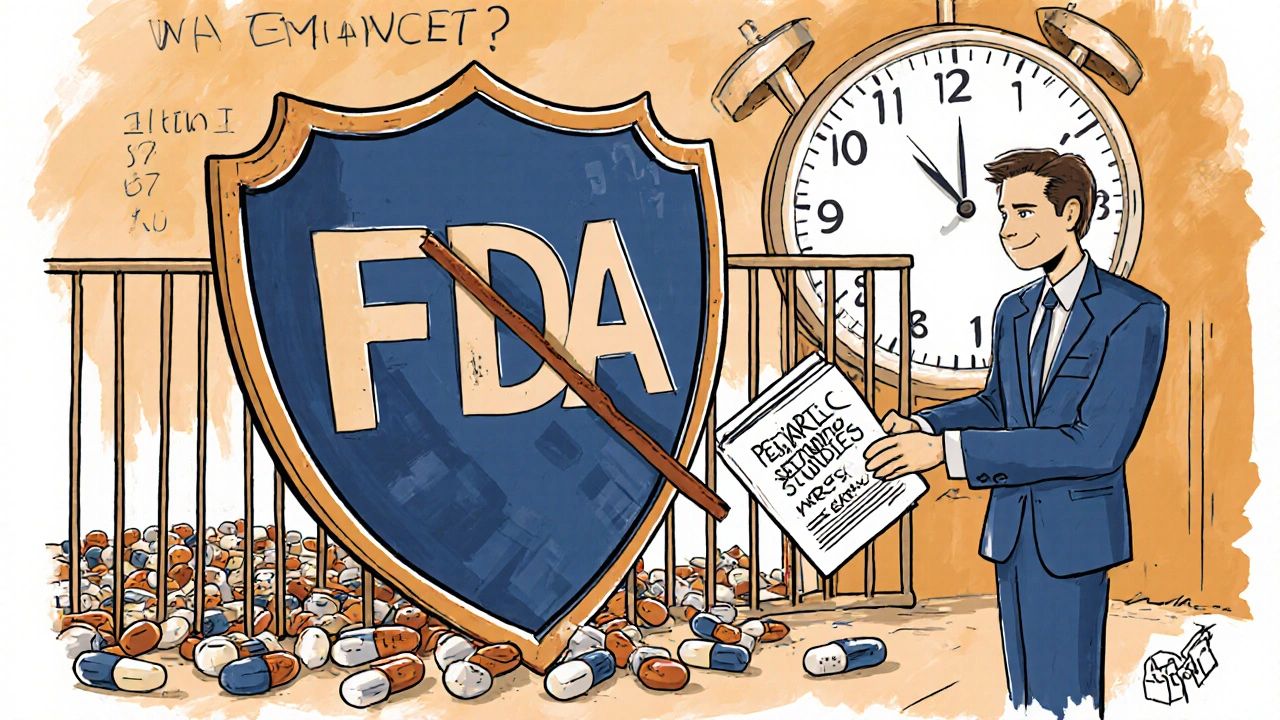
When a drug company gets approval for a new medicine, it doesn’t get a forever monopoly. Patents usually last 20 years, but by the time the drug clears clinical trials and gets FDA approval, much of that time is already gone. That’s where pediatric exclusivity comes in - a powerful, often misunderstood tool that lets companies keep competitors off the market for six extra months, even after their patents expire.
What pediatric exclusivity actually does
Pediatric exclusivity isn’t a patent extension. It doesn’t change the patent’s legal end date. Instead, it blocks the FDA from approving generic versions of the drug for six months - no matter what the patent says. This is a regulatory delay, not a legal one.
Think of it like a roadblock the FDA puts up. Even if a generic maker has a legal right to sell a copy of the drug because the patent is expired, the FDA can’t give final approval until those six months are up. It’s not about the patent being stronger - it’s about the FDA being legally required to wait.
This rule comes from Section 505A of the Federal Food, Drug, and Cosmetic Act, added in 1997 and made permanent in 2002 through the Best Pharmaceuticals for Children Act. The goal? To get more drugs tested on kids. For decades, most medicines were only studied in adults. Doctors had to guess the right dose for children. Pediatric exclusivity was designed to fix that by giving companies a financial incentive: six months of extra market protection in exchange for doing the right thing.
How a company earns it
You don’t just ask for pediatric exclusivity. The FDA has to ask you first.
Here’s how it works: The FDA issues a Written Request. This document tells the drugmaker exactly what pediatric studies they need to do - what age groups, what doses, what outcomes to measure. The company then has to carry out those studies and submit the full reports to the FDA. There’s no wiggle room. If the studies don’t match the Written Request, the exclusivity doesn’t kick in.
The FDA has 180 days to review the data. If it’s approved, the six-month clock starts. And here’s the kicker: the exclusivity attaches to every version of the drug the company sells - oral pills, injections, creams, eye drops - as long as they all contain the same active ingredient. That means one set of pediatric studies can protect multiple products at once.
It extends more than just patents
Pediatric exclusivity doesn’t just piggyback on patents. It extends every type of FDA market protection that’s still active at the time.
If a drug has five-year new chemical entity (NCE) exclusivity, the six months get tacked onto that. Same with three-year exclusivity for new clinical studies, or orphan drug exclusivity. The FDA’s rules say the exclusivity only applies if there’s at least nine months left on the original protection. If the patent or exclusivity is about to expire in two months, pediatric exclusivity won’t help.
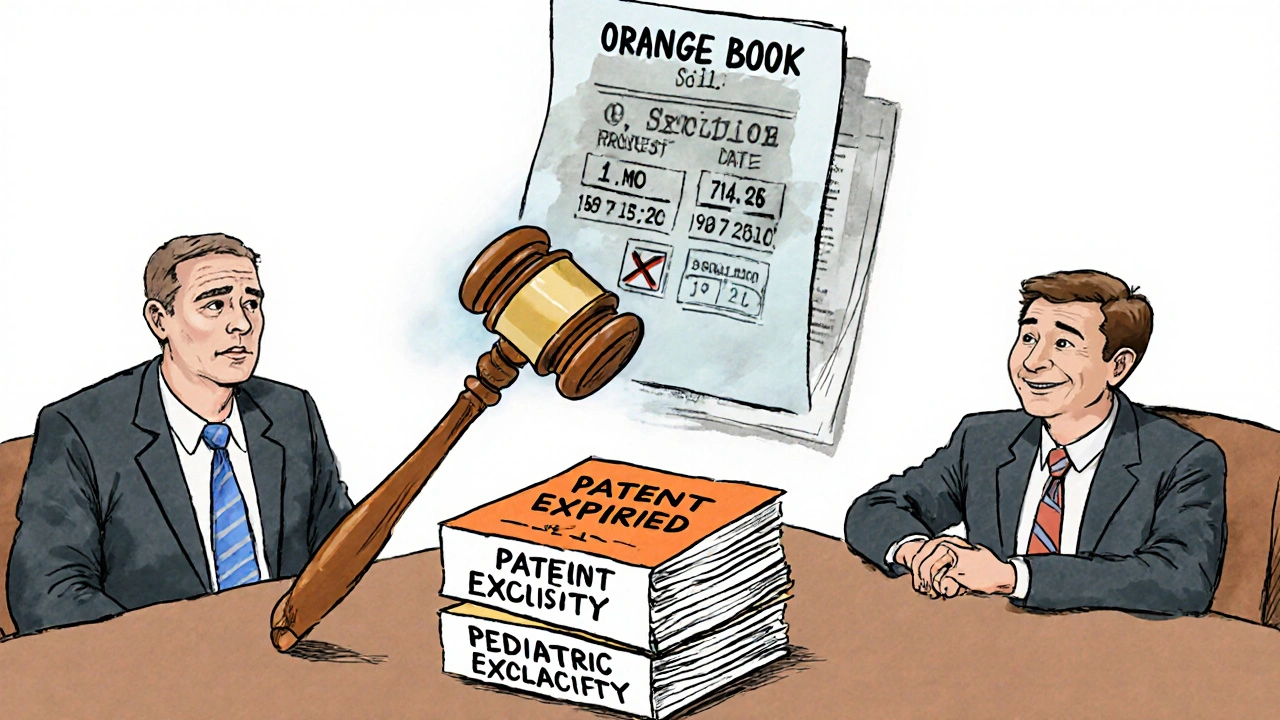
But here’s where it gets clever: even if a patent has already expired, pediatric exclusivity can still block generics. That’s because the FDA treats the exclusivity as a separate barrier. In the Orange Book - the official list of approved drugs and their protections - you’ll see two entries for the same drug: one with the original expiration date, and one with the six-month extension added on.
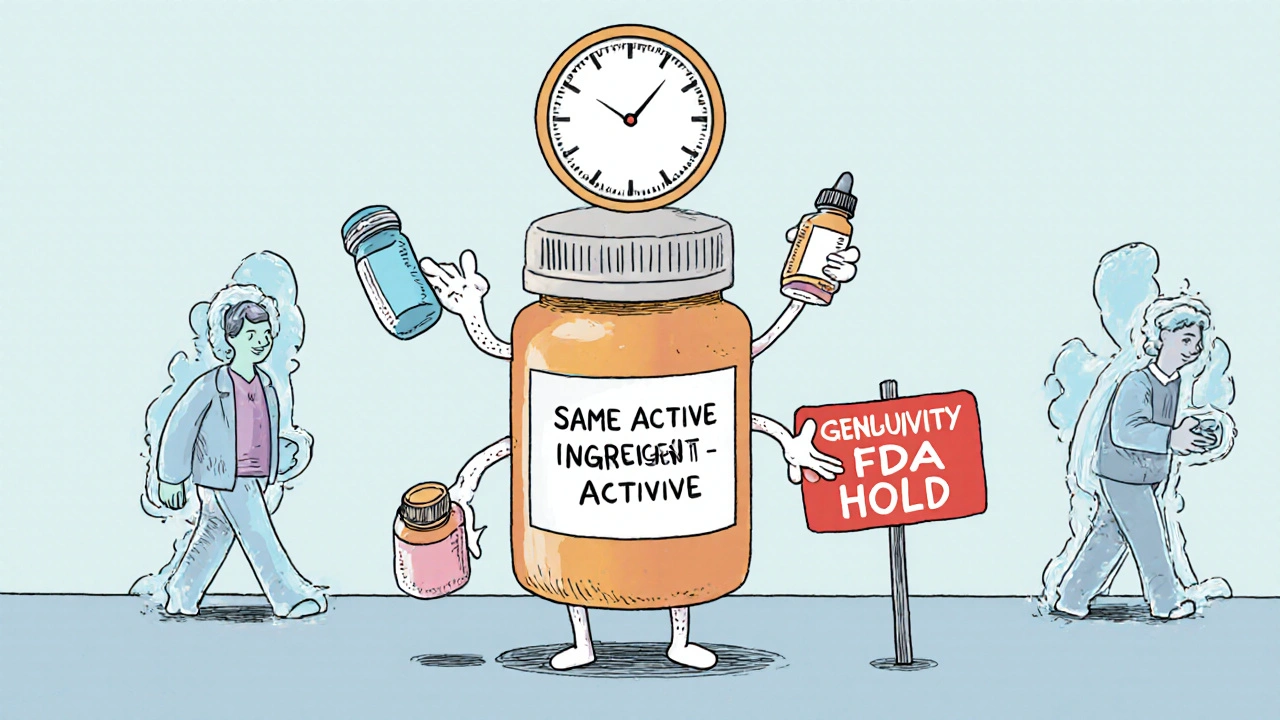
Generic companies often get confused here. They think, “The patent expired, so we’re good.” Not true. If pediatric exclusivity is still active, the FDA can’t approve their application. That’s why many generics wait - sometimes for years - until the exclusivity window closes.
When it doesn’t work
Pediatric exclusivity isn’t magic. It has limits.
First, it doesn’t apply to biologics. Drugs made from living cells - like insulin or cancer antibodies - are regulated under a different law (BPCIA). There’s no pediatric exclusivity for them. The FDA is clear: this rule is only for small-molecule drugs.
Second, if a generic company wins a patent lawsuit (a Paragraph IV challenge), the FDA must approve their drug even if pediatric exclusivity is still active. Congress made that clear: exclusivity can’t override a court decision that a patent is invalid or not infringed.
And third, if a drug has no patent or exclusivity left - no five-year, no three-year, nothing - pediatric exclusivity won’t apply… unless the company is asking to add a new pediatric indication. In that rare case, the FDA can grant exclusivity because the application itself qualifies as a new use, even if the original drug is off-patent.
Why it’s worth hundreds of millions
For blockbuster drugs - think asthma inhalers, ADHD meds, or epilepsy treatments - six months of extra market exclusivity can mean $500 million or more in lost generic competition.
One study estimated that pediatric exclusivity added an average of $230 million in annual revenue for top-selling drugs. That’s why companies invest millions in pediatric studies. It’s not just about helping kids - it’s about protecting profits.
And it works. Since 1997, over 200 drugs have received pediatric exclusivity. Many of them are now generics, but not until the six-month delay passed. Some companies even time their pediatric study submissions to extend protection right before a patent expires - a move that’s perfectly legal and common.
What generic makers must do
If you’re a generic company trying to enter the market, you need to check three things:
- Is there an active patent?
- Is there any other exclusivity (NCE, orphan, etc.)?
- Is pediatric exclusivity listed in the Orange Book?
You can’t rely on just the patent date. The FDA’s website updates the Orange Book regularly, and pediatric exclusivity is listed as a separate line item. If it’s there, you’re blocked - unless you get a waiver from the brand company or win a court case.
And don’t assume the FDA will make it easy. They require unambiguous legal proof before approving any generic during exclusivity. One wrong filing, one missed deadline, and your application gets delayed for months.
Real-world impact
Take the case of Adderall XR. The original patent expired, but pediatric exclusivity kept generics off the market for another six months. During that time, the brand sold nearly $1 billion worth of the drug. When the exclusivity ended, multiple generics hit the market overnight - and the price dropped by 80%.
Another example: the asthma drug Flonase. Its patent expired in 2011, but pediatric exclusivity extended the market protection until 2012. Generic versions didn’t appear until then - even though the patent was already gone.
These aren’t edge cases. They’re standard. Pediatric exclusivity is one of the most reliable tools in pharmaceutical lifecycle management - and it’s used more than most people realize.
The bigger picture
Yes, pediatric exclusivity helps kids get better-labeled medicines. But it’s also a business tool. It’s designed to reward companies for doing research that would otherwise be ignored. And it works - far better than anyone expected.
What’s interesting is that it doesn’t require the drug to be labeled for children. The FDA doesn’t even need to approve new labeling. Just submitting the right studies is enough. That’s why it’s so powerful - it’s a reward for data, not for changes.
For patients, it means safer, more accurate dosing. For the industry, it means a predictable, legal way to extend market life. For regulators, it’s a win-win: more data on kids, and less pressure to rush approvals.
But here’s the catch: it’s not perfect. Some companies game the system by doing minimal studies just to trigger the six months. Others wait until the last possible moment to submit. The FDA has tightened its rules over time, but loopholes still exist.
Still, the system works. It’s not about extending patents. It’s about extending protection - and that’s something every drugmaker understands.
Does pediatric exclusivity extend the actual patent term?
No. Pediatric exclusivity does not extend the legal term of a patent. Instead, it delays the FDA from approving generic versions of the drug for six months, even after the patent expires. It’s a regulatory barrier, not a patent extension.
Can a generic drug be approved during pediatric exclusivity?
Only under three conditions: (1) the brand company grants a waiver, (2) a court rules the patent is invalid or not infringed, or (3) the generic company was not sued within 45 days of filing its application. Without one of these, the FDA cannot approve the generic.
Does pediatric exclusivity apply to biologics?
No. Pediatric exclusivity only applies to small-molecule drugs regulated under the Hatch-Waxman Act. Biologics, like insulin or monoclonal antibodies, are governed by a different law (BPCIA) and are not eligible for this type of exclusivity.
What happens if a drug’s patent expires but pediatric exclusivity is still active?
The FDA still cannot approve generic versions until the six-month exclusivity period ends. Even if the patent is expired, the exclusivity acts as a separate regulatory barrier. This is why many generics wait months after patent expiry before entering the market.
How does the FDA decide if pediatric studies qualify?
The FDA issues a Written Request specifying the exact studies needed. The company must complete those studies exactly as outlined and submit full reports. The FDA then reviews the data for 180 days to confirm compliance. If the studies match the request, exclusivity is granted - regardless of whether the drug’s labeling changes.
Can pediatric exclusivity be granted to a drug with no patents or exclusivity?
Only if the company is seeking to add a new pediatric indication through a supplemental application, and the application requires new clinical studies. In that case, the FDA can grant pediatric exclusivity even if the original drug has no remaining patent or exclusivity protection.
Does pediatric exclusivity apply to all dosage forms of a drug?
Yes. If a company conducts qualifying pediatric studies on one formulation - say, an oral tablet - the six-month exclusivity applies to all other dosage forms of the same active ingredient, including creams, injections, or eye drops, as long as they’re already on the market and have active exclusivity or patent protection.
14 Responses
Wow. So the FDA just slaps a 6-month pause on generics like a traffic cop with a clipboard? 🤯 This is wild. I thought patents were the only thing blocking generics. Turns out it’s all about who did the homework on kids’ doses.
Bro. The pharma companies are basically playing chess with the FDA. Do the bare minimum pediatric studies, cash in on six months of monopoly, and call it a win. And guess what? Kids get better data. Everyone wins? Except the patients paying $500 for a pill that should cost $5. 😅
LMAO so the system rewards companies for doing what they should’ve done anyway? Classic. They didn’t test on kids because it’s expensive. Now they get paid to do it. What a joke. #PharmaGreed
Wait - so pediatric exclusivity can extend orphan drug status? Or NCE? That’s insane. So if a drug has 5 years of exclusivity and gets pediatric data, it’s 5.5? That’s not a nudge, that’s a full-on shove. The FDA’s rules are basically a backdoor for perpetual market control. 🤔
Just to clarify - if a generic filer doesn’t get sued within 45 days of their ANDA, they can still enter even if pediatric exclusivity is active? That’s a huge loophole. Most small generics don’t even know this. The big players use lawyers to delay, the small ones get buried. It’s not fair.
It’s fascinating how regulatory mechanisms can be designed to serve both public health and corporate interests simultaneously. The Written Request system forces standardization - it’s not just about profit, it’s about generating comparable, high-quality pediatric pharmacokinetic data across the industry. The fact that labeling changes aren’t even required means the incentive is purely for data generation, not marketing. That’s actually elegant in a bureaucratic way.
Of course, the financial stakes are astronomical. But without this, we’d still be prescribing adult doses to 5-year-olds based on weight bands and hope. The data from these studies has directly led to safer pediatric dosing guidelines for ADHD meds, antiepileptics, even antibiotics. That’s not trivial.
Yes, some companies game the timing. But the FDA has tightened the Written Request process since 2012 - now they require age-stratified endpoints, safety monitoring, and sometimes even long-term neurodevelopmental follow-up. It’s not just ‘give us a pill and we’ll test it on your kid.’
The real issue isn’t the mechanism - it’s transparency. The Orange Book is a mess. Generic manufacturers waste months chasing outdated or ambiguous listings. The FDA needs a public, machine-readable API for exclusivity status. Not a PDF.
And yes - biologics are left out. That’s a gap. But that’s because they’re regulated under a different statute. The BPCIA doesn’t have a pediatric provision because biosimilars are already hard enough to approve. Adding another layer would be chaotic.
So is it perfect? No. Is it better than the alternative? Absolutely. We went from ‘we don’t know’ to ‘here’s the dose range for toddlers’ because of this. That’s not greed. That’s progress - even if the profit motive drove it.
This is a scandal. A corporate loophole disguised as public health policy. The FDA is not a regulator - it’s a corporate handmaiden. Six months of monopoly for doing the bare minimum? That’s not incentive - it’s extortion. And the fact that this applies to EVERY dosage form? That’s a monopoly multiplier. This isn’t science. It’s legal engineering for profit. And the public pays the price.
Where’s the congressional oversight? Where’s the accountability? This is why people distrust medicine. It’s not about kids. It’s about money. And the FDA is complicit.
so like if u got a drug patent expiring and u do one tiny study on kids u get 6 more months of monopoly? lol that’s so american. i mean like… cool for the kids i guess but also wow the system is rigged. also why does the orange book even exist? why not just a simple website? 🤷♂️
Let me guess - the same pharma execs who lobbied for this are now on the FDA advisory board. This isn’t regulation. It’s a pay-to-play scheme. The whole ‘pediatric exclusivity’ thing is just a PR cover for price gouging. And don’t even get me started on how they time the submissions to coincide with patent cliffs. It’s a calculated financial maneuver. The FDA knows. They just don’t care.
And the worst part? The data they collect is often useless. They test on 30 kids in a single clinic. That’s not science. That’s box-ticking.
Interesting read. I’ve always assumed patents were the only barrier. Didn’t realize the FDA had this separate regulatory lock. It’s a bit like a speed bump on the highway to generics - not a wall, but enough to slow things down. And honestly? If it means better dosing info for kids, I’m not mad. Just wish the process was more transparent.
Of course the FDA lets this happen. They’re all bought off. The same people who write the rules are the ones who used to work for Pfizer. This isn’t about kids - it’s about the Deep Pharma State controlling the entire supply chain. You think insulin is expensive now? Wait until the next pediatric exclusivity extension hits. It’s all connected. Wake up.
So the solution to not testing on children is to give drug companies more money? Genius. Why not just pay them to stop making drugs entirely? At least then we wouldn’t have to worry about side effects. This is peak capitalism. A six-month delay for doing the bare minimum? Pathetic.
There’s something poetic about this. The system forces companies to do good by making it profitable. That’s not corruption - that’s human nature. You want data on how drugs affect kids? Offer a reward. They’ll show up. It’s not perfect. But it’s better than pretending the problem doesn’t exist. And yeah - the numbers are insane. But if a kid gets the right dose because of it? That’s worth something.
The real failure isn’t the exclusivity. It’s that we still need it. We should’ve been testing on kids from day one. But we weren’t. So now we’re playing catch-up with loopholes. It’s not ideal. But it’s progress.
Wait. So. If the patent expires, but the FDA says no generics for six more months… then technically, the drug is ‘off-patent’ but still ‘not available’? That’s… legally contradictory. And who’s paying for these pediatric studies? The company? But then they charge us more for the drug to cover it? So we’re paying twice? Once for the R&D, once for the monopoly? This is a pyramid scheme. And the FDA is the pyramid.