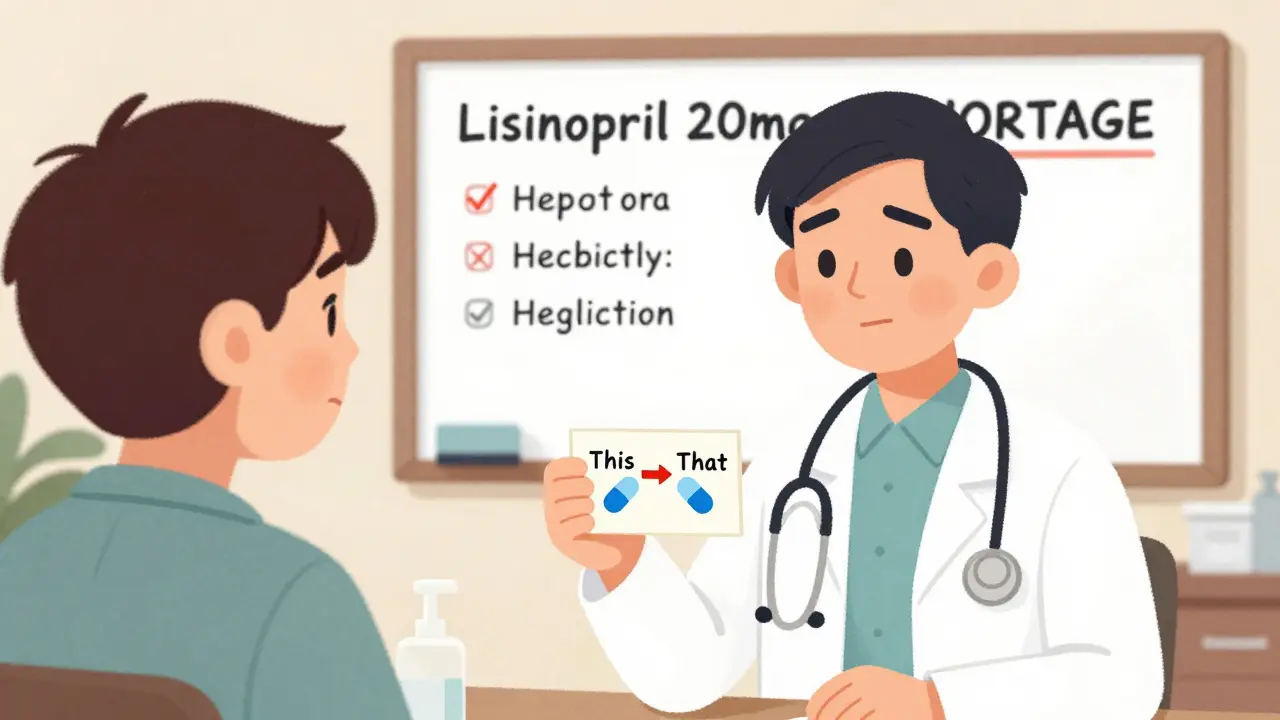
When a medication disappears from the pharmacy shelf, patients don’t just lose a pill-they lose stability, trust, and sometimes hope. A drug shortage isn’t just a supply chain problem. It’s a patient communication crisis. And the responsibility to handle it well falls squarely on healthcare providers.
What Counts as a Drug Shortage?
A drug shortage happens when there’s not enough of a medicine to meet patient needs. The World Health Organization defines it simply: demand exceeds supply. But in practice, it’s messier. It could be a heart drug running out in a rural clinic, a cancer treatment delayed by a manufacturing hiccup, or an antibiotic that’s suddenly unavailable after a factory shutdown. In the U.S. alone, 298 medications were in shortage in Q2 2023-a 37% jump since 2019. Cardiovascular and oncology drugs make up half of these gaps. And when these medicines vanish, patients panic. They call their doctor. They show up at the pharmacy. They search online. If providers don’t respond clearly, confusion spreads.What Providers Are Required to Do
Healthcare systems aren’t just encouraged to communicate during shortages-they’re legally and ethically bound to. In the U.S., the FDA’s FDASIA law requires manufacturers to report potential shortages six months in advance. That gives providers time to prepare. In Europe, the EMA’s 2022 guidance makes communication mandatory for all licensed facilities. But knowing the rules isn’t enough. Providers must act. The Joint Commission, which accredits U.S. hospitals, now lists structured communication during shortages as a National Patient Safety Goal. Starting in January 2025, facilities that fail to implement clear, empathetic communication protocols risk losing accreditation. That’s not a warning-it’s a mandate. And it’s not just about legal compliance. It’s about trust.The Four Essentials of Good Communication
Patients don’t need a pharmaceutical lecture. They need four things:- Clear identification of what’s missing: Brand name? Generic? Strength? Form? Don’t say "your pill"-say "your 20mg lisinopril tablet."
- Transparent scope: Is this a 10% shortage or 90%? Will it last weeks or months? If you don’t know the exact end date, say so-but give a realistic estimate.
- Real alternatives: Not just "we’ll switch you to something else." Explain why the alternative is safe and effective. Show data. Use simple comparisons.
- Contact info: Who can they call if they’re confused? A phone number. An email. A dedicated line. Not "ask your pharmacist."
How to Talk to Patients-Without Overwhelming Them
Most providers have 15 minutes per visit. That’s not enough to explain a drug shortage, a new treatment, and a patient’s fears. So how do you do it right? The CDC’s "Chunk, Check, Change" method works. Break information into three-minute chunks. Then check: "Can you tell me how you’ll take this new medication?" If they get it wrong, change your approach. Don’t repeat the same explanation. Simplify. Use visuals. A picture of two pills side by side, with arrows showing "This → That," cuts through confusion faster than a paragraph of text. And never use jargon. "Bioequivalent"? "Pharmacokinetics"? Those words shut people down. Use "works the same way" or "helps your body the same way." The CDC says all written material must be written at a 6th- to 8th-grade reading level. That’s not a suggestion. It’s a standard.What Works: Real Examples
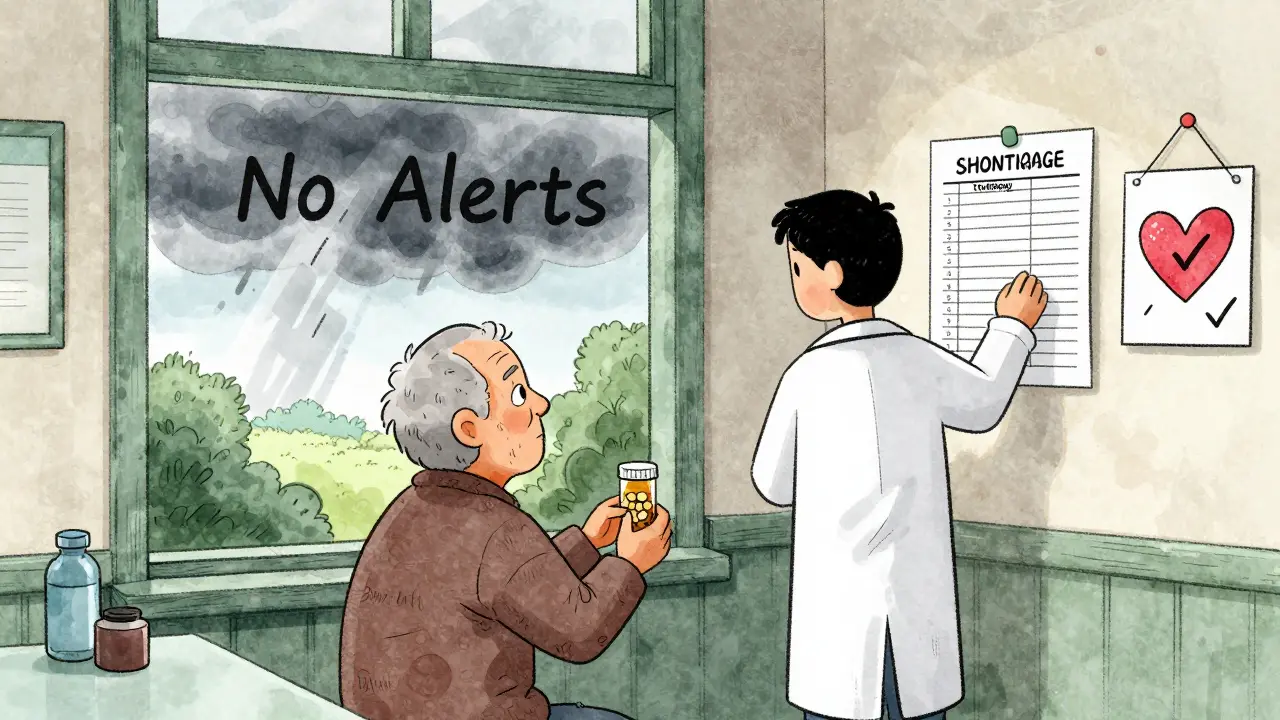
At Mayo Clinic, they use SHIP-Shortage Handling and Information Protocol. Every provider gets a one-page cheat sheet with the current shortages, alternatives, and patient FAQs. They train staff for 4.2 hours per year. Result? 87% of patients say they felt well-informed during shortages. Kaiser Permanente built shortage alerts into their electronic health record. When a provider opens a patient’s chart, a pop-up says: "Lisinopril 20mg is currently in shortage. Alternative: Telmisartan 40mg. Patient education sheet attached." No extra time needed. The system does the work. Memorial Sloan Kettering assigns trained communication specialists to handle all cancer drug shortages. These aren’t pharmacists-they’re experts in emotional support. They spend 37% more time on empathetic statements than regular providers. Patients report feeling less anxious, even when the news is bad.What Fails: The Dark Side of Poor Communication
When providers don’t communicate well, patients suffer. On Reddit, one patient wrote: "My heart medication vanished. My doctor just handed me a different pill. No explanation. I took it for a week, then had chest pain. I thought it was me." That’s not rare. A 2021 study found 72% of patients described providers as "just handing me a different pill without explaining why." On Healthgrades, reviews mentioning drug shortages average just 2.1 stars-far below the site’s 3.8 overall average. Common complaints? "No warning before my refill was denied." "The pharmacist looked as confused as I was." And here’s the worst part: 63% of patients don’t ask questions during these conversations. They’re afraid of sounding stupid. Or they assume the provider knows best. So they stay silent. And that silence can kill.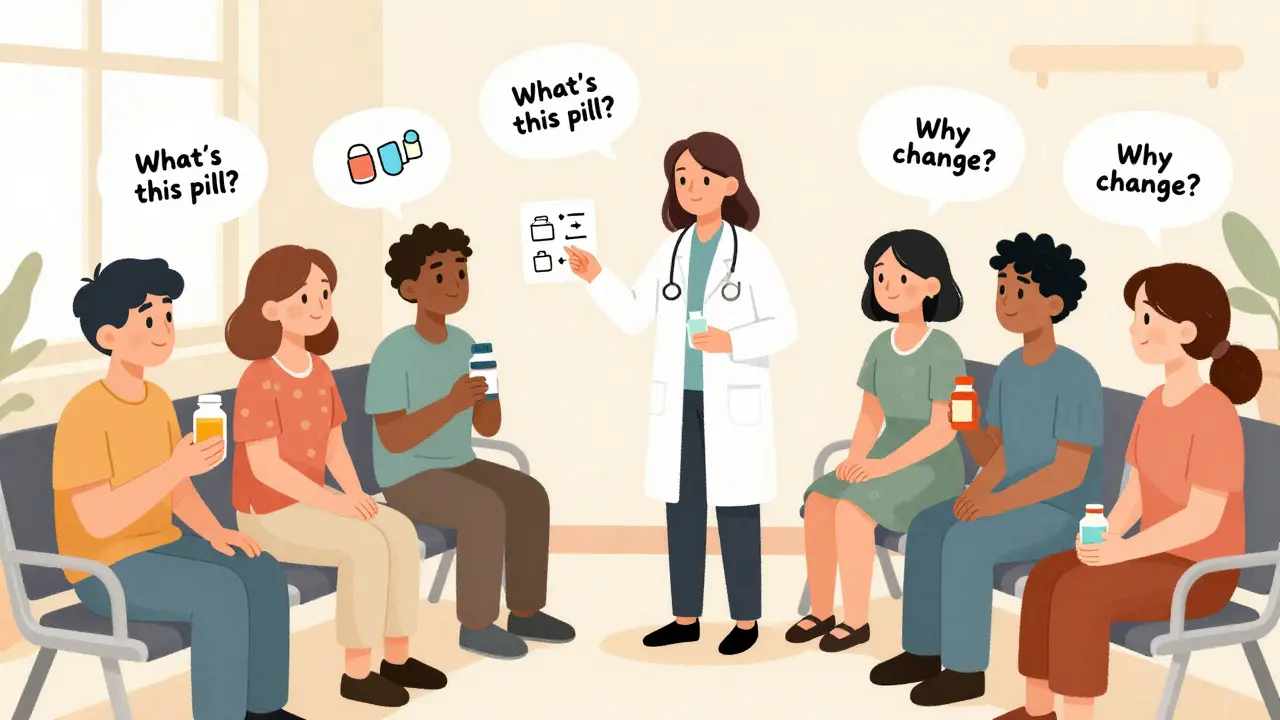
Special Challenges: Rural, Low-Income, Non-English Speakers
Not all patients have the same access to information. In rural areas, 68% of providers say they don’t have real-time shortage updates. No alerts. No system. No support. That means patients in small towns are the last to know-and the most at risk. For non-English speakers, misunderstanding rates are 3.2 times higher. A Spanish-speaking patient might hear "you’ll take a different pill" and assume it’s the same medicine with a new label. Without translated materials, they’re flying blind. And 47% of U.S. adults have limited health literacy. They struggle with medical terms. They forget instructions. They don’t ask for help. Providers must adapt-not just speak slower, but use pictures, gestures, and plain language every single time.What You Can Do Today
You don’t need a $12,500 system to start. Here’s how to begin:- Keep a printed list of current shortages and alternatives in your exam rooms. Update it weekly.
- Use the CDC’s teach-back method in every shortage conversation: "Can you tell me how you’ll take this new medicine?"
- Send a simple email or text after the visit: "Your lisinopril is in shortage. You’ll now take telmisartan 40mg once daily. Here’s why: [one sentence]. Call us if you have questions."
- Ask your EHR vendor: "Do you have a shortage notification module?" If not, demand one.
The Bottom Line
Drug shortages aren’t going away. In fact, they’re getting worse. But how providers handle them is within our control. Clear communication isn’t optional. It’s care. It’s safety. It’s trust. Patients don’t need perfect solutions. They need honest ones. They need to know why their medicine changed. They need to feel heard. And they need to know someone is still looking out for them-even when the system fails.What should I say to a patient when their medication is in shortage?
Start with the facts: "Your medication, [brand/generic name], is currently in shortage. This means we don’t have enough to fill all prescriptions right now. We’re switching you to [alternative name], which works the same way for your condition. Studies show it’s just as effective. I’ve attached a simple chart comparing the two. You’ll take [dosage] once daily. If you feel any side effects, call us immediately. We expect this shortage to last about [timeframe]. We’ll let you know if anything changes."
Is it okay to just give a patient a different pill without explaining?
No. Giving a patient a new medication without explanation is not just poor communication-it’s dangerous. A 2021 study found that 72% of patients who received unexplained switches reported confusion, anxiety, or stopped taking their medicine altogether. Patients need to understand why the change happened and why the alternative is safe. Without that, they lose trust in you-and in the system.
How do I communicate with patients who have low health literacy?
Use plain language, visuals, and teach-back. Avoid medical terms like "hypertension" or "antihypertensive." Say "high blood pressure" and "medication to lower it." Show pictures of pills. Ask them to explain back what they’ll do. The CDC recommends writing all materials at a 6th- to 8th-grade reading level. Use large font. Highlight key points. And never assume they understand because they nodded.
Do I need to document the conversation about a drug shortage?
Yes. In 92% of malpractice cases tied to drug shortages, providers were found to have inadequate documentation. Record what was said, what alternative was chosen, how the patient responded, and whether they understood. Use phrases like: "Patient verbalized understanding of alternative medication and dosing schedule. Asked no further questions."
What if I don’t know when the medicine will be back?
Be honest. Say: "I don’t have an exact date yet, but we’re tracking updates from the manufacturer and the FDA. We’ll call you if anything changes. In the meantime, the alternative we’ve chosen is safe and approved for your condition. I’ll check in with you in two weeks to see how you’re doing." Patients appreciate honesty more than false promises.
Are there tools or templates I can use?
Yes. The FDA’s Drug Shortage Communication Collaborative now provides standardized patient materials for participating manufacturers. Many hospitals, like Mayo Clinic and Kaiser, share their internal templates online. You can also use the CDC’s Health Literacy Toolkit to create simple, clear handouts. Start with one: a one-page sheet with the old drug, the new drug, why it’s safe, and a phone number.
14 Responses
Let’s be real - most providers don’t even know their own pharmacy’s inventory. I’ve seen docs hand out alternatives like they’re trading baseball cards. No context, no warnings, just ‘here’s a new pill, go nuts.’ And then they wonder why patients show up in the ER with panic attacks. This isn’t rocket science. It’s basic human decency.
Also, 298 drugs in shortage? That’s not a supply chain issue - that’s systemic failure. We’re outsourcing production to countries that don’t care about our patients. Fix the supply, not just the script.
And stop telling people to ‘ask their pharmacist.’ Pharmacists are drowning in 80-patient queues. They’re not your therapist. They’re not your counselor. They’re the last line of a broken system.
Yo, this is the kind of post that makes me believe in healthcare again 😊
Clear ID + Transparent scope + Real alternatives + Contact info = THE GOLDEN QUAD.
Love the Mayo/Kaiser examples. Why can’t every hospital just copy-paste this? It’s not magic. It’s *basic*. Like brushing your teeth. But somehow… we forgot.
Also, ‘tell me how you’ll take this’? YES. Teach-back > textbook. I’m telling my aunt this tomorrow. She’s on lisinopril. 🙌
Man, I wish my doc back in ’22 had read this. I got switched from my heart med to some generic I’d never heard of. No explanation. Just ‘it’s cheaper.’
I started Googling. Found out it was a totally different class of drug. Took me 3 weeks to get back in touch with someone. I almost quit taking it.
Just saying - this isn’t just policy. It’s survival. And yeah, the CDC’s chunk-check-change? That’s gold. I use it with my kids when they’re sick. Works every time.
Also - printed lists in exam rooms? Duh. Why don’t we do this already? It’s like not having a menu at a restaurant.
You all are missing the real issue. This isn’t about communication - it’s about control. The pharmaceutical-industrial complex *wants* shortages. Why? Because it creates dependency on their ‘alternatives’ - which are often just rebranded generics with 400% markups.
Look at the stats. 37% increase since 2019? Coincidence? No. It’s a business model. You think the FDA is acting? They’re asleep at the wheel.
And don’t get me started on ‘patient education sheets.’ Who writes those? Marketing departments. They’re designed to make you feel safe while they profit.
True change? Break the monopoly. Nationalize production. End patent abuse. Otherwise, you’re just rearranging deck chairs on the Titanic.
So… we’re blaming doctors for a problem caused by Congress, Chinese factories, and Wall Street?
Also, ‘empathy’ is now a compliance metric? 😅
Meanwhile, I’m over here wondering why my 70-year-old neighbor is still taking a 2009 version of metformin because ‘it’s the only one available.’
TL;DR: This is a policy problem wearing a stethoscope.
But hey - at least we’re talking about it. 🤷♂️
Wait - so now we’re telling doctors they have to be therapists AND supply chain analysts? How about we just fix the damn system instead of putting all the emotional labor on the front-line staff?
Also, ‘accrue accreditation risk’? That’s a fancy way of saying ‘you’ll get fined.’
Meanwhile, the same hospitals that get fined for bad communication are the ones cutting nursing staff by 20%. You can’t fix communication with a checklist when your staff is working 12-hour shifts with no breaks.
Just saying. 😏
This is all a distraction.
The real reason drugs are in shortage? The government is secretly replacing real medicine with placebos to reduce healthcare spending. You think that’s crazy? Then why are all the ‘alternatives’ made by the same 3 companies? Why do they always ‘run out’ right after a new drug is approved?
I’ve got friends on chemo. They’re getting pills with no active ingredient. The labels say ‘FDA-approved.’
They’re not testing on rats. They’re testing on US citizens.
And no one’s talking about it. Because they’re scared.
Wake up.
They’re coming for your insulin next.
And yes - I’ve seen the documents. I can’t share them. Yet.
Okay, but have you considered that ‘clear communication’ is just another way to gaslight patients into accepting inferior care?
‘Here’s a different pill - it works the same!’
Does it? How do you know? Who tested it on people who actually have your condition? Not the FDA. Not the pharmaceutical reps. Not the hospital admin.
And ‘contact info’? What if your phone line is automated? What if your email goes to a bot? What if your ‘dedicated line’ is just a voicemail that never gets checked?
This isn’t patient care. It’s PR.
Also - 87% of patients feel ‘well-informed’? That’s because they’re too tired to argue. Not because they understand.
Stop pretending empathy fixes structural collapse.
Thank you for this comprehensive and evidence-based overview. The alignment with Joint Commission standards, FDA mandates, and CDC health literacy guidelines is both timely and necessary.
As a clinician with over 18 years in primary care, I can attest that structured communication protocols - particularly the teach-back method and EHR-integrated alerts - have demonstrably reduced adverse events related to medication changes.
That said, implementation requires institutional investment, not just individual goodwill. Training, documentation templates, and staff time must be allocated as non-negotiable components of patient safety infrastructure.
Recommendation: Embed this framework into residency curricula. It is, quite literally, life-preserving.
WHY IS NO ONE TALKING ABOUT THE FACT THAT THE FDA ISN’T DOING THEIR JOB?!
They’re supposed to oversee drug manufacturing - and they’re letting factories in India and China shut down without consequences?!
And don’t even get me started on the ‘alternatives’ - half of them are generics with 30% less bioavailability! But hey, let’s just tell patients ‘it works the same’ - like that’s a medical fact and not a marketing slogan!
And now they want us to ‘document understanding’? What if the patient is too scared to say they don’t understand? What if they nod because they think you’ll yell at them?
This isn’t a communication problem - it’s a criminal negligence problem.
Who’s getting fined? Who’s going to jail? NO ONE.
And you wonder why people don’t trust the system?
Okay, I’ve been thinking about this a lot. Not just as a nurse, but as someone who’s watched my mom go through three different drug switches in two years.
It’s not just about what we say - it’s about how we say it. Tone matters. Eye contact matters. The pause before you say ‘I know this is scary’ matters.
At my clinic, we started doing ‘shortage check-ins’ - 72 hours after a switch, we call. Not to sell them on the new med. Just to ask: ‘How’s it going?’
Turns out, 4 out of 5 patients had side effects they never told anyone about. One guy thought his dizziness was ‘just aging.’ Another thought the new pill was making her hallucinate - turns out, it was a bad batch.
Simple call. 5 minutes. Changed everything.
Also - we stopped using ‘pharmacist’ as a fallback. We gave out our direct line. And yes - we got flooded with calls. But we also saved two people from ER visits.
It’s not about protocols. It’s about showing up.
And if your system doesn’t let you do that? Then your system is broken.
Let’s analyze the meta-structure of this discourse. The entire framework is predicated on a neoliberal healthcare paradigm that individualizes systemic failure. The ‘Four Essentials’ model is a performative compliance artifact designed to absolve institutions of structural responsibility while burdening frontline workers with affective labor.
The EHR pop-up? A techno-solutionist band-aid. The teach-back? A surveillance mechanism disguised as empathy.
Meanwhile, the root causes - patent monopolies, global supply chain fragility, and capital-driven manufacturing - remain untouched.
Communication is not the problem. Capital is.
And you’re all just optimizing the narrative.
When we talk about drug shortages we are really talking about the collapse of trust in institutions
Patients do not fear the lack of medicine
They fear the silence
The silence of the doctor who does not know
The silence of the pharmacist who cannot help
The silence of the system that pretends to care
Communication is not about information
It is about presence
Presence is the only medicine left
And we have forgotten how to give it
Not because we are lazy
But because we were never taught
That to hold space
Is to heal
Even when you have nothing else to give
I’ve been doing this for 20 years. And I’ll tell you what works - not the checklist, not the EHR pop-up, not even the CDC handouts.
What works? When I sit down. When I look them in the eye. When I say, ‘I know this sucks. I’m sorry. I don’t have a perfect answer, but I’m going to find you one.’
Then I give them my personal number. Not the clinic line. My cell.
And I mean it.
I’ve had patients text me at 2 a.m. because they were scared. I’ve answered. Sometimes I just said, ‘I’m here.’
That’s the real ‘four essentials’:
Presence.
Permission.
Patience.
Promise.
Everything else? Just noise.
And if your system doesn’t let you do this? Then you’re not a provider.
You’re a clerk.