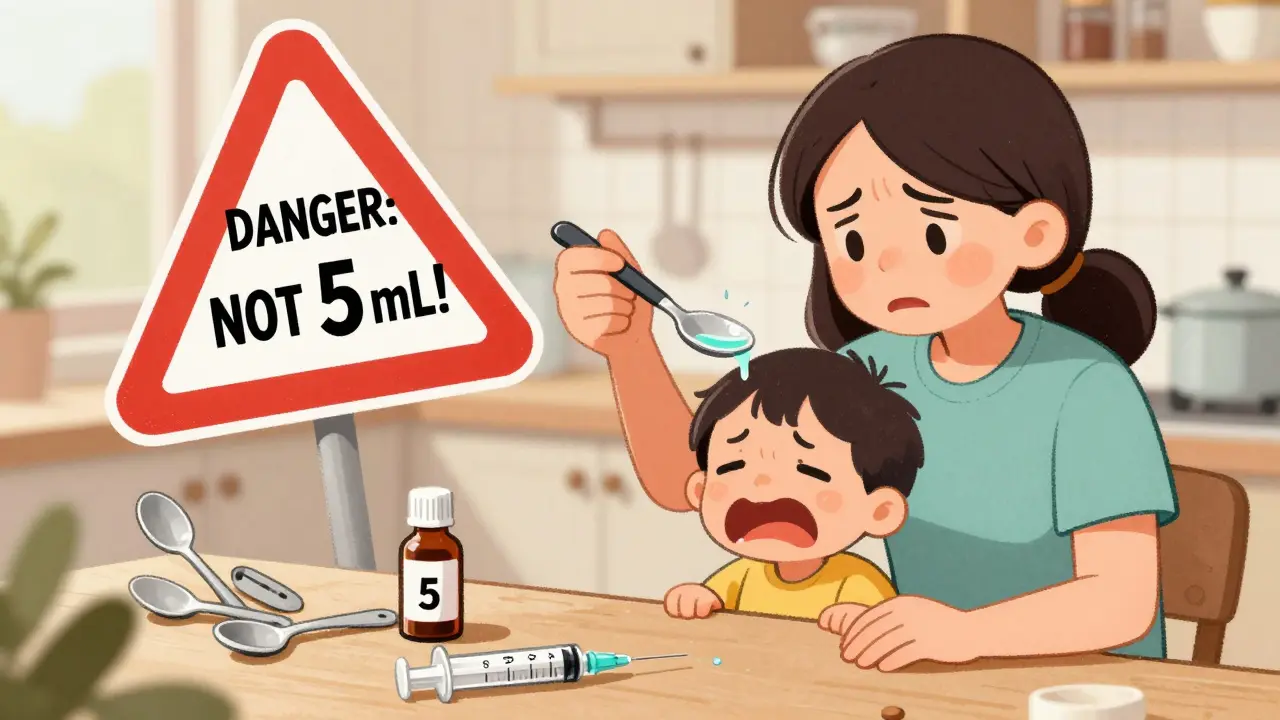
Every year, more than 10,000 calls are made to poison control centers in the U.S. because a child was given the wrong amount of liquid medicine. Not because the prescription was wrong. Not because the doctor made a mistake. But because a parent used a kitchen spoon.
It sounds simple. You’ve got a bottle of cough syrup. You’ve got a teaspoon. You scoop. You pour. You think you’re doing the right thing. But here’s the hard truth: a kitchen spoon is not a medical tool. And using it to give medicine to a child can be dangerous - even deadly.
Why Household Spoons Are a Risk
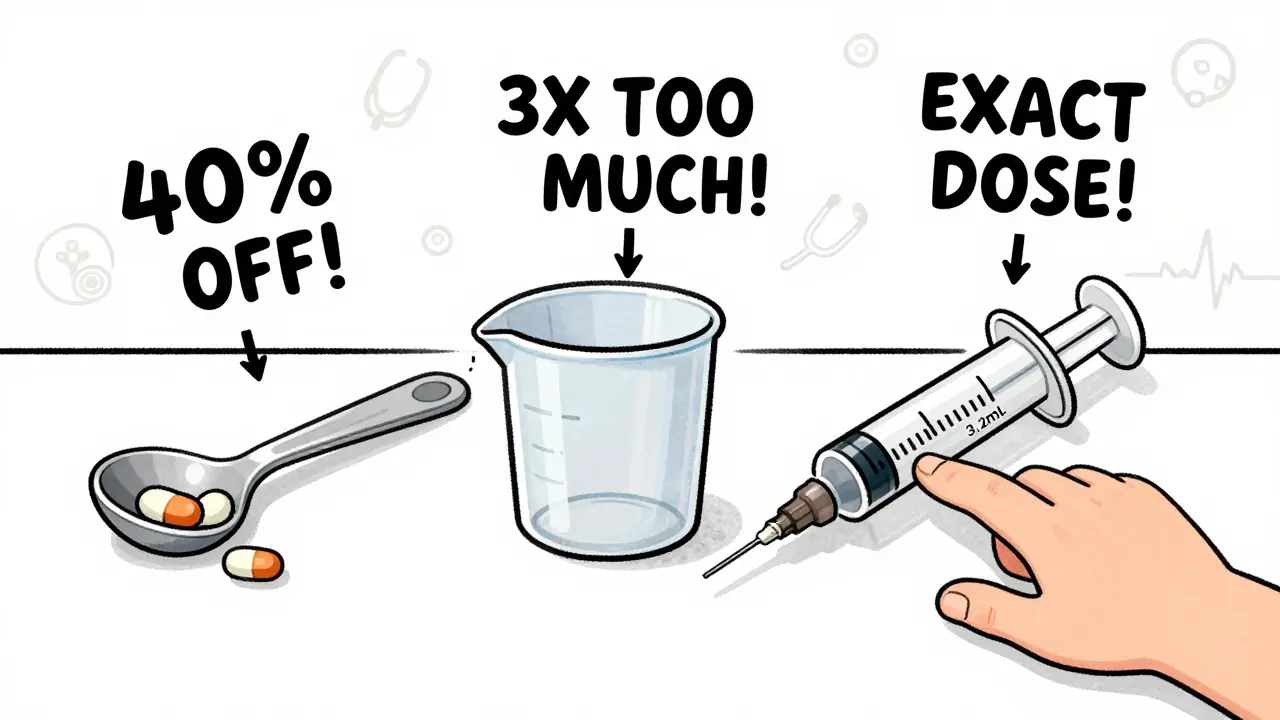
A teaspoon on your kitchen counter doesn’t hold 5 milliliters (mL). It might hold 3 mL. Or 7 mL. Or even 9 mL. That’s a 40% difference. And when you’re giving medicine to a 2-year-old, that kind of variation isn’t just inconvenient - it’s life-threatening.
Research from the National Institutes of Health found that nearly 40% of parents who used household spoons gave the wrong dose. Over 41% of those parents didn’t even realize they’d made a mistake. That’s not a small error. That’s a child getting too much medicine - which can cause drowsiness, breathing trouble, or seizures - or too little, which lets an infection keep spreading.
And it’s not just teaspoons. A tablespoon is three times bigger than a teaspoon. If you grab the wrong one - thinking you’re giving a teaspoon but using a tablespoon - you’re giving three times the dose. That’s not a typo. That’s an emergency.
The Science Behind the Warning
The American Academy of Pediatrics (AAP) first warned against using kitchen spoons back in 1978. Over 45 years later, we’re still hearing the same advice - because the problem hasn’t gone away.
Studies show that when medicine labels say “teaspoon” or “tsp,” about one-third of parents reach for a kitchen spoon. But when the label says “5 mL,” fewer than 10% do. The words matter. “Teaspoon” sounds familiar. “Milliliter” sounds clinical. But “milliliter” is precise. It’s consistent. It’s safe.
And it’s not just about the label. The tools matter too. Oral syringes - the kind with clear markings for 0.1 mL, 0.5 mL, 1 mL, up to 10 mL - are the most accurate. They let you measure exactly what the doctor ordered, even if it’s 2.3 mL or 4.7 mL. Dosing cups? They’re better than spoons, but only if they’re marked in milliliters and you read them at eye level. Droppers? They work, but they’re easy to squeeze too hard. Spoons? They’re a gamble.
What You Should Use Instead
If your child’s medicine comes with a measuring device - use it. Always. Even if it’s ugly. Even if it’s hard to clean. Even if you think you know how much a teaspoon holds. That device was made for this purpose.
- Oral syringes are the gold standard. They’re accurate down to 0.1 mL. Perfect for small doses. Easy to use. Just insert the tip into the side of your child’s mouth, between the cheek and gums, and gently push the plunger. No choking. No gagging.
- Dosing cups are okay if they’re marked in mL and you’re measuring doses of 5 mL or more. But don’t use them for doses like 1.5 mL. You can’t eyeball that. And never use a cup that only has “teaspoon” markings.
- Never use kitchen spoons, shot glasses, coffee spoons, or any other household item - no matter how “close” it looks.
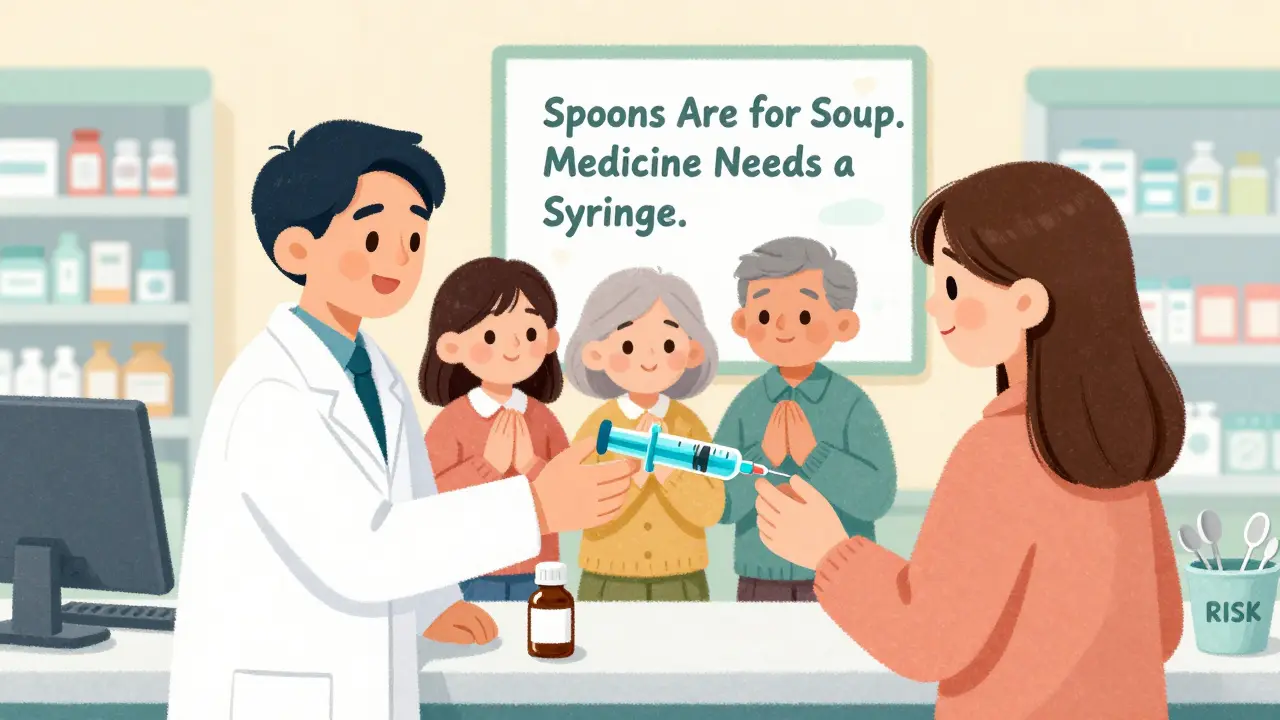
Pharmacies are starting to catch on. Many now hand out oral syringes with every liquid prescription for kids. If yours didn’t? Ask. Say: “Can I get a proper measuring syringe for this?” They’ll give you one. It’s free. It’s safe. It’s the right thing to do.
How to Measure Correctly
Accuracy isn’t just about the tool. It’s about how you use it.
- Read the label - always in milliliters (mL). Ignore anything that says “tsp” or “tablespoon.”
- Use the right tool - syringe if possible. If using a cup, make sure it’s designed for medicine and has mL markings.
- Measure at eye level - hold the syringe or cup up to your eyes. Don’t look down. Don’t tilt. Look straight at the line.
- Don’t guess - if the dose is 3.2 mL and your syringe only goes to 3 mL or 4 mL, ask your pharmacist for a finer tool. There’s no such thing as “close enough.”
- Administer safely - squirt the medicine slowly between the cheek and tongue. Don’t aim for the back of the throat. That can cause choking or vomiting.
Why This Matters More for Kids
Children aren’t small adults. Their bodies process medicine differently. A dose that’s safe for a 150-pound teen might be toxic for a 25-pound toddler. Even a 10% overdose can cause serious side effects - especially with painkillers, antibiotics, or fever reducers.
One parent in a CDC study gave her 18-month-old child 10 mL of acetaminophen instead of 5 mL - because she used a tablespoon thinking it was a teaspoon. The child ended up in the hospital with liver damage. She didn’t mean to. She thought she was following instructions. That’s the tragedy.
And it’s not rare. The CDC estimates that 75% of American households still keep a kitchen spoon handy for medicine. That’s three out of four families. That’s millions of kids at risk.
What’s Changing - and What You Can Do
More drug manufacturers are switching to milliliter-only labeling. The FDA and AAP are pushing for this to become standard. Some states are even considering laws requiring pharmacies to include a measuring device with every pediatric liquid prescription.
But change won’t happen overnight. Until then, the responsibility falls on you.
Here’s what you can do today:
- Throw out the medicine spoons from your kitchen drawer.
- Ask your pharmacist for an oral syringe - even if you don’t think you need one.
- Write “mL” on the bottle with a marker if the label says “tsp.”
- Keep the syringe clean and in the same place - taped to the fridge, in a drawer with baby supplies, next to the thermometer.
- Teach everyone who gives medicine to your child - grandparents, babysitters, daycare staff - the same rule: Spoons are for soup. Medicine needs a syringe.
Final Thought: It’s Not About Being Perfect - It’s About Being Safe
You don’t need to be a scientist. You don’t need to memorize dosing charts. You just need to use the right tool. One that measures in milliliters. One that’s designed for medicine. One that doesn’t leave room for guesswork.
That’s not being overly cautious. That’s being a responsible parent. Because when it comes to your child’s medicine, there’s no such thing as “close enough.”
Can I use a kitchen teaspoon if I don’t have a syringe?
No. A kitchen teaspoon holds anywhere from 3 to 7 milliliters - not the standard 5 mL. Even if you think you’re measuring right, you’re taking a risk. Ask your pharmacist for a free oral syringe. They’re required to provide one if you’re giving medicine to a child.
Why do some medicine labels still say “teaspoon”?
Some older labels haven’t been updated yet. But the FDA and AAP now strongly recommend using only milliliters (mL). If your label says “tsp,” call your pharmacist. They can confirm the correct dose in mL and give you a proper measuring device. Never rely on the word “teaspoon” alone.
What if my child spits out the medicine?
Don’t give another full dose. Call your doctor or pharmacist. They’ll tell you whether to give a partial dose or wait until the next scheduled time. Giving extra medicine because your child spit it out can lead to overdose. Always check before repeating a dose.
Are dosing cups better than syringes?
Only for doses of 5 mL or more - and only if they’re marked in milliliters. For smaller doses (like 1.5 mL or 3.2 mL), syringes are far more accurate. Dosing cups can’t measure precisely below 5 mL. Syringes can. Always choose the syringe when in doubt.
Can I reuse an oral syringe?
Yes - but only if you clean it properly. Rinse it with warm water after each use. Let it air dry. Don’t use soap unless the manufacturer says it’s safe - some syringes can degrade. Store it in a clean, dry place. If it’s cracked, broken, or hard to push, throw it out and get a new one.
Is it okay to mix medicine with juice or food?
Only if your pharmacist or doctor says it’s safe. Some medicines lose effectiveness when mixed. Others taste awful but must be given as-is. Never mix medicine without checking first. And never use a kitchen spoon to mix it - use a clean syringe or dosing cup to measure the medicine, then mix it in a small amount of food or liquid.
What should I do if I think I gave the wrong dose?
Call your local poison control center immediately. In the U.S., that’s 1-800-222-1222. Don’t wait for symptoms. Don’t try to “see what happens.” Even if your child seems fine, a small overdose can cause damage hours later. Have the medicine bottle ready when you call - they’ll need the exact name and dose.
12 Responses
So let me get this straight-we’re still having this conversation in 2025? 🤦♀️ I used a kitchen spoon for my kid’s amoxicillin until the pharmacist looked at me like I’d just tried to feed them gasoline. Now I keep three syringes taped to the fridge. One for each kid. One for emergencies. One for when I’m sleep-deprived and still somehow manage to mess it up. Spoiler: I didn’t. Because I stopped being lazy. And yes, the syringe looks like a tiny medical device from a sci-fi movie. But it doesn’t kill kids. Spoons do.
This is such an important reminder, especially in places where medicine packaging isn’t always clear. I’ve seen grandparents in my village use spoons because they don’t trust the ‘strange numbers’ on the bottle. But once we showed them the syringe and how easy it is-no measuring, no guessing-they loved it. Maybe we need more community health workers to demo this. Not everyone has access to pharmacies. But everyone can learn to use a syringe. Small change, huge impact.
Let us not obscure the epistemological crisis inherent in this phenomenon: the conflation of culinary utensils with pharmacological instruments represents a fundamental collapse of semiotic precision in domestic life. The teaspoon-as a cultural artifact-has been anthropomorphized into a proxy for scientific measurement, despite its inherent vagueness. This is not negligence; it is a metaphysical failure of the modern parent to recognize that language, when unmoored from metric rigor, becomes a vector of harm. Milliliters are not merely units-they are ontological anchors. And yet, we persist in spooning uncertainty into our children’s mouths. The tragedy is not statistical. It is existential.
OMG YES. I did this. I totally used a spoon. My son was sick and I was tired and I thought ‘it’s just a little more’-turns out it was WAY more. He got super drowsy and I panicked. We went to urgent care. They gave me a syringe and said ‘you’re lucky he’s okay.’ Now I keep one in my purse, my diaper bag, and my glove compartment. I even made a little sticker that says ‘NO SPOONS’ and stuck it on my kitchen drawer. My husband still forgets. But I’m not letting it happen again. 😅
This is an excellent and thoroughly researched piece. The data presented is both alarming and actionable. The recommendation to use oral syringes is not merely prudent-it is medically indefensible to ignore. I have shared this with my colleagues in pediatric nursing, and we are now standardizing the distribution of syringes with all liquid prescriptions for children under six. The cost of prevention is negligible compared to the cost of an ER visit. Thank you for the clarity.
My mom used a spoon for everything. I used a spoon. Now I use a syringe. My kids use syringes. It’s not hard. It’s not fancy. It’s just… safer. I used to think I was being careful by ‘eyeballing it.’ Turns out, my eyeballs are terrible at math. Now I just trust the line on the syringe. And I feel way less guilty. Seriously-go get one. It’s free. Your kid deserves that.
Oh please. You people are overreacting. I’ve given my three kids medicine with spoons for 15 years. No one died. No one even got sick. You think your syringe is magic? It’s just plastic. You’re not a scientist. You’re just scared. And now you’re shaming everyone who doesn’t buy into your medical cult. Chill. Kids are tougher than you think. Also, your syringe probably has bacteria on it from being washed in the sink. 🤷♀️
Wait… so you’re saying I shouldn’t use my coffee spoon? 😳 I thought that’s what it was for! I mean, it’s the same size as the teaspoon on my spoon set… right? 🤔 Also, why do I need a syringe if the bottle says ‘1 tsp’? Isn’t that the same? 🙃 I’m confused now…
i never knew this. i used a spoon every time. my daughter had a fever last week and i gave her the medicine with a regular spoon. i thought it was fine because i filled it to the top. now im so scared. i just went to the pharmacy and got a syringe. they gave it to me for free. i feel stupid but also so much better. thank you for posting this. i’ll tell everyone i know.
As a global health educator, I’ve seen this exact issue in rural clinics across three continents. The problem isn’t ignorance-it’s access. In Nigeria, India, even parts of rural America, families don’t have syringes. They have spoons. And they trust what’s familiar. The solution isn’t just education-it’s distribution. Pharmacies must provide syringes as standard. Not as an ‘ask.’ Not as a ‘bonus.’ As part of the prescription. Period. This isn’t a parenting tip. It’s a public health imperative.
Y’all ain’t ready for this… I gave my lil’ one a spoonful of cough syrup… and then I DIDN’T KNOW WHAT TO DO… I was like ‘ohhhhh noooooo’… I called my mama… she screamed… I called the doctor… he said ‘you got lucky’… I cried for an hour… now I got THREE syringes… one for each room… one for the car… one for my bag… I even named them. This ain’t drama… this is LIFE.
I just realized… I still have that old medicine spoon in my drawer… I thought it was ‘for emergencies’… but I never used it… I used spoons… and I thought I was being careful… now I’m going to throw it out… and I’m going to ask for a syringe tomorrow… I feel so stupid… but also… grateful? Thank you for this. I didn’t know I was putting my kid at risk.