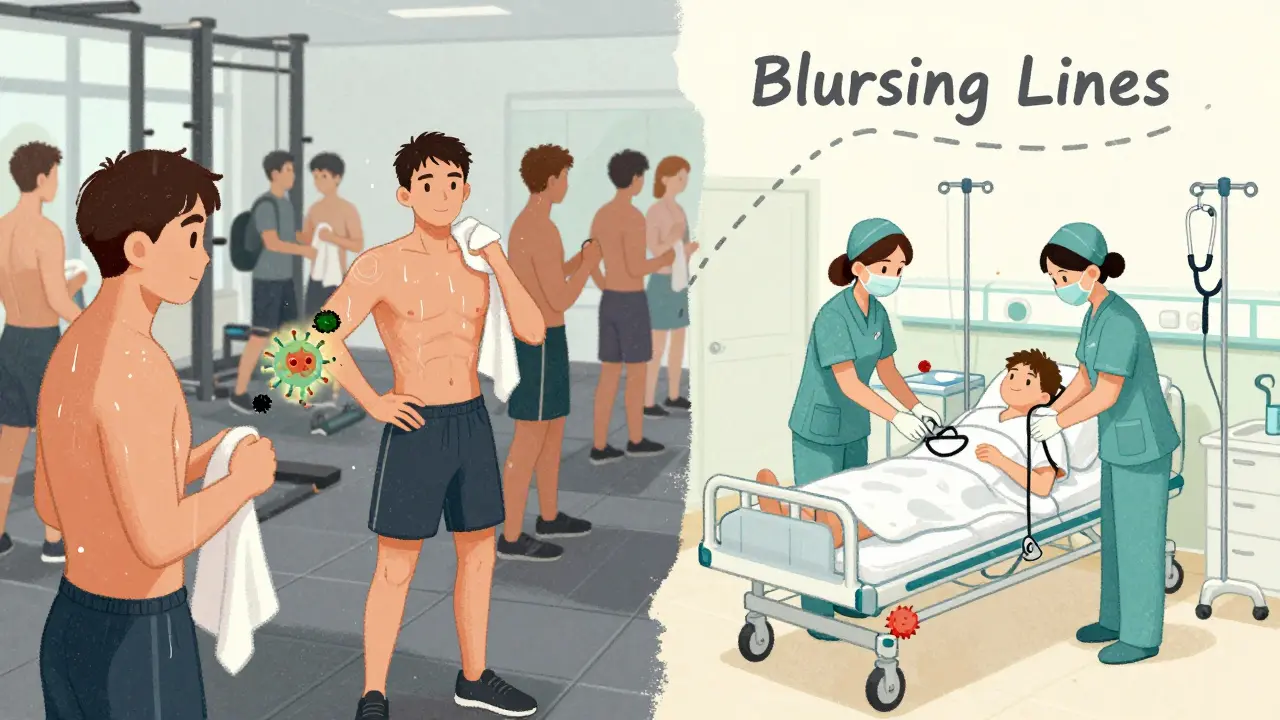
MRSA isn’t just a hospital problem anymore. You might think it’s something that only happens to people in hospitals or nursing homes, but that’s not true anymore. In fact, more and more healthy people without any recent medical care are getting MRSA infections - and they’re getting them in gyms, locker rooms, prisons, and even at home. At the same time, hospitals are seeing more MRSA strains that originally came from the community. The line between community MRSA and hospital MRSA is fading fast, and that’s changing how we treat, prevent, and think about this dangerous infection.
What Is MRSA, Really?
MRSA stands for Methicillin-Resistant Staphylococcus aureus. It’s a type of staph bacteria that doesn’t respond to common antibiotics like penicillin, amoxicillin, or methicillin. Staph bacteria are everywhere - on our skin, in our noses. Most of the time, they don’t cause any harm. But when they get into a cut, scrape, or wound, they can turn into something dangerous. And when they become resistant to the antibiotics we rely on, they become MRSA.
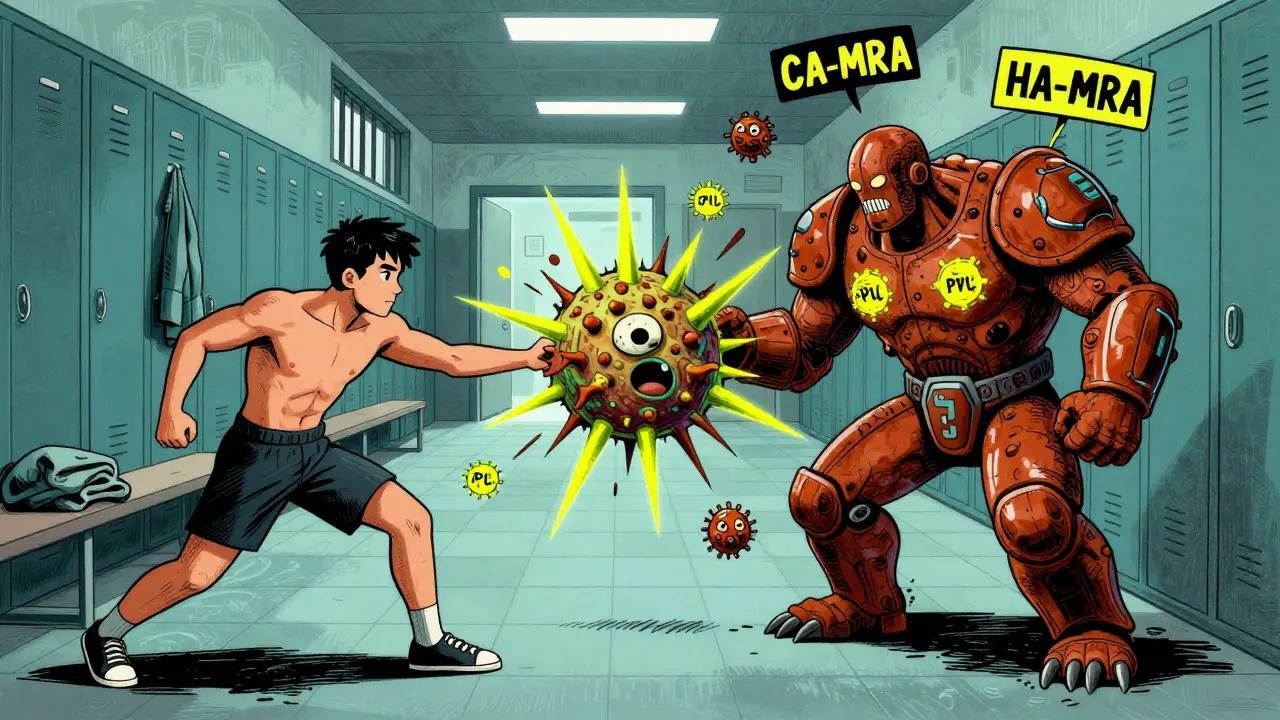
Back in the 1960s, MRSA was almost always picked up in hospitals. That’s why it was called HA-MRSA - hospital-associated MRSA. But in the late 1990s, something changed. People who had never been in a hospital, never had surgery, never used a catheter - they started getting MRSA infections. These were different. They were more aggressive. They showed up as painful boils or abscesses on the skin. And they spread fast. That’s when CA-MRSA - community-associated MRSA - became a real concern.
How Are They Different? Genetics and Behavior
At the genetic level, CA-MRSA and HA-MRSA are not the same. Think of them as two different versions of the same bug, each built for a different environment.
CA-MRSA usually carries a smaller genetic package called SCCmec IV or V. This package doesn’t give it resistance to many antibiotics - just methicillin. But it does give it something else: powerful toxins. The most dangerous one is called Panton-Valentine leukocidin (PVL). This toxin kills white blood cells, which are your body’s first line of defense. That’s why CA-MRSA often causes nasty skin infections or even life-threatening pneumonia in healthy people. The USA300 strain is the most common CA-MRSA in the U.S., and it’s responsible for about 70% of community cases.
HA-MRSA, on the other hand, carries larger SCCmec types - I, II, or III. These give it resistance to many more antibiotics: erythromycin, clindamycin, fluoroquinolones. It’s a multi-drug-resistant beast. It doesn’t usually carry PVL. Instead, it’s built to survive in hospitals where antibiotics are used constantly. It’s slower to spread but harder to kill.
And here’s the twist: these two types aren’t staying separate. Studies show that HA-MRSA strains are now showing up in the community - and CA-MRSA strains are showing up in hospitals. A Canadian study found that nearly 28% of hospital MRSA cases were caused by strains that originally came from the community. And 27.5% of community cases were caused by hospital strains. The two worlds are mixing.
How Do They Spread? Transmission in Real Life
CA-MRSA spreads through skin-to-skin contact. You don’t need to be sick to spread it. If you have MRSA in your nose or on your skin - even if you have no symptoms - you can pass it to someone else.
High-risk places? Crowded, sweaty, unclean environments:
- Prisons - 14.9 times higher risk than average
- Military barracks - 12.3 times higher
- Homeless shelters - 8.7 times higher
- Subsidized housing - 6.2 times higher
Injecting drug users are a major reservoir. Sharing needles, poor hygiene, and frequent skin punctures make it easy for USA300 to spread. In fact, MRSA infections among people who inject drugs have risen sharply in recent years.
But it’s not just drug users. Athletes, especially in contact sports like wrestling or football, are at risk. Shared towels, equipment, and locker rooms are perfect breeding grounds. Even kids in daycare can spread it. One study found that 1.3% of people living in the community - not in hospitals - carry MRSA in their nose. That’s more than one in a hundred people walking around with the bacteria and not even knowing it.
HA-MRSA spreads differently. It’s often carried by healthcare workers who touch patients, then touch surfaces, then touch another patient. Catheters, IV lines, and surgical wounds are common entry points. But now, because patients move between hospitals and homes, and because staff might carry CA-MRSA strains home, the boundaries are breaking down.
Treatment: What Works for Which Type?
Here’s where things get tricky. You can’t treat all MRSA the same way.
For CA-MRSA: Many infections - especially boils and abscesses - can be treated just by draining them. No antibiotics needed. If antibiotics are required, clindamycin works well - it’s effective in 96% of CA-MRSA cases. Trimethoprim-sulfamethoxazole (Bactrim) and tetracyclines like doxycycline are also good options. These drugs are affordable, widely available, and usually don’t require hospitalization.
For HA-MRSA: Because it’s resistant to so many drugs, doctors often have to use vancomycin, linezolid, or daptomycin. These are stronger, more expensive, and sometimes given through an IV. Hospital stays are longer - on average, 21 days for HA-MRSA patients compared to less than 3 days for CA-MRSA patients. That’s because HA-MRSA often causes deeper infections: bloodstream infections, pneumonia, or bone infections.
But here’s the problem: we’re seeing hybrid strains now. Some MRSA strains are combining the worst of both worlds - the high virulence of CA-MRSA with the multi-drug resistance of HA-MRSA. These are harder to treat. They can spread quickly and resist more drugs. In China, for example, a strain called ST59 - once a community strain - is now appearing in hospitals with HA-MRSA traits. This is the new frontier.
Why the Blurring Line Matters
The old way of thinking - separate CA-MRSA and HA-MRSA - doesn’t work anymore. The CDC used to define CA-MRSA based on whether a person had been in a hospital in the last year. But studies show that’s useless. A person might never have been hospitalized, yet carry a hospital strain. Another might have had surgery last month, but get infected with a community strain.
This matters because:
- Doctors might pick the wrong antibiotic if they assume it’s a hospital strain.
- Hospitals might not screen new patients properly if they think MRSA only comes from other hospitals.
- Public health efforts might ignore the community reservoir - and that’s where the infection is growing.
One study found that 20% of hospital MRSA infections in Canada were caused by CA-MRSA strains. That means hospitals are getting infected by people who never went to a hospital. If hospitals only focus on cleaning their own environment and ignoring what’s coming in from the community, they’re fighting a losing battle.
And it’s getting worse. Mathematical models show that CA-MRSA strains are more transmissible in everyday life. If nothing changes, they could eventually take over in hospitals. That’s not science fiction - it’s happening in real time.
What Can You Do?
There’s no magic bullet. But there are simple, proven steps:
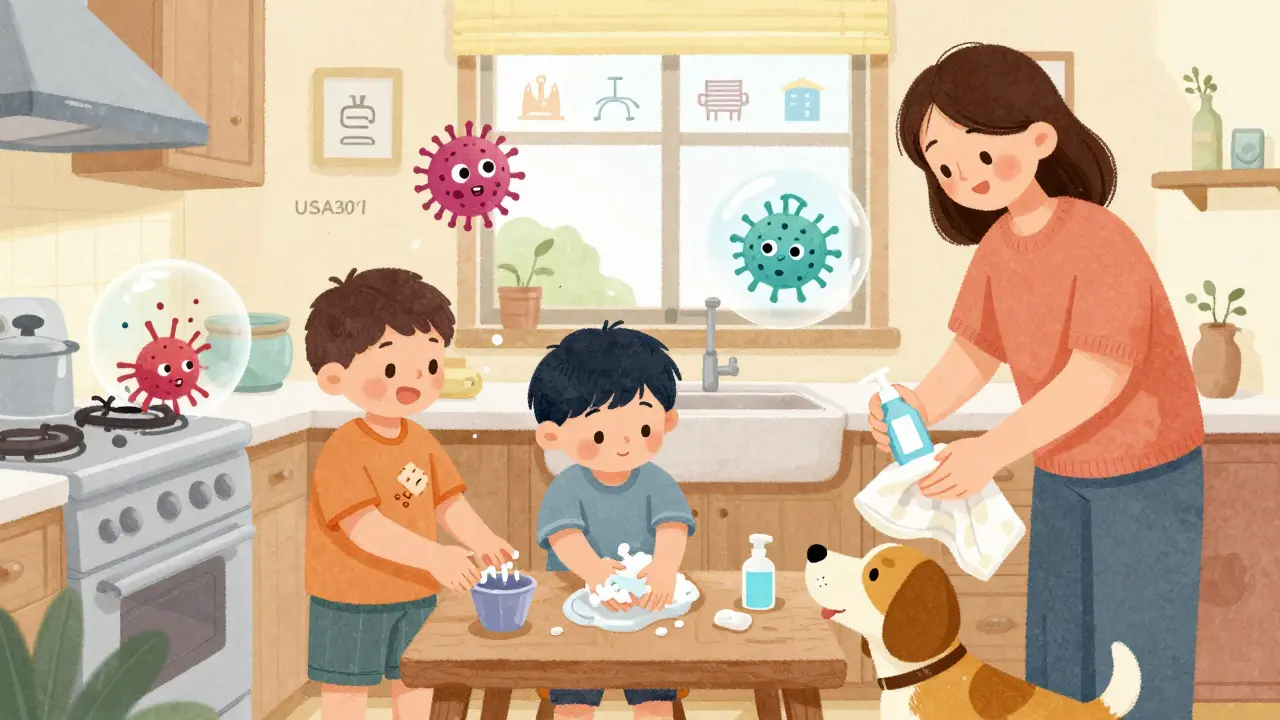
- Wash your hands often - especially after using public facilities, before touching wounds, and after sports.
- Don’t share towels, razors, or athletic equipment.
- Keep cuts and scrapes clean and covered until healed.
- If you have a boil or pus-filled bump that won’t heal, see a doctor. Don’t pop it yourself.
- Don’t pressure your doctor for antibiotics. Most skin infections don’t need them.
Hospitals need to change too. They need to screen patients not just for hospital exposure, but for risk factors like homelessness, incarceration, or drug use. They need to track which strains are circulating - not just where they came from, but what they can do. Surveillance needs to cover the whole chain: from prisons to homes to clinics to hospitals.
The Future of MRSA
MRSA is no longer just a hospital bug or a community bug. It’s both. And it’s moving between them faster than ever. The days of treating them as separate problems are over.
What we need now is a unified approach: monitor strains across all settings, treat based on the bug’s traits - not where it came from - and stop assuming that only sick or hospitalized people carry it. The real threat isn’t just the infection. It’s our outdated thinking about it.
And that’s why the next big fight against MRSA won’t be fought in hospitals alone. It’ll be fought in locker rooms, shelters, homes, and on the streets - where most of the transmission is happening now.
Can you get MRSA from a toilet seat?
It’s possible, but unlikely. MRSA spreads mostly through direct skin-to-skin contact or contact with infected wounds or drainage. While the bacteria can survive on surfaces like toilet seats, towels, or gym equipment for hours or even days, you’d need to have an open wound or broken skin touching that surface to get infected. Good hand hygiene and covering cuts makes this risk very low.
Is MRSA always dangerous?
Not always. Many people carry MRSA in their nose or on their skin without ever getting sick. This is called colonization. It only becomes dangerous when the bacteria enter the body through a cut, burn, or surgical wound. In healthy people, it often causes a simple boil. But in people with weakened immune systems, it can lead to serious infections like pneumonia, bloodstream infections, or bone infections.
Can MRSA be cured completely?
Yes, most MRSA infections can be cured with proper treatment. Skin infections often heal with drainage and antibiotics. More serious infections may require longer courses of IV antibiotics. Even people who are colonized (carrying MRSA without symptoms) can be decolonized using nasal ointments and special body washes - but this is usually only done in high-risk situations, like before surgery.
Why is CA-MRSA more common in prisons?
Prisons have perfect conditions for CA-MRSA: overcrowding, poor hygiene, frequent skin-to-skin contact, and limited access to clean showers or soap. Many inmates also have tattoos or skin injuries from fights or self-harm. These create openings for the bacteria. Plus, sharing personal items like towels or razors is common. The risk is 14.9 times higher than in the general population.
Does hand sanitizer kill MRSA?
Alcohol-based hand sanitizers (at least 60% alcohol) can kill MRSA on hands - but only if used correctly. You need to rub it in for at least 20 seconds, covering all surfaces. But if your hands are visibly dirty or greasy, soap and water work better. Hand sanitizer is great for quick cleanups, but it’s not a substitute for proper handwashing after using the bathroom or before touching wounds.
11 Responses
bro mrsa in gyms is wild. i had a boil that looked like a spider bite. thought it was a spider. turned out it was just me being a walking petri dish. no hospital, no surgery. just a dirty towel and bad luck. 🤷♂️
this is why i never share towels anymore. 🧼🚫 even if it looks clean. MRSA doesn’t care about appearances. stay clean, stay alive.
i swear every time i go to the gym now i feel like i’m playing russian roulette with my skin. they say wash your hands but no one washes the dumb weight machines. it’s a germ zoo. i’m done.
The blurring of community and hospital strains reflects a deeper epistemological failure in public health paradigms. We persist in binary classifications when reality is a continuum. The bacteria do not recognize administrative boundaries. Our frameworks must evolve.
I must emphasize, based on peer-reviewed epidemiological data and CDC surveillance protocols, that the assertion that CA-MRSA is overtaking HA-MRSA is not only misleading but potentially dangerous. The CDC's own 2022 report indicates a 12% decline in community strains in urban centers. This narrative is being amplified by non-scientific media outlets with vested interests in pharmaceutical lobbying. We must not allow fearmongering to override evidence-based policy.
Bacteria don't care about borders. Neither should we. The real issue isn't where it came from. It's that we treat it like a puzzle with missing pieces when it's just one evolving system. Clean hands. Cover wounds. Don't share stuff. Simple. But we make it complicated.
Look, I read the whole thing and I’m just gonna say this: if you’re not getting screened for MRSA before you go into a hospital, you’re being reckless. And don’t get me started on how prisons are basically petri dishes. I mean, we lock people up in overcrowded cells with no soap and then act shocked when they get sick? That’s not a health issue - that’s a crime. And hospitals? They’re not even trying. They’re still using 1990s protocols. I’ve seen it. My cousin got MRSA from a catheter in a ‘highly sanitized’ ICU. The staff didn’t wash their hands. They just used hand sanitizer. Like that’s a magic spell. No. It’s negligence. And someone needs to be held accountable.
In India, we have been managing this for decades. MRSA? We use turmeric paste, neem oil, and proper hygiene. No expensive antibiotics needed. Why are Americans so dependent on pills and IVs? We don’t need fancy hospitals to fix what’s broken. Simple living, clean air, and traditional wisdom - that’s the real solution. Your system is broken because you over-medicalize everything. 🇮🇳
this is actually really hopeful. if we start treating this like a shared problem - not just hospitals or just communities - we can actually beat it. clean hands, no sharing gear, and paying attention to the signs. small things. big impact.
I just want to say - thank you for writing this. Seriously. I’ve had two MRSA infections. Both in gyms. Both because I didn’t wipe down the equipment. I thought it was fine. I was wrong. Now I carry disinfectant wipes everywhere. And I tell everyone. You’re not just sharing info. You’re saving lives.
I work in a prison clinic. I see this every day. The inmates are the canaries in the coal mine. They get MRSA first. Then it spreads to their families. Then to hospitals. We’re not fighting MRSA in hospitals. We’re fighting it in the streets. And no one’s listening.