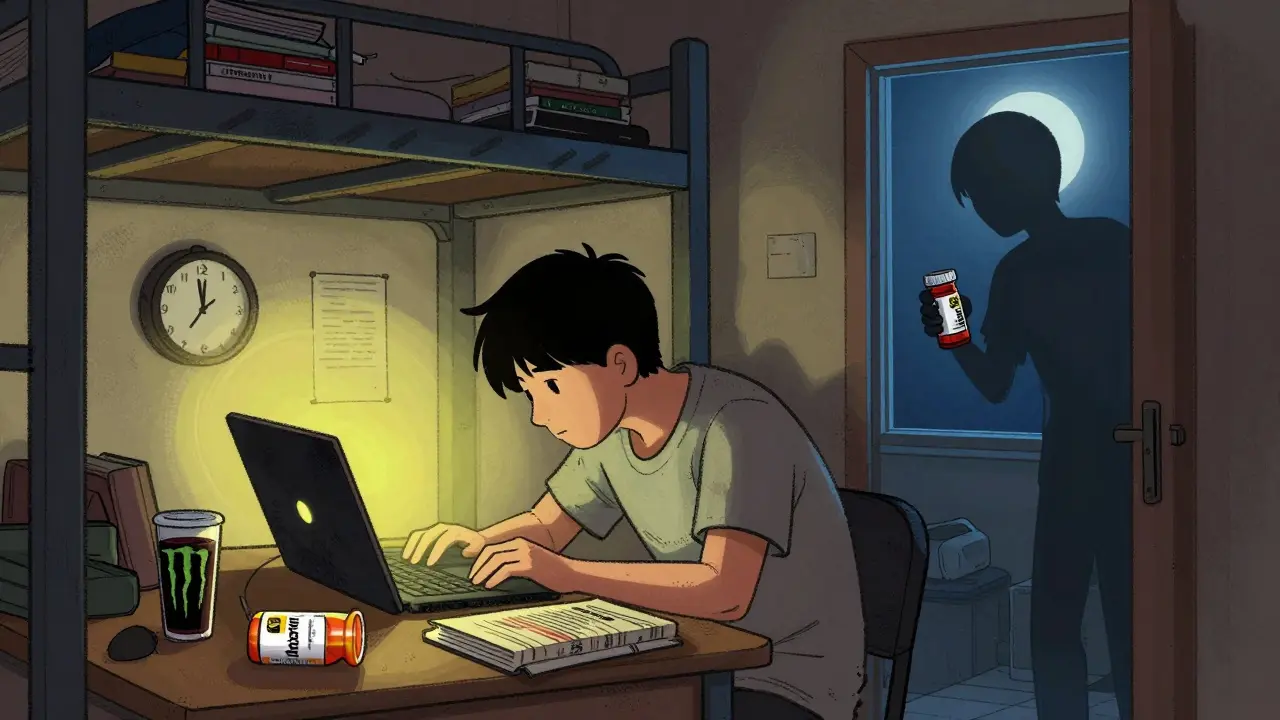
Every year, thousands of college students start the semester with a backpack full of textbooks, a new roommate, and a prescription bottle they didn’t get from their doctor. It’s not always illegal - but it’s almost always dangerous. Medication safety isn’t just about reading labels. For young adults in college, it’s about surviving a system that makes it too easy to misuse drugs - and too hard to get real help.
Think about it: you’re stressed, sleep-deprived, and surrounded by peers who say, "Just take one, it’s prescription." Adderall. OxyContin. Xanax. These aren’t party drugs. They’re powerful medications with real risks - and college students are using them at the highest rates of any age group. According to the National Survey on Drug Use and Health, more than 28% of college-aged young adults have misused a prescription drug at least once in their lifetime. That’s not a rumor. That’s data.
What Are College Students Actually Misusing?
The numbers don’t lie. Stimulants - especially Adderall - are the most common. A 2021 study of 312 college students found that 75% of all prescription drug misuse involved stimulants. Why? Because students believe they’ll help them study longer, stay awake, and crush exams. One University of Michigan student posted on Reddit: "I’ve seen Adderall passed around like candy before exams - people don’t think it’s a big deal because it’s prescription."
But here’s the truth: if you don’t have ADHD, Adderall doesn’t make you smarter. It makes your heart race, your blood pressure spike, and your sleep vanish. The CDC says stimulant-related ER visits among young adults tripled between 2005 and 2010. And that’s just the tip of the iceberg. Many cases go unreported because students don’t think it’s an emergency.
Pain relievers like Vicodin and OxyContin are still around, but their misuse has dropped since 2012. Sedatives and tranquilizers like Xanax and Valium? Still common. About 6% of college students report misusing them in the past year. These drugs slow your breathing. Mix them with alcohol - which many students do - and you’re playing Russian roulette with your lungs.
Where Are They Getting It?
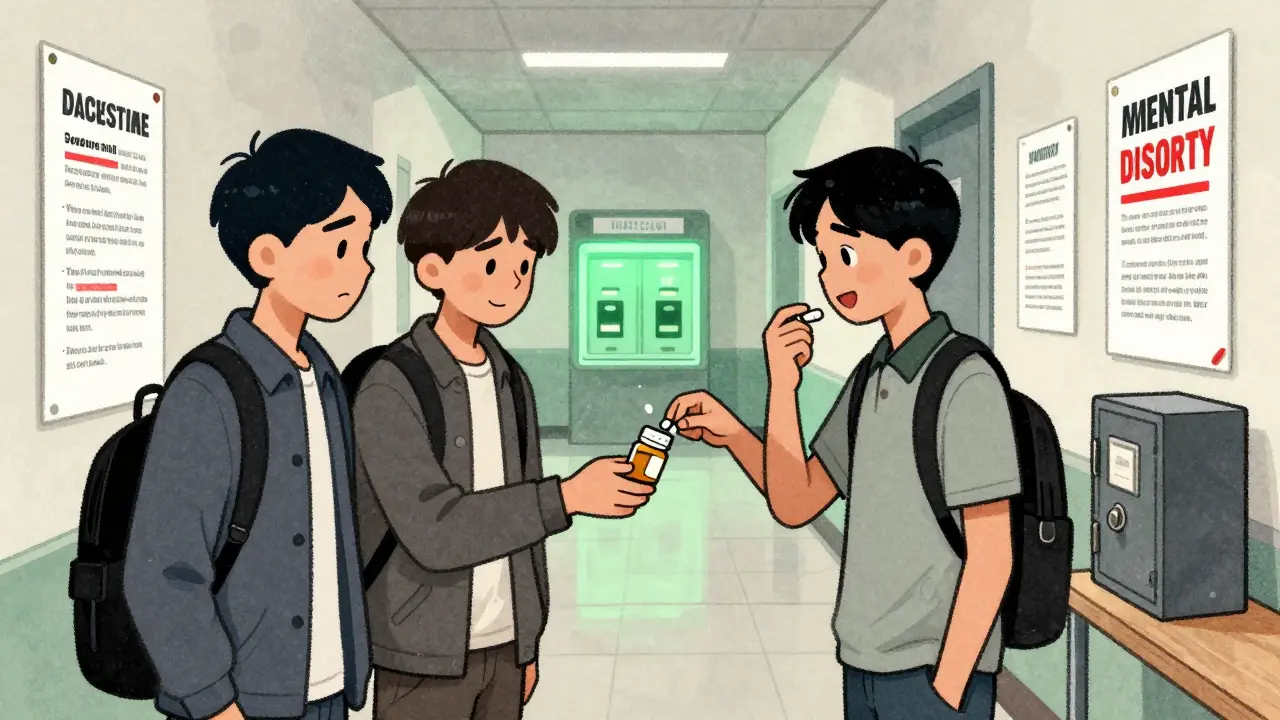
Most of these drugs don’t come from dealers. They come from friends. Roommates. Roommates who got a prescription for ADHD and decided to share. Classmates who had extra pills after switching meds. A 2021 study found that 60% of misused prescriptions were obtained from peers. That’s not black market. That’s your dorm. That’s your study group.
And here’s the kicker: nearly one in three college seniors will be offered stimulants for nonmedical use during their time in school. That’s not a statistic - that’s a social norm. And when something becomes normal, people stop asking questions.
Why Is This Happening?
It’s not just about partying. It’s about pressure. Dr. Jane Maxwell from the University of Texas put it simply: "The pressure for academic success, erratic sleep schedules, and recreational drug culture typically associated with college life" are the perfect storm.
Students are working part-time jobs, managing mental health, and trying to keep their grades up. Sleep? That’s a luxury. So they turn to what’s easy: a pill they think will fix everything. But the reality? Stimulants make anxiety worse. They cause insomnia. They mess with your mood. And when the high fades? You feel worse than before.
And it’s not just students. The system is failing them too. A 2022 study found that only 29% of students could find a proper medication disposal location on campus. That means leftover pills sit in medicine cabinets - where anyone can grab them. Or worse, they get flushed down the toilet, polluting water systems.
What’s Being Done?
Some schools are fighting back - and winning.
The University of Florida launched "Safe Meds" in 2019. They gave students free lockboxes for their meds and installed disposal kiosks across campus. Within two years, stimulant misuse dropped by 18%. Simple. Practical. No lectures. Just solutions.
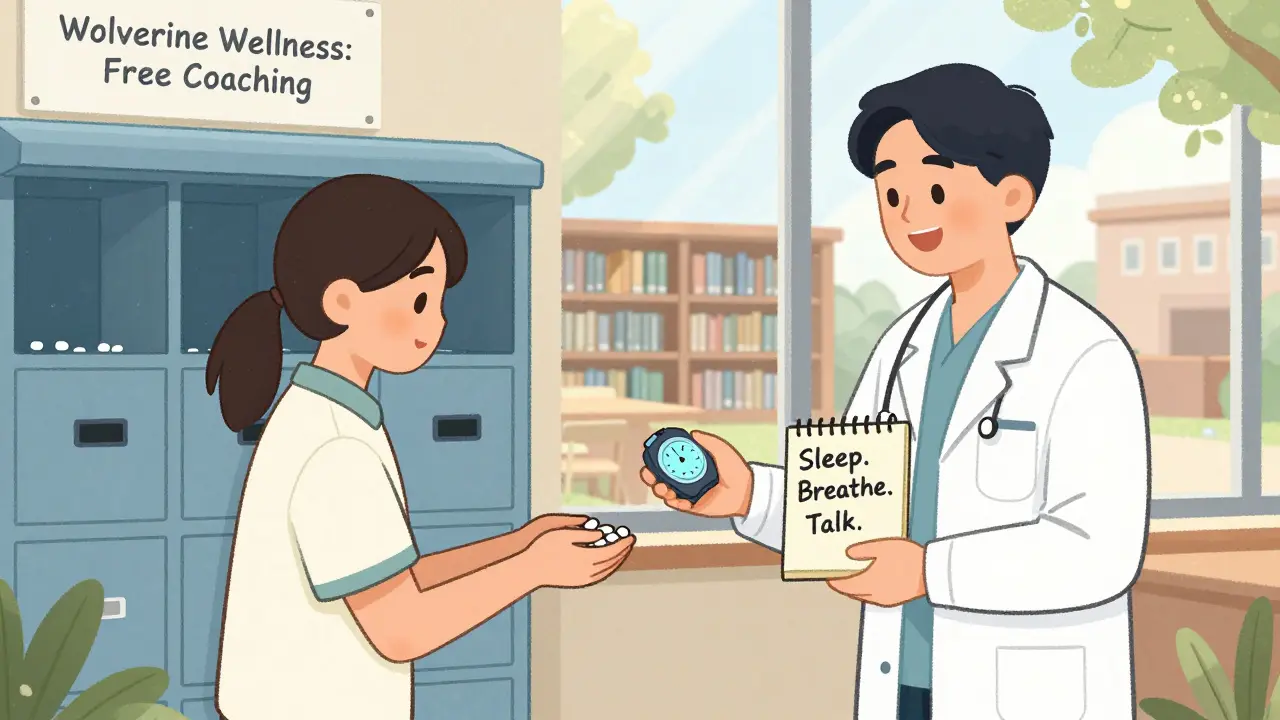
The University of Michigan’s "Wolverine Wellness" program went further. They didn’t just talk about drugs. They offered free academic coaching. Students who used the program saw a 22% drop in stimulant misuse - and a 47% increase in tutoring use. Why? Because they addressed the root cause: stress, not drugs.
Pharmaceutical companies are pitching in too. Shire, the maker of Adderall, donated $4.2 million to college health programs in 2022. The DEA now requires electronic prescriptions for all Schedule II drugs in 49 states - cutting down on forged prescriptions by 31%. And the FDA approved new abuse-deterrent versions of stimulants in 2022. Early data from Purdue University shows a 15% drop in misuse of these new formulations.
But here’s the problem: 67% of students say current campus interventions are "not properly targeted." That means most of what’s out there is a poster on a wall or a 10-minute lecture during orientation. It’s not enough.
What You Can Do
You’re not powerless. Here’s what actually works:
- Never share your meds. Even if you’re not using them, they’re still prescribed to YOU. Sharing is illegal - and dangerous.
- Store them safely. Use a lockbox. Keep them away from roommates. A simple $10 lockbox from Amazon can prevent a crisis.
- Dispose of leftovers properly. Most campuses now have disposal kiosks. If yours doesn’t, check with your local pharmacy. Don’t flush them. Don’t toss them in the trash.
- Know the signs. If someone you know is using stimulants to stay awake for days, or seems anxious, jittery, or depressed after using them - talk to them. And if they’re not responding - tell a resident advisor or campus health staff.
- Use real tools. Need to study longer? Try the Pomodoro technique. Need to sleep? Try a consistent bedtime. Need to manage stress? Talk to a counselor. These aren’t "nice-to-haves." They’re your best defense.
And if you’re already using someone else’s prescription? You’re not alone. But you’re not safe. Campus health centers offer confidential help. No judgment. No paperwork. Just support.
The Bigger Picture
Prescription drug misuse costs U.S. colleges $1.8 billion a year - in ER visits, lost productivity, counseling, and security. That’s not just money. It’s futures. A student who misuses Adderall might not get through finals. A student who overdoses on Xanax might not wake up.
But there’s hope. In 2015, only 215 colleges had comprehensive medication safety programs. By 2023, that number jumped to 1,472. The Biden administration just allocated $25 million for campus drug prevention. Insurance now covers buprenorphine for opioid use disorder on 68% of university health plans - up from 32% in 2015.
This isn’t about shaming students. It’s about building systems that actually work. One lockbox. One disposal kiosk. One trained counselor. One honest conversation.
You don’t need to be a doctor to make a difference. You just need to care enough to act.
12 Responses
This is why we need to stop pretending this is just a "college thing." It’s a public health crisis wrapped in a GPA.
Sharing prescriptions isn’t bonding-it’s reckless. And if you think you’re "just one person," you’re already part of the problem.
Y’all keep talking about Adderall like it’s the devil’s coffee… but have y’all *seen* the campus counseling waitlists? 🤦♀️
Like, sure, don’t share pills-but also, why are we treating burnout like it’s a personal failure instead of a systemic one?
My school has a 6-week wait for a therapist. Meanwhile, the pharmacy has Adderall in the same drawer as energy drinks.
Stop shaming kids for using the only tools they’ve got. Fix the damn system.
Also-thank you for mentioning disposal kiosks. My RA had one in our lounge. I used it. I cried. It felt like someone finally saw me.
America is soft. We turn every problem into a lecture. If you can’t handle college, go work at Walmart. No one cares if you’re stressed.
Get tough. Stop whining. And stop letting people take your meds. 🤷♂️
You say "it’s not about shaming" but the whole article is a guilt trip disguised as advice.
Let me guess-you’ve never missed a deadline? Never pulled an all-nighter? Never felt like you were one bad grade away from losing everything?
People aren’t using Adderall because they’re lazy. They’re using it because the system is rigged.
And now you want them to buy a $10 lockbox? That’s like telling someone drowning to wear a life jacket made of tissue paper.
Also, how many of these "solutions" were actually *asked for* by students? Or just handed down by admin like a corporate wellness pamphlet?
The ethical and sociological dimensions of this phenomenon are profoundly troubling.
Prescription drug misuse among young adults reflects not merely individual pathology, but a systemic erosion of institutional support structures, compounded by neoliberal pressures on academic performance.
The commodification of cognitive enhancement, coupled with the absence of robust mental health infrastructure, creates a perfect epistemic vacuum-one in which pharmaceuticals are reconfigured as palliative solutions to structural failures.
One must interrogate not only the pharmacological risks, but the ontological alienation that renders students vulnerable to such interventions.
Perhaps the most urgent intervention is not the lockbox, but the reconstitution of community as a pedagogical and affective space.
The data’s solid, but the framing’s off.
You’re treating this like a pharmacology problem when it’s clearly a productivity crisis.
Students aren’t misusing stimulants because they’re stupid-they’re using them because they’re overworked, under-resourced, and trapped in a meritocracy that rewards grind culture over sleep.
And yeah, the lockbox thing? Cute. But if your campus doesn’t have a 24/7 academic coach or a sleep hygiene lab, you’re just rearranging deck chairs.
Also-why is Shire donating money? Sounds like greenwashing with a side of PR.
I’ve been on both sides of this. Used Adderall once in sophomore year. Thought it was magic. Then I couldn’t sleep for 72 hours. Started shaking. Thought I was having a panic attack.
Turned out it was just the drug.
Went to counseling. Got a real ADHD diagnosis (I don’t have it). Learned about time-blocking. Now I use a planner. And I sleep.
It’s not glamorous. But it works. And no one’s judging you for trying to find a better way.
bro u just described my life
took xanax once bc my roommate said "its chill"
woke up on the floor with my cat licking my face
never again lol 🤢
In India, we have no such luxury. Students take stimulants because they study 18 hours a day for entrance exams.
Here, you have lockboxes. There, you have no sleep, no counselors, and no access to healthcare.
Do not moralize. Do not lecture. The real issue is global inequality in mental health infrastructure.
I’m so glad someone finally said this.
I used to think I was the only one who felt like a zombie between classes.
Then I found my school’s peer wellness group. We met every Thursday. No meds. Just talking.
One girl shared she was taking Adderall to finish her thesis. We helped her apply for an extension. She’s graduating next month.
You don’t need a pill to survive college. You just need someone who won’t look away.
This is a textbook example of American overreach.
Prescription drugs are regulated. If you misuse them, you are responsible.
Do not infantilize young adults. Do not pathologize ambition.
Education should toughen people, not coddle them.
Lockboxes? Disposal kiosks? This is not a solution-it is a surrender.
I appreciate the emphasis on practical steps.
But I wonder-how many of these solutions are actually funded by the institutions themselves?
Or are they outsourced to student groups with no budget?
I’ve seen posters about safe storage… in a building where the only lockbox available is in the health center… which closes at 5 PM.
And the kiosk? Broken since September.
Real change requires institutional accountability-not just awareness campaigns.