
Medication Safety Check
Check Your Symptoms
This tool helps identify potential warning signs of medication-related suicidal thoughts. Based on FDA guidelines and clinical research.
Critical Action Required
Immediate Action Needed
You may be experiencing medication-related suicidal thoughts. Contact your prescriber immediately.
What to say: "I'm having thoughts I don't recognize. I feel restless and on edge. I can't stop thinking about ending it, even though I don't want to."
Important Notes
Most cases resolve within days when medication is stopped or adjusted. Do not stop medication abruptly without medical guidance. Call 988 for immediate support.
Monitor Closely
Your symptoms suggest possible medication-related reactions. Please contact your healthcare provider within 24 hours.
Consider asking about:
- Adjusting your medication dosage
- Alternative treatment options
- Genetic testing for CYP2D6/CYP2C19 variants
Low Risk Detected
Based on current symptoms, your risk appears low. However, always report unusual thoughts to your doctor.
Stay vigilant during the first 28 days of treatment. If new symptoms appear:
- Document when symptoms began
- Note specific descriptions
- Track changes in behavior
When you start a new medication for depression, anxiety, or another mental health condition, you expect to feel better. But for some people, the very drug meant to help can trigger something dangerous: sudden, intense suicidal thoughts or urges. This isn’t common-but when it happens, it happens fast. And it often starts with subtle changes you might mistake for "just getting used to the medicine."
It’s Not Just Depression Getting Worse
Many assume that if someone on antidepressants starts thinking about suicide, their depression is getting worse. That’s not always true. In fact, the most dangerous cases often happen when the person feels more energized-not more tired. They may sleep better, talk more, or seem "improved" on the surface. But inside, they’re overwhelmed by thoughts they don’t recognize as their own. These are called ego-dystonic thoughts: intrusive, violent, or self-destructive ideas that feel foreign, terrifying, and impossible to control.One patient described it like this: "I didn’t want to die. But the thought kept showing up-like a video loop I couldn’t turn off. I didn’t feel sad. I felt trapped."
This isn’t imagination. It’s a documented reaction linked to certain medications, especially in the first few weeks of treatment. The U.S. Food and Drug Administration (FDA) confirmed this in 2007 by requiring a "black box" warning on all antidepressants-meaning the strongest possible alert for serious risk.
The Top Three Warning Signs You Can’t Ignore
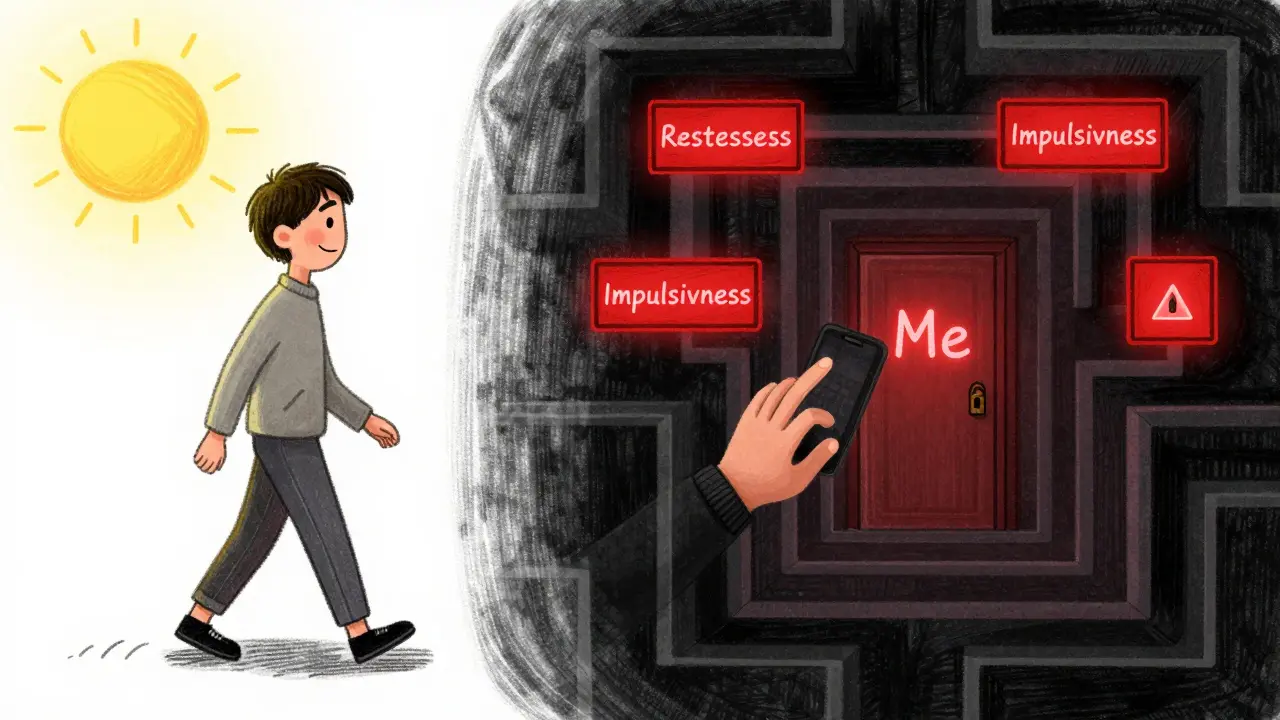
There are three clear, measurable signs that a medication might be triggering suicidal thoughts-not because the illness is worsening, but because the drug is causing a harmful side effect. These aren’t vague feelings. They’re specific symptoms with real data behind them.- Restlessness (akathisia) - This isn’t just fidgeting. It’s an unbearable inner tension, like your body is wired to move but you can’t find a way to release it. Patients describe it as "ants crawling under the skin," "feeling like I’ll explode if I sit still," or "my legs won’t stop shaking even when I’m asleep." Studies show this is the most common warning sign, appearing in over half of all cases. It’s so strongly linked to suicide risk that researchers call it the "canary in the coal mine."
- Increased impulsiveness - Someone who was cautious and thoughtful suddenly makes reckless decisions. They might quit their job, end relationships, or act on dangerous ideas without thinking. This isn’t rebellion. It’s a neurological shift caused by the drug altering brain chemistry too quickly.
- Ego-dystonic thoughts - As mentioned, these are suicidal urges that feel alien. The person doesn’t believe them. They fight them. But they won’t go away. And the more they try to suppress them, the stronger they become.
These symptoms together make up what the FDA calls the "activation syndrome." It includes panic attacks, irritability, insomnia, and even hypomania. When these show up within the first month-especially after a dose increase-the risk spikes dramatically.
When Does This Happen? Timing Matters
This isn’t a slow burn. Most cases happen fast.According to Stanford University researchers, 78% of medication-related suicidal events occur within the first 28 days of starting a new drug or changing the dose. The highest risk window? Days 7 to 14. That’s when the body is adjusting to the chemical shift, and the brain hasn’t stabilized yet.
Aggressive dosing makes it worse. Starting with a high dose-sometimes done to "get results fast"-doubles the chance of triggering these reactions. Gradual titration, even if it takes longer to feel better, is far safer.
And it’s not just antidepressants. While SSRIs like fluoxetine and SNRIs like duloxetine are most commonly linked to this issue, other drugs carry risk too. A 2024 study found that antibiotics like doxycycline, painkillers like piroxicam, and even asthma inhalers like formoterol have been tied to suicidal thoughts in rare cases. The mechanism isn’t always clear-but the pattern is.
Who’s Most at Risk?
Some people are more vulnerable than others. Risk isn’t random-it’s predictable.- Age: People under 25 are 2.3 times more likely to experience this reaction than adults over 24.
- History of suicide attempts: If you’ve tried to end your life before, your risk jumps by 47%.
- Family history: Having a close relative who died by suicide adds 32% more risk.
- Co-occurring anxiety: If you have both depression and an anxiety disorder, your risk goes up by 58%.
- Fast dose increases: Jumping from 10 mg to 40 mg in a week? That’s a red flag.
Interestingly, if the medication doesn’t seem to be working after two weeks, that’s actually a *lower* risk sign. The real danger comes from the "activation"-the sudden surge in energy mixed with dark thoughts-not from ongoing sadness.
What Should You Do If You Notice These Signs?
Don’t wait. Don’t hope it will pass. Don’t assume your doctor already knows.Call your prescriber immediately. Say exactly what you’re feeling: "I’m having thoughts I don’t recognize. I feel restless and on edge. I can’t stop thinking about ending it, even though I don’t want to."
Most cases resolve quickly once the medication is stopped or adjusted. A 2024 study found that 87% of patients saw these thoughts disappear after discontinuing the drug. That’s not a small number. That’s the majority.
Don’t stop cold turkey unless instructed. But do not delay speaking up. Your life depends on it.
How Doctors Are Trying to Prevent This
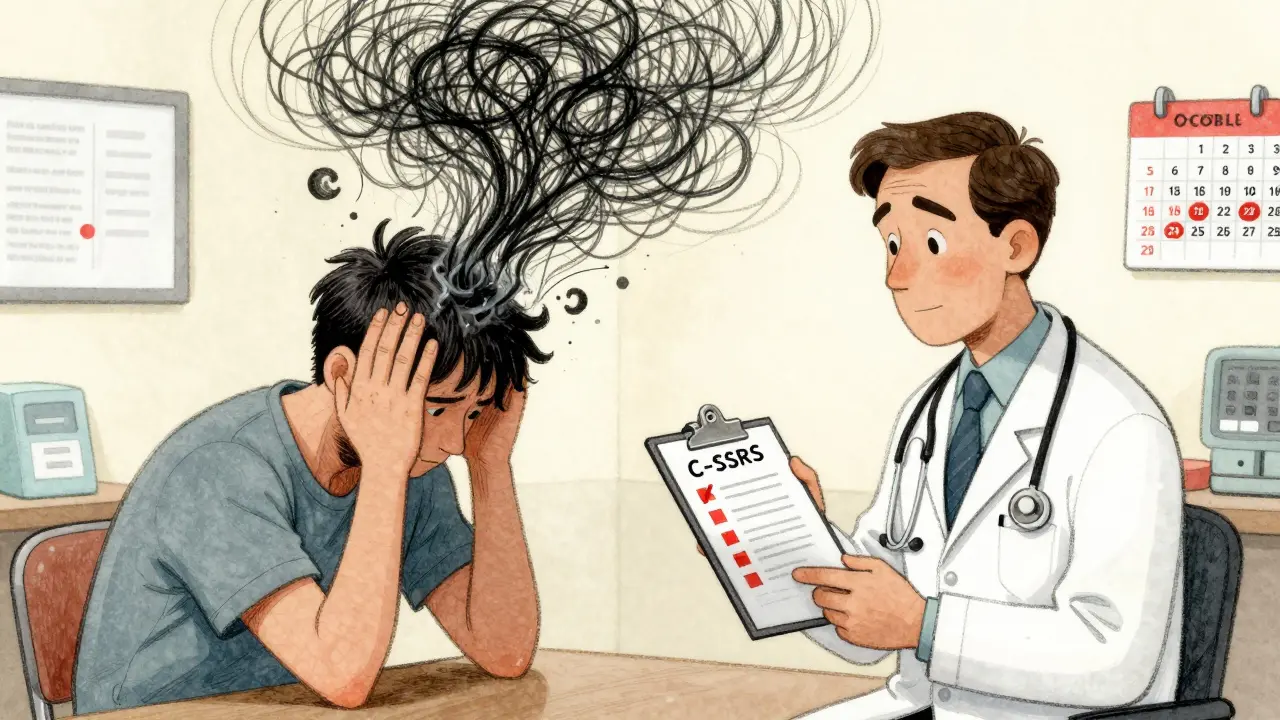
The FDA requires weekly check-ins during the first month of treatment. But only 92% of clinics actually follow this rule. And only 68% of doctors document that they warned patients about these risks during the consent process.Tools like the Columbia-Suicide Severity Rating Scale (C-SSRS) help. It’s a simple set of questions that can detect emerging risk with 89% accuracy. Ask your provider if they use it.
Safety plans work. A 2021 study showed they reduce hospitalizations by 41%. A good plan includes:
- Writing down your personal warning signs (like restlessness or sudden impulsiveness)
- Listing coping strategies (walking, calling someone, listening to music)
- Having emergency contacts ready-family, crisis line, therapist
- Knowing when to go to the ER
And now, new tools are emerging. Blood tests can detect genetic variations (like CYP2D6 and CYP2C19) that predict who’s likely to react badly. Smartphones can track changes in sleep, typing speed, or social activity-and flag risk before a person even speaks up. These aren’t sci-fi. They’re already being tested in hospitals.
Why This Isn’t Talked About More
It’s uncomfortable. We want to believe medication fixes everything. We don’t want to think a pill could make someone want to die.But ignoring the data doesn’t make it go away. In fact, underreporting is massive. Experts estimate only 1 in 10 cases ever get reported to safety systems. That means thousands of people are experiencing this without anyone knowing.
And while some argue that antidepressants lower overall suicide rates, those studies look at populations over years. They don’t capture the individual who had a sudden crisis in week two-and didn’t survive to see the long-term trend.
You’re Not Alone. And You’re Not Broken.
If you’ve experienced this, you’re not weak. You’re not failing. You’re not "too sensitive." You’re one of the 1-4% of young people who had a rare but real reaction to a medication. It’s not your fault. And it’s not permanent.What matters now is what you do next. Speak up. Get support. Adjust the plan. There are other options. Other meds. Other therapies. Other paths to healing.
Your life is worth more than the side effects of a pill. And you deserve to be heard-before it’s too late.
Can antidepressants really cause suicidal thoughts?
Yes. While rare, antidepressants-especially in people under 25-can trigger suicidal thoughts or behaviors as a side effect. This isn’t because the depression is getting worse, but because the medication causes a sudden surge in energy combined with intrusive, unwanted thoughts. The FDA has required black box warnings on all antidepressants since 2007 because of this risk.
What’s the difference between depression getting worse and a medication side effect?
Depression worsening usually means more sadness, fatigue, withdrawal, and hopelessness. A medication side effect often looks different: sudden restlessness, insomnia, irritability, impulsiveness, or intrusive suicidal thoughts that feel alien. You might feel more "awake" but also more panicked or trapped. This pattern is called the activation syndrome and is linked to the drug’s effect-not the illness.
How long after starting a new medication do these risks appear?
Most cases occur within the first 28 days, with the highest risk between days 7 and 14. This is especially true after a dosage increase. If you notice new, intense thoughts or feelings during this window, contact your doctor immediately-even if you feel like you’re "getting better" in other ways.
Are only antidepressants linked to this risk?
No. While antidepressants are the most studied, other drugs have also been linked, including antibiotics like doxycycline, painkillers like piroxicam, and even asthma inhalers. The mechanism may be different-sometimes involving liver enzymes or brain chemistry changes-but the outcome can be the same: sudden suicidal urges. Always report unusual thoughts to your doctor, no matter what medication you’re taking.
What should I do if I start having suicidal thoughts while on medication?
Call your prescriber right away. Don’t wait. Don’t try to tough it out. Say exactly what you’re experiencing: "I’m having thoughts I don’t recognize. I feel restless and on edge. I can’t stop thinking about ending it, even though I don’t want to." In most cases, stopping or adjusting the medication leads to full recovery within days. If you can’t reach your doctor, go to the nearest emergency room or call 988 (the Suicide & Crisis Lifeline).
Is it safe to stop the medication if I’m having these thoughts?
Do not stop abruptly without medical guidance, as some medications cause withdrawal symptoms that can be dangerous. But do not delay seeking help. Your doctor can help you taper safely or switch to a different treatment. The priority is stopping the harmful reaction as soon as possible-while avoiding new risks from sudden withdrawal.
Can genetic testing help prevent this?
Yes. Certain genetic variations, especially in the CYP2D6 and CYP2C19 liver enzymes, can predict how your body processes medications. People with these variations are more likely to experience activation syndrome. Testing isn’t routine yet, but it’s becoming more common in psychiatric clinics and can help avoid high-risk medications before they’re even started.
9 Responses
Been there. Started on sertraline, felt like my brain was buzzing under a microwave. Couldn't sit still. Thought I was losing it. Turns out it was the meds. Told my doc, they switched me. Within 3 days, the noise stopped. Not weak. Just biology.
This post saved my life. I thought I was just "not trying hard enough" to get better. Turns out I was having ego-dystonic thoughts-felt like someone else was whispering in my head. I didn't tell anyone for weeks. Don't make my mistake. Speak up, even if it feels embarrassing.
Oh my GOD, I KNEW IT! I’ve been saying this for YEARS! They’re poisoning us with these pills! Big Pharma doesn’t want you to know this-why? Because they make BILLIONS off people who don’t know they’re being turned into walking time bombs! My cousin died after taking Lexapro-she was "improved"-and then BAM! She jumped. They didn’t even warn her! It’s a COVER-UP!
And don’t even get me started on the CDC-they’re in bed with the drug companies! And the FDA? Just a rubber stamp! I’ve read the studies-they’re all faked! You think your doctor knows? HA! They’re trained to ignore the signs!
Also, did you know that 5G signals activate these suicidal thoughts? The pills just amplify it. I’ve got a spreadsheet. I’ll send it. You need to stop taking anything. Go off-grid. Drink lemon water. It’s the only way.
It’s strange how we assume medicine always helps. But the brain isn’t a simple circuit. Sometimes you flip a switch and things go haywire instead of lighting up. The fact that this is documented, yet still under-discussed, says more about our fear of uncertainty than it does about the drugs themselves. Maybe we need to accept that healing isn’t always linear-or even safe.
If you’re reading this and you’re feeling restless or like your thoughts aren’t yours-you’re not alone. I’ve been there. I called my psychiatrist at 2 a.m. and cried. She didn’t judge. She adjusted my dose the next day. It wasn’t weakness. It was courage. You’re not broken. You’re just in the wrong chemical storm. Get help. Now.
They want you to think it's the meds but it's the vaccines. The vaccines messed with your serotonin and now the meds are just making it worse. They put it in the water too. I saw it on a forum. You think this is coincidence? No. It's control. They want you to feel like you're broken so you'll keep taking the pills. 988 is a trap. Don't call. Go to the woods. Live off the land. They can't track you there.
People just need to stop being so dramatic. If you’re having suicidal thoughts you probably should’ve just worked on your mindset instead of popping pills. I’ve never taken antidepressants and I’ve never thought about killing myself. Coincidence? I think not. You’re just weak. Stop blaming the medicine and start taking responsibility.
In India, we don't have this problem because we don't rely on pills. We use yoga, meditation, and family. Your Western medicine is broken. You think a pill can fix your soul? You are fools. My cousin took Prozac for anxiety-he became violent. We took him to a temple. He was fine in two weeks. No pills. Just faith. You need to stop trusting science and start trusting tradition.
Marsha, you’re not wrong-but you’re also not right. This isn’t a conspiracy. It’s science with a blind spot. The system failed this person. The doctor didn’t monitor. The patient didn’t speak up. The drug company didn’t educate. It’s not about Big Pharma vs. the people-it’s about a system that treats mental health like a software update. You don’t just install a patch and hope it works. You test it. You watch for crashes. And we didn’t. We skipped the QA. And now people are dying.
And Jessica? Your 5G theory? Absurd. But your anger? Valid. We’re scared. We’re tired. We’re tired of being told to "just be positive" while our brains betray us. So yes, let’s scream. But let’s scream into the right room. Let’s demand better monitoring. Better consent. Better science. Not witch hunts. Just… better.