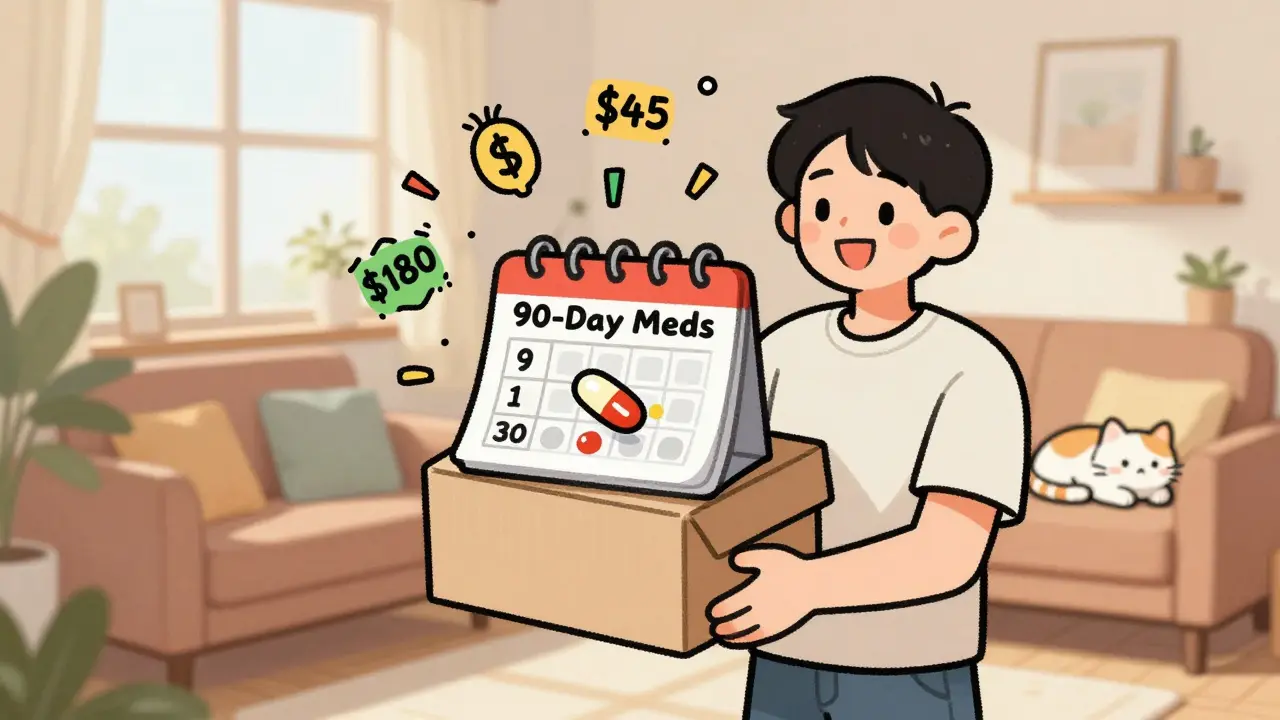
Buying your monthly pills through the mail sounds like a simple idea - save time, save money, skip the pharmacy line. But is it really worth it? For millions of people on long-term medications, mail-order pharmacies deliver real savings and convenience. But they’re not perfect. Some get their blood pressure meds two weeks late. Others pay more than they expected. Let’s break down what actually happens when you switch from your local pharmacy to a mail-order service - the good, the bad, and the quiet surprises.
How Mail-Order Pharmacies Actually Save You Money
Most mail-order pharmacies give you a 90-day supply of your maintenance meds for the price of two 30-day supplies. That’s not a trick. It’s standard pricing. If your statin costs $15 at CVS for a month, you’ll pay around $30 for three months through mail-order - not $45. That’s $15 saved every three months. For someone on three maintenance medications, that’s $45 saved every quarter, or $180 a year. Simple math. No coupons needed. This isn’t just theory. People using Express Scripts, CVS Caremark, or OptumRx report real savings. One user on Reddit said they saved $120 a year just by switching their three prescriptions. That’s a free weekend dinner. For people on expensive brand-name drugs, the savings can be even bigger - sometimes hundreds of dollars a year. The reason this works is scale. Mail-order pharmacies fill thousands of prescriptions a day in centralized warehouses. They use automated systems to pack pills, cut out overhead, and negotiate bulk discounts with drugmakers. Retail pharmacies? They pay rent, hire staff for walk-ins, and stock shelves. Mail-order skips all that.Why Your Meds Might Arrive Late - Or Not at All
Convenience comes with risk. Medications get lost. Packages sit in weather. Sometimes, your prescription gets delayed because the pharmacy needs to verify your doctor’s order. One user shared that their blood pressure pills were lost in transit. They had to rush to Walgreens and pay full price - $70 out of pocket - just to avoid going without. Industry data shows about 0.5% of mail-order shipments have delivery issues. That sounds small, but if you’re the one without your meds, it’s 100% of your problem. This matters most if you’re on insulin, heart meds, or anything that can’t be skipped. You can’t wait five days for a refill if your condition is unstable. Also, first-time orders take time. You can’t just walk in and get your new antibiotic. Mail-order is built for ongoing, predictable needs - not emergencies. If you’re starting a new drug or need a quick refill, retail is still faster.Accuracy and Safety: Fewer Mistakes, More Monitoring
Here’s something most people don’t know: mail-order pharmacies make fewer errors. Their automated dispensing systems have error rates of just 0.016%. Compare that to retail pharmacies, which hover around 0.04%. That’s a 60% drop in mistakes. Fewer wrong pills. Fewer wrong doses. Plus, every order gets reviewed by a pharmacist who checks for interactions - even if you’re taking meds from five different doctors. Retail pharmacists are busy with customers. Mail-order pharmacists have time to look at your full list. They’ll flag if your blood thinner clashes with a new painkiller. That kind of safety net matters. And you’re not alone. Most mail-order services offer 24/7 pharmacist access by phone. Need to ask about side effects at midnight? Call them. No waiting for office hours.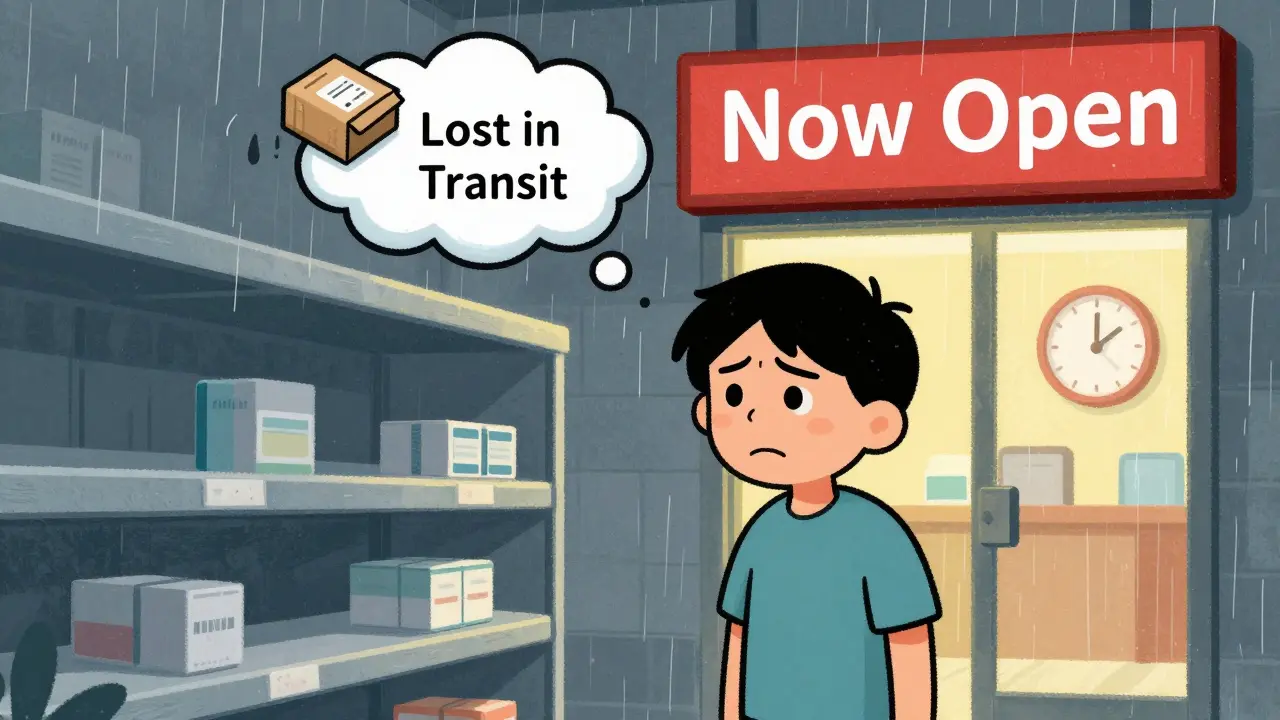
Who Benefits the Most - and Who Should Stay Put
Mail-order works best for people with chronic conditions: diabetes, high blood pressure, thyroid issues, asthma, depression. If you refill the same meds every month, you’re a perfect fit. Rural residents, people with mobility issues, or those without easy access to a pharmacy get huge value. No driving. No waiting. No hassle. But if you’re on short-term meds - antibiotics, painkillers after surgery, new prescriptions - stick with retail. If you like talking face-to-face with your pharmacist, if you want to ask questions on the spot, if you need your meds today - mail-order isn’t for you. Also, check your plan. Some insurance companies make mail-order mandatory after two refills. Others let you choose. If your plan charges extra for retail refills, you’re being pushed into mail-order. That’s fine - if you’re okay with the wait.How to Get Started Without the Headaches
Switching is easier than you think. Most health plans have a portal - just log in, find your prescription, and select "mail-order." You’ll need your doctor’s info and your current pharmacy’s details. The system usually handles the transfer automatically. If not, call the pharmacy benefit manager (PBM) - Express Scripts, CVS Caremark, or OptumRx - and they’ll do it for you. Set up automatic refills. That’s the key. Don’t wait until you’re out. The system will send your next batch before you run out. Many users report never missing a dose since they started. Track your shipments. Express Scripts now offers real-time GPS tracking. You’ll know exactly when your package leaves the warehouse and when it’s out for delivery. If it’s delayed, you can call right away.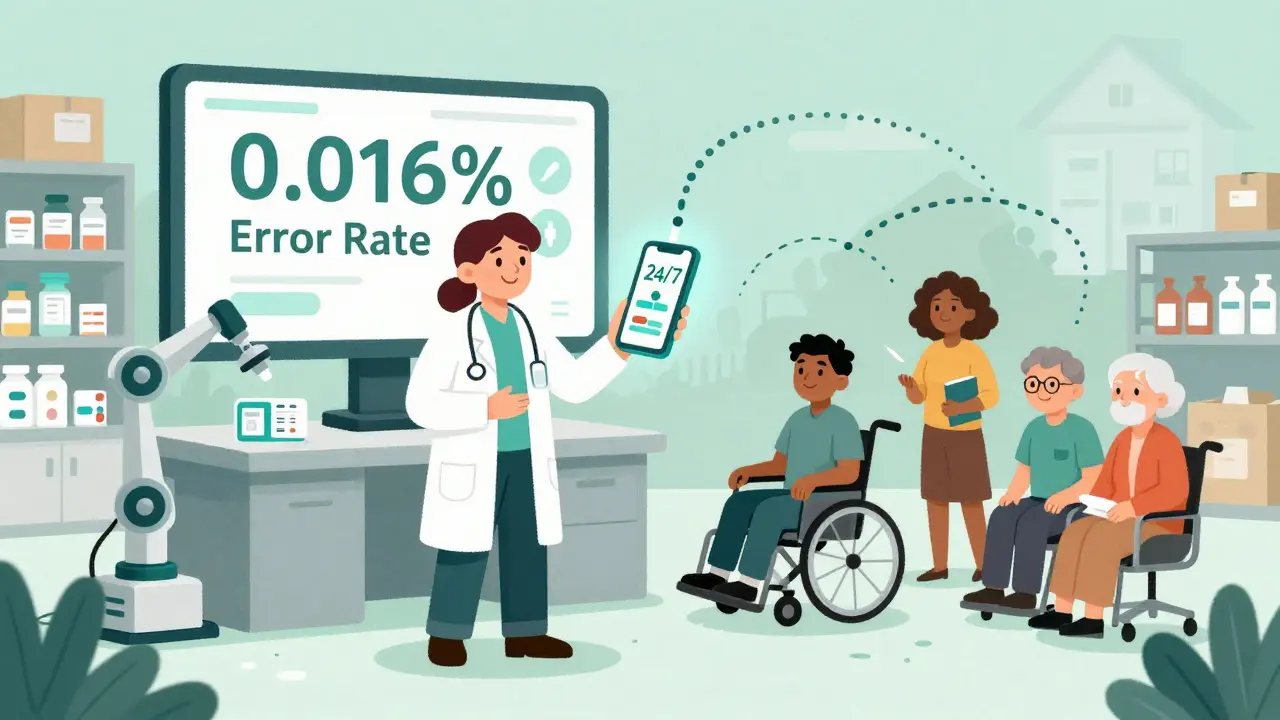
12 Responses
Wow, someone finally said the quiet part out loud. Mail-order saves me $200/year on my diabetes meds. No more driving 20 minutes in traffic just to get pills I don’t even need to pick up in person. Simple math, folks.
they say its cheaper but i think the gov and big pharma are using this to track us. every pill you take is logged. they know when you skip. they know when you’re sick. this is just the beginning. next they’ll send drones to check if you’re taking your meds. i’m not falling for it.
lol so now we’re trusting big pharma with our life-saving drugs? next they’ll mail us a QR code that says ‘scan to confirm you’re not dead yet’. also my last shipment got stuck in a warehouse in Nebraska for 11 days. guess i’m paying $80 for a 3-day emergency refill again. thanks, capitalism.
i tried it once. my blood pressure meds arrived with a note that said ‘you’re doing great, keep going!’ like i’m a 3rd grader. i didn’t know if i was being cheered on or gaslit. also, the box smelled like wet socks. i’m back at CVS. no offense, but i’d rather pay more and talk to a human who doesn’t sound like a chatbot.
the 0.016% error rate? cute. that’s like saying ‘only 1 in 6,000 people die in car crashes’ - until you’re the one in the ditch. and the ‘24/7 pharmacist’? yeah, good luck getting through to someone who sounds like they’re reading from a script while chewing gum. i’ve been on hold for 47 minutes. no thanks.
you guys are overthinking this. i switched 2 years ago. saved $150/year. never missed a dose. got a call from a pharmacist when my new antidepressant clashed with my beta-blocker. she even asked how my cat was doing (yes, she looked at my file). it’s not magic. it’s just better logistics. try it for one med. you’ll thank yourself.
this is the kind of post that makes me believe in humanity again 😊. i’m a single dad with two kids and a chronic condition - mail-order lets me focus on my family instead of running to the pharmacy every 30 days. and yeah, sometimes it’s late. but i set reminders, track the package, and call if it’s overdue. it’s not perfect… but it’s way better than the alternative. you got this!
The assertion that mail-order pharmacies exhibit a 60% reduction in dispensing errors is statistically misleading. Retail pharmacies operate under dynamic, high-volume conditions with human interaction variables. Mail-order systems, while mechanized, are vulnerable to systemic failures in logistics, regulatory compliance, and patient-specific verification protocols. The data cited lacks peer-reviewed validation and appears sourced from industry-affiliated studies.
i live in a town with no pharmacy for 50 miles. mail-order isn’t a convenience for me - it’s a lifeline. i don’t care if the box smells funny or takes 7 days. i care that i don’t have to drive 2 hours in the snow to get my thyroid pills. thank you for writing this. someone needed to say it.
i just want to say that i think the real issue here isn’t mail-order vs retail - it’s how we’ve let insurance companies and PBMs control our access to care. i switched to mail-order because my plan forced me to, not because i wanted to. and now i’m stuck with a system that’s efficient but impersonal. i miss when my pharmacist remembered my name, knew my dog’s name, and gave me extra samples when i was short on cash. we’re trading humanity for efficiency, and i’m not sure it’s worth it - even if it saves me $180 a year.
the data makes sense. mail-order saves money, reduces errors, and improves adherence. but the emotional side matters too. some people need the human touch. others need speed. neither is wrong. the key is choice. if your plan gives you options, use what fits your life. if not, push for it. health care shouldn’t be one-size-fits-all.
Try one med. Set up auto-refill. Track the shipment. Call if it’s late. Done. You’re already ahead of 90% of people who just keep doing what they’ve always done.