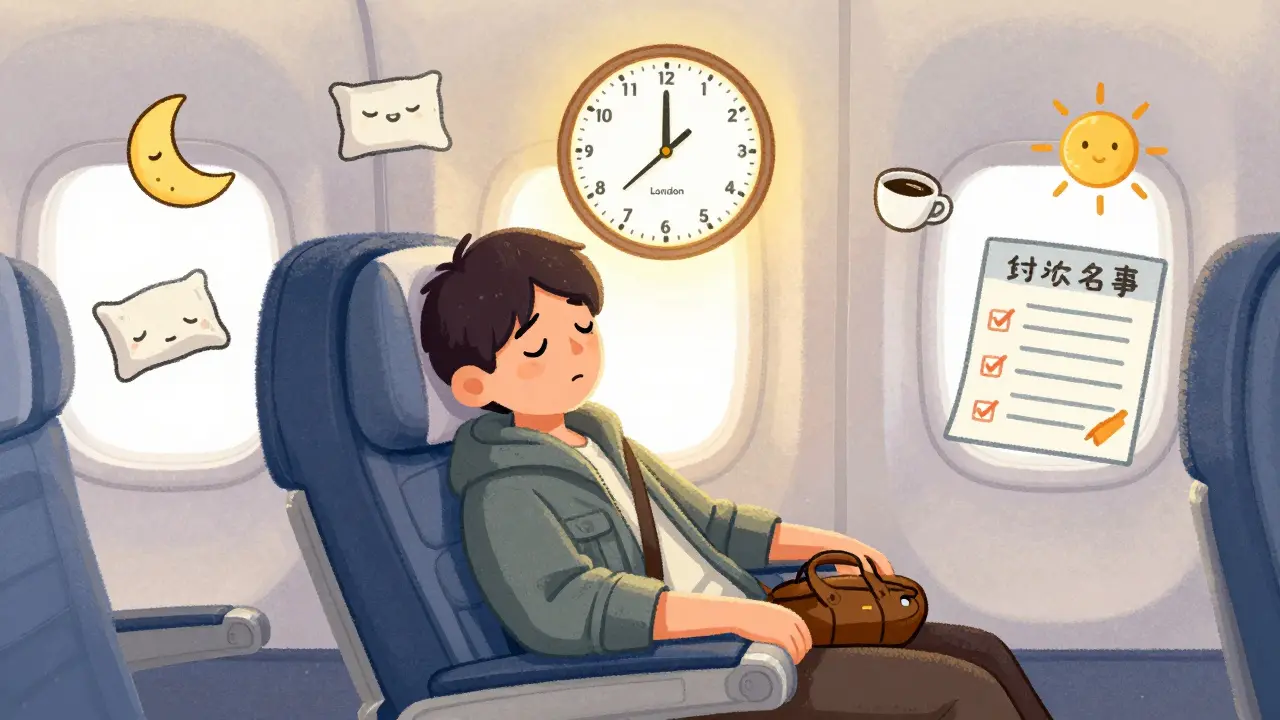
When you land in Tokyo after a 14-hour flight from London, your body still thinks it’s 3 a.m. But the sun is up, your meeting starts in two hours, and your brain feels like it’s running on wet sand. This isn’t just tiredness-it’s jet lag, a real biological mismatch between your internal clock and the world outside. And if you’ve tried time-released melatonin to fix it, you’re not alone. But you might be making it worse.
Why Jet Lag Isn’t Just ‘Being Tired’
Jet lag, or desynchronosis, happens because your body runs on a 24-hour rhythm controlled by your brain’s master clock. This clock doesn’t flip instantly when you cross time zones. It takes days to catch up. For every time zone you cross, your body needs about one day to adjust-but not evenly. Eastward travel, like flying from New York to Dubai, forces your clock to speed up. That’s harder. Westward travel, like flying from Tokyo to Los Angeles, lets your clock slow down. That’s easier. The CDC says eastward travelers often need 1.5 days per time zone. Westward? Closer to one day.And it’s not just sleep. Jet lag messes with your digestion, focus, mood, and even your immune response. You might feel nauseous, foggy, or wired at the wrong time. It’s not laziness. It’s biology.
What Most People Get Wrong About Melatonin
Melatonin is the hormone your body naturally makes at night to signal sleep. When you take it as a supplement, you’re giving your clock a nudge. But not all melatonin is the same.There are two main types: immediate-release and time-released. Immediate-release dissolves fast. Melatonin hits your bloodstream in minutes, peaks around 30-60 minutes later, and clears out in 2-3 hours. That’s perfect-because your body only needs a short, sharp signal to reset its clock.
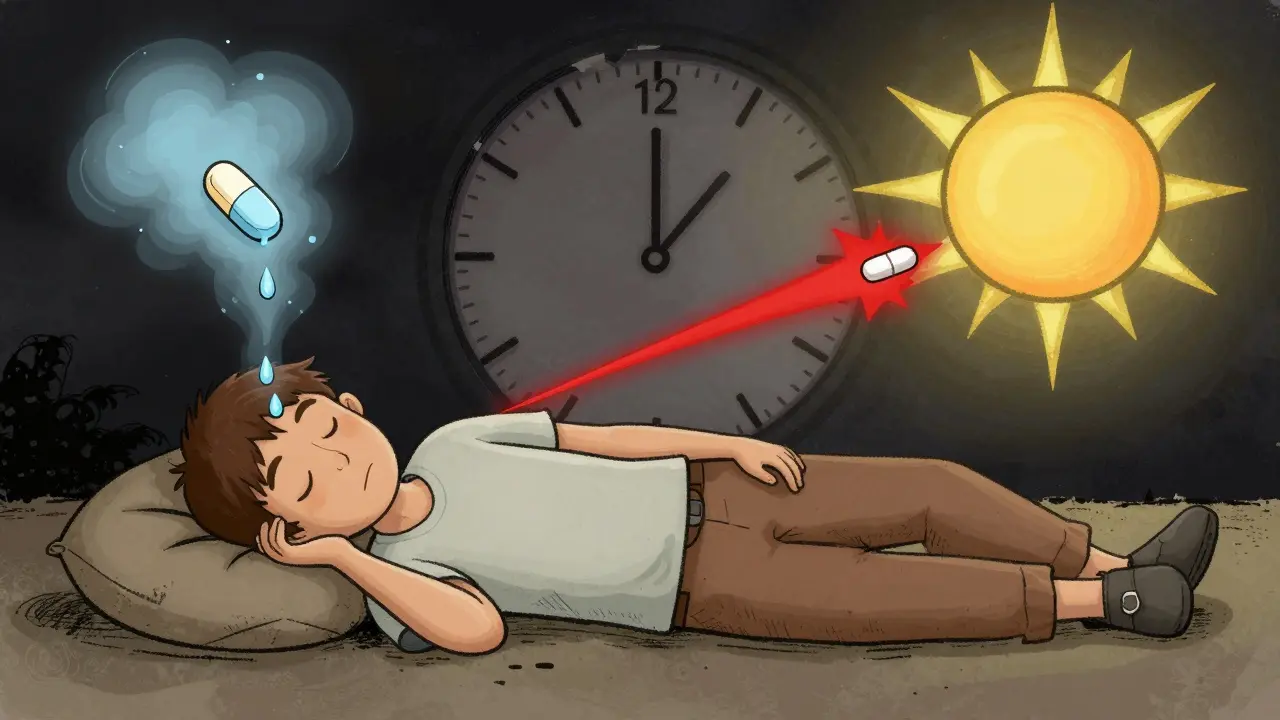
Time-released melatonin, on the other hand, is designed to drip melatonin into your system over 6-8 hours. It sounds smart-like a slow burn to keep you asleep all night. But that’s exactly why it fails for jet lag.
The American Academy of Sleep Medicine says time-released melatonin isn’t recommended for jet lag. Why? Because your circadian clock doesn’t respond to a long, steady drip. It responds to a brief, timed flash.
Why Time-Released Melatonin Makes Jet Lag Worse
Studies show time-released melatonin delivers only about a third of the phase-shifting power of immediate-release at the same dose. In one 2019 study, 3 mg of immediate-release melatonin taken at 10 p.m. local time shifted your clock forward by 1.8 hours. The time-released version? Just 0.6 hours. That’s not progress-that’s barely a nudge.And here’s the kicker: when melatonin sticks around too long, it shows up at the wrong time. Your body should have zero melatonin during the day. But time-released versions keep levels elevated into morning hours. That tricks your clock into thinking it’s still night. Result? You wake up groggy, your rhythm gets confused, and your body delays adjustment instead of advancing it.
Travelers crossing 8+ time zones eastward are especially vulnerable. A 2021 study found 68% of people using time-released melatonin felt worse after the trip. Only 22% of those using immediate-release said the same.
Real user reports back this up. On Amazon, time-released melatonin averages 2.8 stars. Comments like “woke up at 3 a.m. feeling wired” and “felt groggy all morning after taking it for Tokyo” are common. Meanwhile, immediate-release products average 4.1 stars.
What You Should Take Instead
Use immediate-release melatonin. Dose matters too. You don’t need 5 mg. Research shows 0.5 mg is just as effective for shifting your clock as 5 mg. Higher doses (2-3 mg) might help if you’re struggling to fall asleep, but they don’t improve phase-shifting. More isn’t better-it’s just more lingering.Timing is everything. For eastward travel, take your dose 30 minutes before your target bedtime at your destination. If you’re flying to Tokyo (10 hours ahead), and you want to sleep at 10 p.m. Tokyo time, take the melatonin at 10 p.m. Tokyo time-even if it’s 12 p.m. your local time. Do this for 4-5 nights after arrival.
For westward travel, you need to delay your clock. That’s trickier. The CDC suggests taking melatonin upon waking at your destination for 2-3 days. But most people don’t do this. Light exposure is more important here: get bright sunlight in the morning to tell your body it’s time to wake up.
Light Is Your Secret Weapon
Melatonin alone won’t fix jet lag. Light does most of the work. Your brain uses sunlight to set its clock. After landing, get outside for 30-60 minutes in bright daylight-ideally 2,000 to 10,000 lux. Avoid blue light (phones, screens) after sunset. If you can’t get natural light, a 10,000-lux light box works too.Combine timed melatonin with timed light, and you cut your adjustment time in half. One Business Insider travel writer crossed 9 time zones eastward and adapted in 3.5 days using 1 mg immediate-release melatonin + light exposure guided by the Timeshifter app. He said the time-released version he accidentally took once left him disoriented for two full days.
Why the Market Still Sells Time-Released Melatonin
The global jet lag market is worth $1.74 billion and growing. Melatonin makes up 68% of that. But here’s the problem: most products on shelves are time-released because they’re marketed as “all-night sleep aids.” Companies sell them for insomnia, not jet lag. The European Medicines Agency approved one time-released melatonin product (Circadin) for insomnia in people over 55-but explicitly excluded jet lag.The FDA doesn’t regulate melatonin as a drug. It’s sold as a supplement. That means quality varies wildly. One FDA warning in 2023 found melatonin supplements contained 83% to 478% more than labeled amounts. So you might think you’re taking 1 mg, but you’re getting 3 mg. That’s dangerous for timing.

What Experts Say
Dr. Charles Czeisler at Brigham and Women’s Hospital says time-released melatonin should be avoided for jet lag because it “conflicts with the phase-response curve requirements.” Dr. Jamie Zeitzer at Stanford says the window for melatonin to shift your clock is only 2-3 hours long. Time-released versions flood that window.Even the best melatonin plan has limits. Dr. Phyllis Zee from Northwestern warns that most people can’t guess their circadian phase without testing saliva melatonin levels. That’s hard to do on a plane. So timing is guesswork for most. Apps like Timeshifter help-they use your flight path, chronotype, and sleep history to suggest exact times. Over 1.2 million travelers use it.
What About Other Medications?
Prescription sleep aids like zolpidem or eszopiclone help you fall asleep, but they don’t reset your clock. Stimulants like modafinil keep you awake during the day but don’t help you adjust faster. They’re symptom managers, not solutions.There’s new hope: Hetlioz (tasimelteon), approved by the FDA in 2024, is a melatonin receptor agonist with a cleaner, shorter half-life. But it’s not time-released. It’s still a precise, timed signal. And it’s expensive.
Final Rule: Less Is More
You don’t need high doses. You don’t need slow release. You need a small, sharp signal at the right time.For eastward travel: 0.5-1 mg immediate-release melatonin, 30 minutes before target bedtime, for 4-5 nights. Combine with bright morning light. Avoid screens after dark.
For westward travel: 0.5 mg melatonin upon waking, plus sunlight exposure. Skip the time-released stuff entirely.
Jet lag isn’t a problem you can sleep through. It’s a rhythm you have to retrain. And the best tool for that isn’t a pill that lasts all night-it’s a pill that lasts 90 minutes, used like a metronome.
8 Responses
I took time-released melatonin to Tokyo last year and woke up at 3 a.m. feeling like I’d been hit by a truck. Turns out I was doing it wrong. I didn’t even know immediate-release existed until now. Thanks for the wake-up call.
Okay, so… melatonin isn’t just a sleepy pill?? I thought it was like… herbal Ambien?? Like, if it’s slow-release, it’s better, right?? But no?? Wait, so the body doesn’t want a drip?? It wants a… a *blip*?? Like a tiny, tiny, tiny, *ping*?? And I’ve been poisoning myself with 5mg slow-release gummies for years?? I’m not even mad, just… stunned.
Of course the market sells the wrong version. People don’t want to fix their circadian rhythm-they want to sleep through the entire trip. They want a chemical nap, not a biological reset. That’s why time-released melatonin dominates shelves. It’s not science-it’s convenience culture. And now you’re telling me the solution is… timing? And light? And not just popping a pill and hoping? That’s too much work. The system is rigged to keep people dependent on easy fixes.
Just to clarify: 0.5mg immediate-release is the sweet spot for phase-shifting. Higher doses don’t help you adjust faster-they just make you groggy longer. And timing is everything. For eastward trips, take it 30 minutes before your target bedtime at destination, not your home time. And yes, light exposure is non-negotiable. I’ve used this protocol with clients for years. The ones who skip the light? They’re still jet-lagged on day 5. The ones who do both? Back to normal by day 2.5.
I appreciate the rigor of this analysis. The distinction between phase-shifting efficacy and sleep maintenance is clinically significant. I have observed in my practice that patients who utilize immediate-release melatonin in conjunction with photic entrainment demonstrate significantly accelerated circadian re-synchronization. The data cited from the American Academy of Sleep Medicine and the 2019 phase-response study are particularly compelling. I will be revising my travel recommendations accordingly.
So… I’ve been taking that slow-release stuff for my 12-hour flights to Singapore and wondering why I feel like a zombie for a week. Turns out I was just adding more zombie to the mix. Who knew?
Back home in Lagos, I don’t get jet lag. We don’t have time zones here, just vibes. But I saw this and thought-man, this is the same as when I go to London. I used to take the slow-release thing too. Now I just go outside at sunrise. Feels better. No pills needed.
Thank you for this. I have been recommending melatonin for years without realizing the formulation mattered. I will update my patient handouts immediately. Immediate-release. Low dose. Correct timing. Light. Simple. Effective. I wish I had known this sooner.