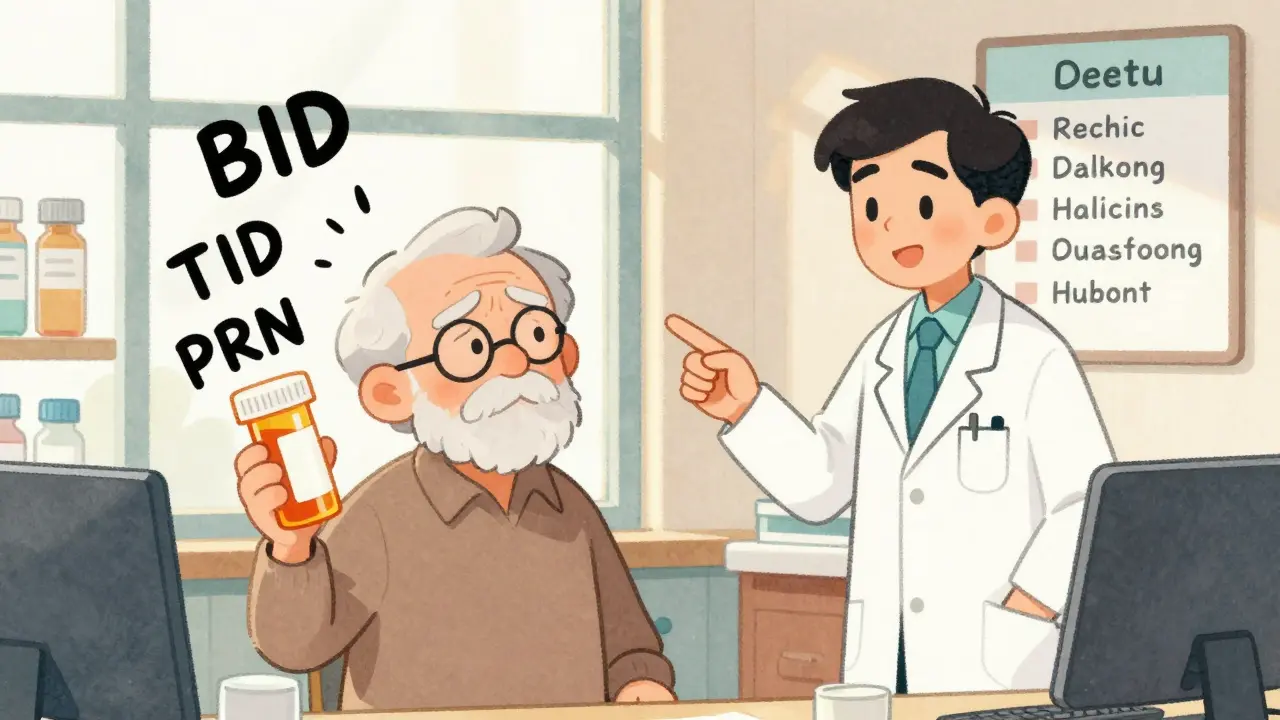
Ever looked at your prescription bottle and felt like you’re decoding a secret code? You’re not alone. Abbreviations like BID, TID, and PRN show up on most prescriptions in the U.S., and they’re not random letters - they’re Latin shortcuts that have stuck around for over a century. But here’s the problem: if you don’t know what they mean, you might be taking your medicine wrong. And that can make your treatment less effective - or even dangerous.
What BID, TID, and PRN Really Mean
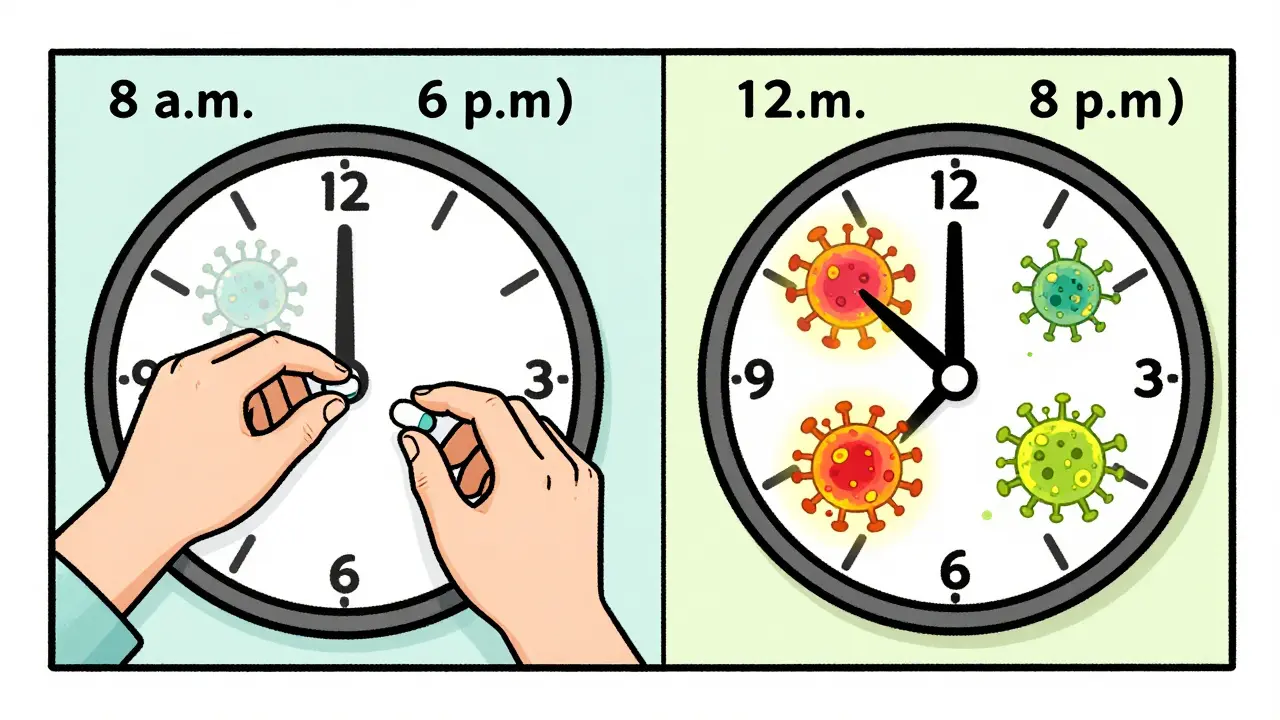
BID stands for bis in die, which is Latin for "twice a day." That doesn’t mean morning and night, though. It means roughly every 12 hours. So if you take your first dose at 8 a.m., the second should be around 8 p.m. Skipping the evening dose or taking both at breakfast? That throws off your drug levels. A 2020 Mayo Clinic study found that when antibiotics prescribed BID were taken with uneven spacing - say, 6 hours apart instead of 12 - effectiveness dropped by 38%.
TID means ter in die, or "three times a day." Again, it’s not just breakfast, lunch, and dinner. The goal is 8-hour intervals. So 6 a.m., 2 p.m., and 10 p.m. That keeps the drug concentration steady in your bloodstream. If you take it only at meal times, you’re leaving gaps. A 2021 Johns Hopkins study showed that when TID antibiotics were spaced unevenly - like 10 hours apart - treatment success dropped by 27%. For drugs like blood thinners or seizure meds, that gap can be life-threatening.
PRN comes from pro re nata, meaning "as needed." This one trips up the most people. It doesn’t mean "take whenever you feel like it." It means "take only when symptoms happen, and only up to a certain limit." For example: "Ibuprofen 400 mg PRN for pain, max 3 doses in 24 hours." That means you can take it when you hurt, but no more than three times a day - even if you’re still in pain. Many patients think PRN means "take whenever I remember," and end up overdosing. In fact, the FDA reported that PRN medications caused 31% of all dosing errors in 2021.
The Other Common Abbreviations You’ll See
Here’s the full list of the most common ones you’ll find on your label:
- QD - once daily (quaque die). Take it at the same time each day, like 8 a.m.
- QID - four times daily (quater in die). That’s every 6 hours: 6 a.m., 12 p.m., 6 p.m., 12 a.m.
- QH - every hour (quaque hora). Usually written as q4h (every 4 hours), q6h (every 6 hours), etc.
- AC - before meals (ante cibum). Take it 30 to 60 minutes before eating.
- PC - after meals (post cibum). Take it within 30 minutes of finishing your meal.
- HS - at bedtime (hora somni). Take it right before you go to sleep.
- PO - by mouth (per os). This just means oral - not injection or patch.
These aren’t just random guesses. They’re based on how your body processes the drug. For example, antibiotics need steady levels to kill bacteria. Blood pressure meds work best when taken at consistent times. And painkillers? You need them before the pain gets too bad - not after.
Why These Abbreviations Still Exist
You’d think in 2026, with digital prescriptions and barcode scanners, we’d have gotten rid of Latin codes. But we haven’t. Why?
It’s history. Back in the 1910s, doctors wrote prescriptions by hand on tiny pads. Latin abbreviations saved space and time. Even today, many doctors trained decades ago still use them out of habit. A 2023 survey by the American Medical Association found that 22% of physicians still write "BID" without periods - making it look like "bid" - which some pharmacists misread as "bid" meaning "twice daily," while others thought it was a typo.
Worse, some prescriptions still get handwritten. About 17% of U.S. prescriptions in 2023 were still paper-based, according to the American Pharmacists Association. And on paper, handwriting can be messy. "TID" can look like "TID," "TID," or "TID" - and if it’s smudged? You’re guessing.
Even electronic systems aren’t perfect. Some pharmacy software still converts "TID" to "three times a day" without specifying timing. That’s why 68% of patients still report confusion, according to a 2023 Kaiser Family Foundation survey.
The Real Danger: Mistakes That Cost Lives
It’s not just about feeling worse. Misreading these abbreviations leads to real harm.
One patient took her TID antibiotic only twice a day because she thought "TID" meant "three days." She finished the bottle in four days instead of ten. The infection came back - stronger.
Another patient took his PRN painkiller every 4 hours for two days - not knowing the max was 3 doses in 24 hours. He ended up with liver damage.
And then there’s "U" for units. The Joint Commission banned it in 2006 because "U" looked like "0" - leading to 10x insulin overdoses. Still, some handwritten prescriptions use it. A 2019 analysis found 1,247 medication errors in just four years from abbreviation confusion.
Older adults are especially at risk. A 2023 Consumer Reports survey found that 42% of adults over 65 thought "BID" meant "before and after dinner." That’s not just confusing - it’s dangerous.
What You Can Do Right Now
You don’t have to guess. Here’s how to take control:
- Ask the pharmacist - Seriously. They’re trained to explain this. In a 2022 Pharmacy Times survey, 89% of patients said they felt more confident after asking. No judgment. No embarrassment. They’ve heard it all.
- Use pill organizers with time labels - Buy one with AM/PM or 6AM/2PM/10PM slots. A 2021 Annals of Internal Medicine study showed these improved adherence by 52%.
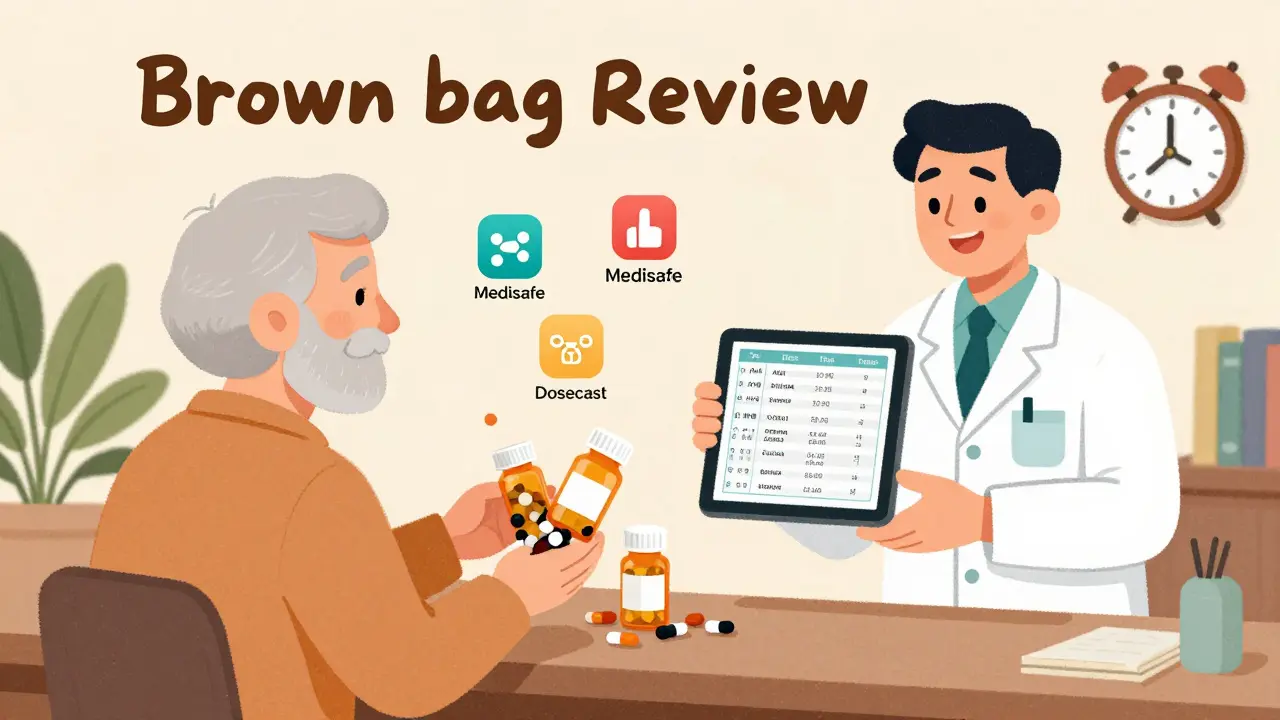
- Download a medication app - Apps like Medisafe, MyTherapy, or Dosecast convert "TID" into alarms with exact times. Over 18 million people use them. They even send reminders if you skip a dose.
- Do a "brown bag review" - Once a month, bring all your meds (including vitamins and OTC drugs) to your doctor or pharmacist. They’ll check for overlaps, duplicates, and misinterpretations.
- Ask for plain English - Say: "Can you write this out in simple words?" Most pharmacies now offer it. CVS and Walmart do it on 74% and 78% of labels. Independent pharmacies? Only 41%.
What’s Changing - And What’s Coming
The good news? Change is happening.
In 2023, the United States Pharmacopeia (USP) passed a new standard - General Chapter <17> - that requires all prescriptions to use plain English by December 31, 2025. Kaiser Permanente switched in 2022 and saw a 29% drop in patient calls asking for clarification.
The FDA is pushing for digital tools that automatically calculate dosing times. Imagine typing "TID" and your app says: "Take at 6 a.m., 2 p.m., and 10 p.m. based on your wake-up time." That’s coming in 2024.
By 2027, experts predict less than 5% of prescriptions will still use Latin abbreviations. But until then? You’ve got to be your own advocate.
Final Tip: If You’re Unsure, Ask
There’s no such thing as a dumb question about your meds. That viral TikTok video from pharmacist Anna? 2.4 million views. Why? Because people were desperate for clarity.
Don’t rely on memory. Don’t assume. Don’t Google it and hope for the best. Call your pharmacy. Ask your doctor. Text your pharmacist. They’re there to help - not to judge.
Your health depends on it.
13 Responses
I love how this post breaks it down like a damn textbook. I used to take my blood pressure med at breakfast and dinner because I thought TID meant "three meals a day." Ended up in the ER with a syncopal episode. Never again. Thanks for the clarity.
i always thought prn meant "take it when you feel like it" until my pharmacist sat me down and showed me the max doses. i was taking ibuprofen every 3 hours thinking it was fine. turns out i was nearly liver-fried. this stuff saves lives. seriously.
This is why America is falling apart. We’ve got people taking meds like they’re snacks because nobody teaches basic Latin anymore. My grandfather, a WWII vet, knew BID meant twice daily before he could spell "pharmacy." Now? We need a TikTok video to explain "QD." Pathetic.
Let’s be real - Latin abbreviations are archaic. Why are we still using "ante cibum" in 2026? It’s like using a rotary phone to call 911. The FDA should’ve mandated plain English 20 years ago. This isn’t a history lesson, it’s a public health failure.
The real issue is not the abbreviations - it’s the systemic collapse of medical literacy. People don’t read. They don’t ask. They don’t care. I’ve seen my cousin take her TID antibiotic only when she remembered - sometimes twice in one day, sometimes skip three days. She thinks it’s "just pills." Meanwhile, antibiotic resistance is rising because of this laziness. We need mandatory medication literacy courses in high school. Not optional. Mandatory.
I used to think "HS" meant "hurry up and sleep." Turns out it means "at bedtime." I took my sleep med at 11 p.m. because I "felt like it" - until my doctor told me it was supposed to be 10:30 p.m. because of absorption rates. I almost died from a fall because I was groggy at 1 a.m. instead of 4 a.m. Funny how a two-word phrase can change your life.
I work in pharmacy and I can tell you 80% of errors come from misreading "U" for units. One guy thought "10U" was "100". He nearly died. We still have handwritten scripts. We still have software that doesn’t flag "BID" as ambiguous. It’s not a patient problem. It’s a system problem.
The fact that this post is even necessary is a testament to the catastrophic failure of medical education and pharmaceutical infrastructure. The use of Latin in modern prescriptions is not "tradition," it’s negligence dressed up as efficiency. And don’t get me started on how pharmacy software still doesn’t auto-convert "QID" into a visual schedule. We’re in 2026. We have AI. We have predictive algorithms. Why are we still using 1912-era shorthand? It’s not charming. It’s criminal.
You know what’s really going on? The pharmaceutical companies *want* you confused. Why? Because if you don’t know when to take it, you’ll take too much - or too little. Either way, they profit. More refills. More ER visits. More insurance claims. This isn’t about Latin. It’s about profit. They’ve been keeping these abbreviations alive on purpose. Wake up.
I’m from India and we use the same abbreviations here - but we also have a cultural thing where patients don’t question doctors. I once saw a man take his TID heart med at 8 a.m., 10 a.m., and 8 p.m. because his wife said "the doctor said three times." He didn’t even know what "TID" stood for. I had to sit him down for an hour. He cried. We need community health workers who speak the local language and explain these things like they’re talking to their own family.
This is what happens when you let woke culture replace education. Nobody learns Latin anymore. Nobody learns to read. You want clarity? Then stop making everything "accessible." Make people *earn* understanding. If you can’t decode "BID," maybe you shouldn’t be taking a prescription. This isn’t a public service announcement - it’s a wake-up call to stop coddling incompetence.
I’ve been tracking this for years. The real reason they keep Latin abbreviations? They’re testing us. The system is designed to filter out the "unworthy." If you can’t understand "PRN," you’re not fit to manage your own health. That’s why 42% of seniors get it wrong. It’s not ignorance. It’s selection. They want the weak to fail so they can sell more meds. I’ve seen the internal memos. It’s not conspiracy. It’s corporate policy.
I’m a nurse and I’ve seen too many patients hurt because they didn’t understand "AC" vs "PC." I always write it out: "Take 30 minutes before food" or "Take after eating." I’ve had patients cry because they thought "PC" meant "painful" and avoided their meds for weeks. Just take two seconds to write it clearly. It’s not hard. It’s human.