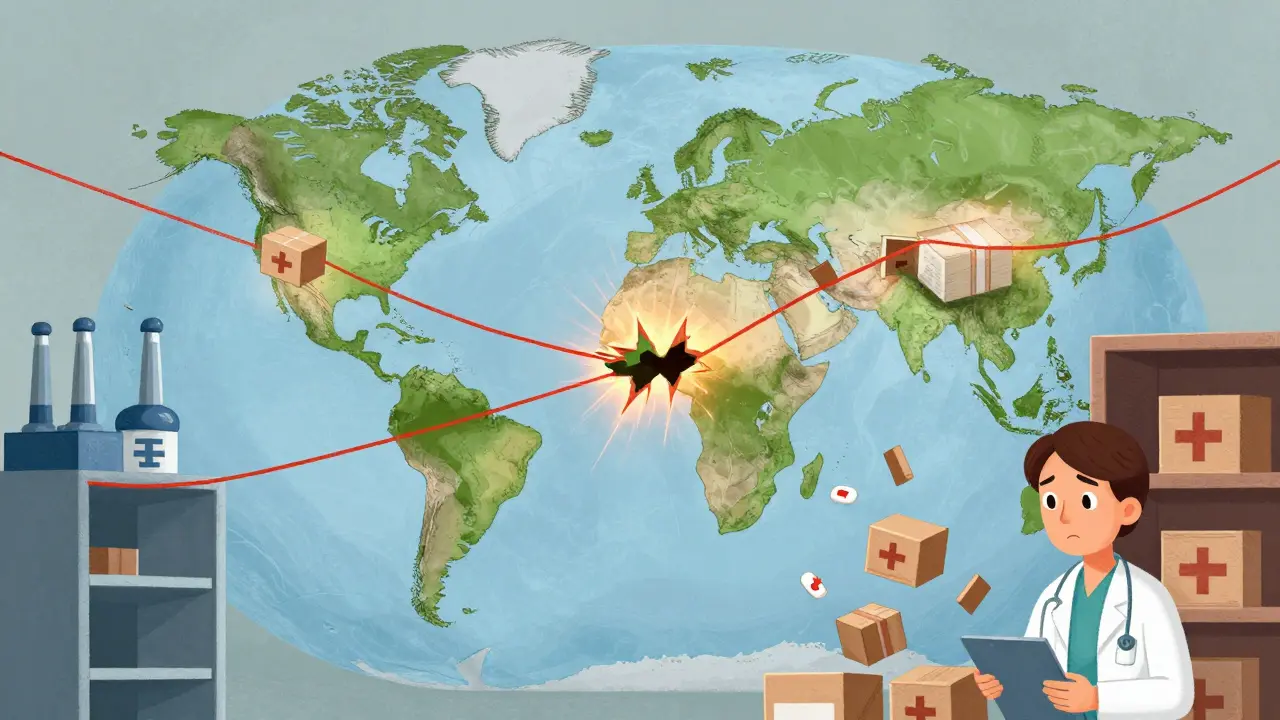
Imagine running out of insulin or antibiotics because a factory halfway across the world shut down. This isn't a hypothetical nightmare; it is the reality many healthcare systems faced during recent global crises. The era of lean, globally optimized supply chains is over. We are entering an era of resilient, regionally balanced networks that accept slightly higher operational costs for a massive reduction in disruption risk. Building resilient pharmaceutical supply chains is no longer just a business continuity issue-it is a critical national security and public health imperative.
The concept of supply chain resilience was formally defined by Mathematica Inc. in a 2023 report commissioned by the U.S. Department of Health and Human Services. They describe it as 'the ability of medical product supply chains to anticipate, prepare for, respond to, and recover from disruptions while maintaining continuous delivery of critical products.' This definition emerged after the pandemic exposed severe vulnerabilities, particularly our heavy reliance on foreign manufacturing for active pharmaceutical ingredients (APIs). Today, approximately 80% of APIs consumed in the United States are manufactured overseas, with China and India accounting for 68% of this production. If those pipelines break, hospitals run dry.
Understanding the Core Components of Resilience
To build a supply chain that can withstand shocks, you need to look at three core technical components identified by industry experts: preparedness, response, and recovery. Preparedness involves proactive efforts like monitoring geopolitical trends and scenario planning. Response capabilities ensure your operations function during a crisis, while recovery capabilities get you back to normal quickly.
Leading companies are moving beyond simple inventory checks. According to PwC's 2024 assessment, top performers implement end-to-end risk assessment protocols that map dependencies across 12-15 tiers of suppliers. This means they don't just know who their direct supplier is; they know who supplies their supplier's raw materials. This deep visibility is crucial when high-risk regions account for nearly half of global API production. Without this map, you are flying blind when a disruption hits.
| Feature | Traditional Lean Model | Resilient Model |
|---|---|---|
| Cost Focus | Minimize cost of goods sold | Balance cost with risk mitigation |
| Supplier Base | Single-source, lowest cost | Dual-sourcing, regional diversification |
| Inventory Strategy | Just-in-time delivery | Buffer stock (60-90 days for critical meds) |
| Visibility | Tier 1 suppliers only | End-to-end (12-15 tiers) |
| Response Time | Reactive (weeks to months) | Proactive (days to weeks) |
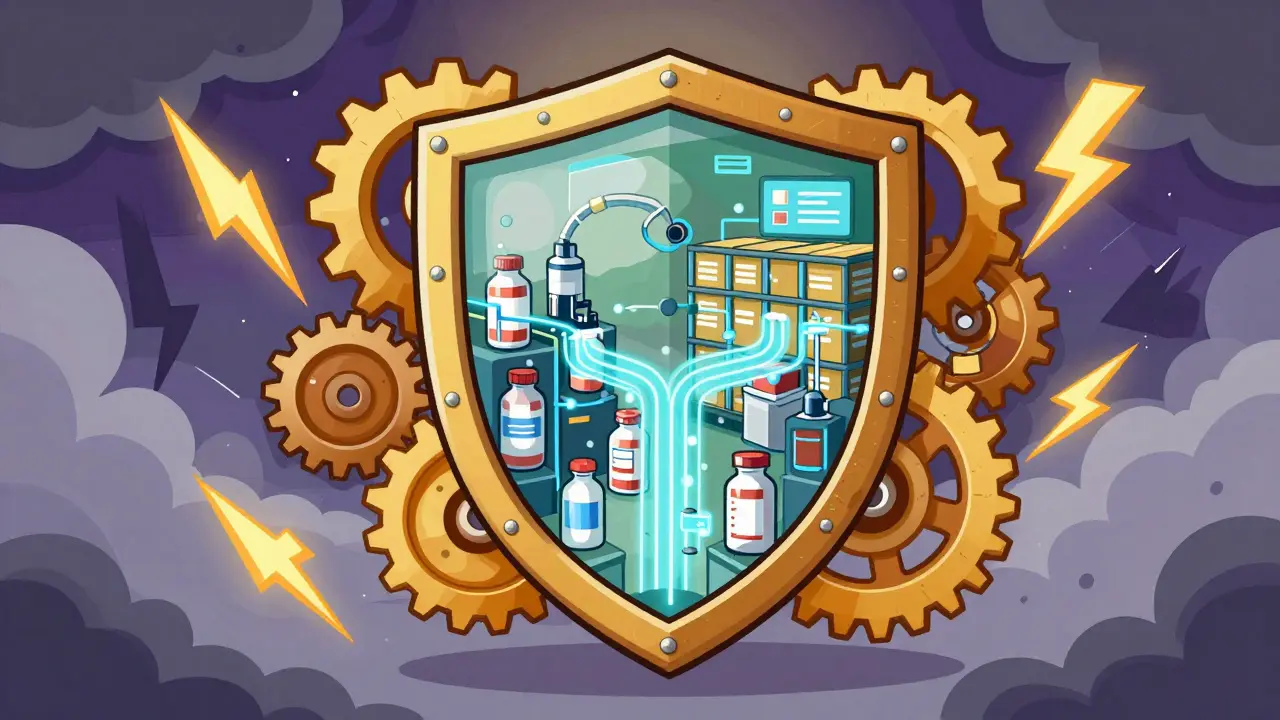
Technology as a Defensive Shield
Technology is not just a tool for efficiency; it is a defensive shield against shortages. Continuous manufacturing systems are revolutionizing how drugs are made. Unlike traditional batch processes, which require large facilities and long lead times, continuous manufacturing shows a 30-40% reduction in facility footprint and 20-25% lower energy consumption. More importantly, it reduces material waste by 15-20%.
Artificial intelligence plays a pivotal role here. AI-enabled process optimization tools have demonstrated an 18-22% improvement in yield rates and a 25-30% reduction in quality deviations. But the real game-changer is predictive analytics. Early pilot programs show that AI-powered systems can forecast disruption risks with 85-90% accuracy 60-90 days in advance. Imagine knowing a port strike or a chemical shortage is coming two months before it happens. That time allows you to reroute shipments or activate backup suppliers.
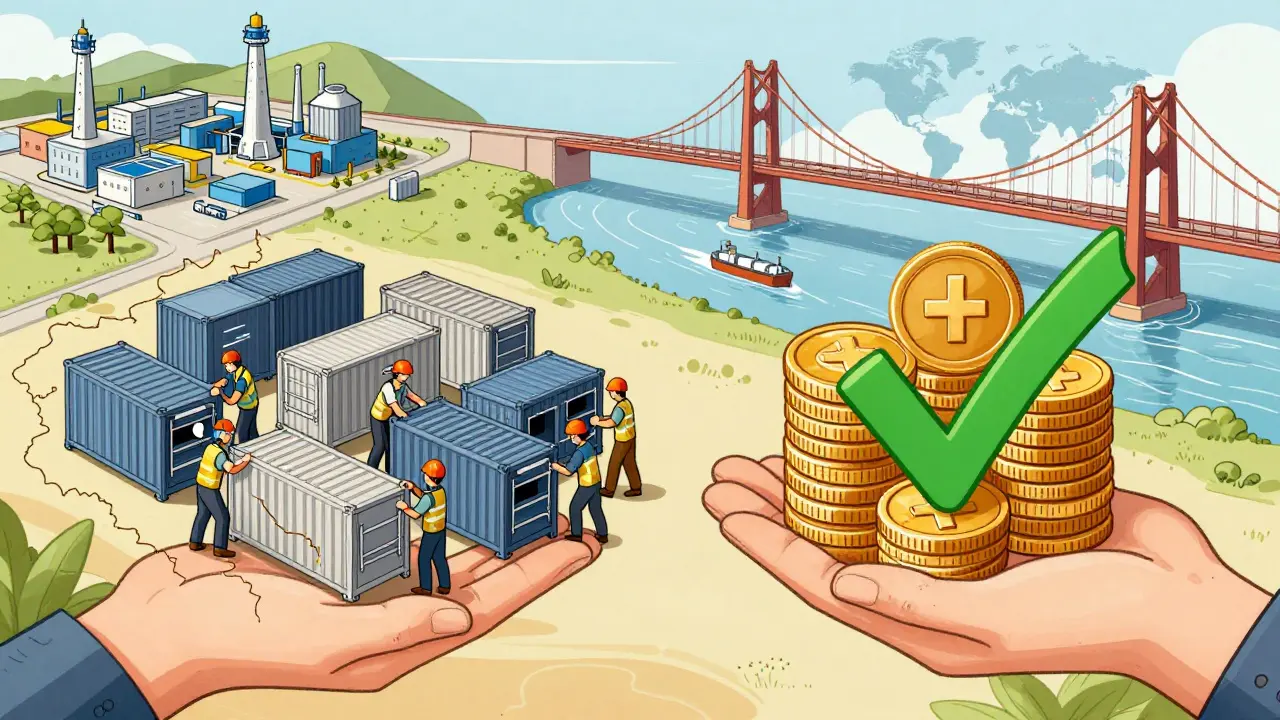
Modular or container-based manufacturing facilities offer another layer of flexibility. These units can be deployed in 12-18 months, compared to 3-5 years for traditional facilities. They scale from 50kg to 2,000kg API production capacity, allowing companies to ramp up production locally when needed. However, adoption faces barriers. Capital requirements for continuous manufacturing range from $50-150 million per facility, and regulatory hurdles remain significant. As of Q2 2025, the FDA had granted only 12 continuous manufacturing approvals compared to over 10,000 batch process approvals. The regulatory landscape is slowly adapting, but the gap persists.
Strategic Sourcing and Regionalization
You cannot rely on a single source for critical medicines. The most effective resilience strategies incorporate dual-sourcing for 70-80% of critical components. This doesn't mean doubling your supplier list randomly; it means building a network of trusted partners across different geographic zones. Geopolitical tensions have accelerated this trend. North American pharmaceutical companies reduced China-sourced API dependencies from 38% in 2022 to 29% in 2025, while increasing domestic production from 22% to 28%.
However, going fully domestic is not a silver bullet. Dr. Robert Chen of the National Academies of Sciences warns that overemphasis on domestic manufacturing could increase costs by 20-30% without necessarily improving resilience if it leads to single-sourcing from domestic suppliers. The goal is a balanced approach: leverage global networks for non-critical items while building strategic domestic capacity for essential medicines. The U.S. currently produces only 28% of essential medicine APIs domestically, with significant shortfalls in sterile injectables (12%) and antibiotics (17%). Closing these gaps requires targeted investment, not blanket protectionism.
Government policy is also shifting. In August 2025, executive orders aimed at strengthening America's pharmaceutical supply chains were signed, including measures to fill a Strategic Active Pharmaceutical Ingredients Reserve. This reserve targets 90-day supply coverage for 150 essential medicines by 2027. While government action helps, private sector agility remains key. Companies implementing comprehensive resilience strategies see a 1.8x return on investment within 36 months through avoided disruption costs.
Implementation Roadmap for Pharma Leaders
Building resilience is a journey, not a one-time project. PwC's 2024 framework recommends a four-phase implementation process:
- Vulnerability Assessment (3-6 months): Map your entire supply chain. Identify single points of failure. Use data integration platforms to reduce vulnerability identification time from 45 days to just 7 days.
- Strategic Scenario Planning (2-4 months): Develop scenarios for various disruptions-geopolitical, natural disasters, cyberattacks. Train your team using scenario-based simulations, which improve response effectiveness by 35-45%.
- Investment Prioritization (1-3 months): Decide where to allocate capital. Leading companies allocate 5-7% of annual supply chain budgets to resilience initiatives, with top performers investing 8-10%. Focus on high-impact areas like buffer stock for critical products and dual-sourcing agreements.
- Cross-Functional Execution (Ongoing): Break down silos. Organizational silos are reported by 78% of surveyed companies as a major challenge. Cross-functional alignment can reduce decision-making time by 40-60% during disruption events. Secure executive sponsorship, which correlates with 3.2x higher implementation success rates.
Common pitfalls include inadequate data integration and regulatory uncertainty. Ensure your IT systems can talk to each other. A fragmented data environment blinds you to emerging risks. Also, stay engaged with regulators. The FDA's 2025 guidance on continuous manufacturing represents a significant shift, reducing approval timelines for qualified facilities. Being part of these conversations helps shape policies that support innovation.
The Financial Reality of Resilience
Let's talk money. Resilience investments add 8-12% to the cost of goods sold according to CSIS (2025). For some CFOs, this sounds expensive. But consider the alternative. ZS Associates' 2024 analysis shows that companies with comprehensive resilience strategies demonstrate 23% higher operational continuity during disruptions. This translates to approximately $14.7 million in avoided revenue losses per major disruption event for large pharmaceutical firms.
The global pharmaceutical supply chain resilience market is projected to grow from $4.2 billion in 2023 to $9.7 billion by 2027. This growth reflects a broader recognition that cheap is not always best. When a drug shortage hits, the reputational damage and loss of patient trust far outweigh the incremental cost of a more robust supply chain. Moreover, operational efficiencies from new technologies like continuous manufacturing can partially offset these costs over time.
Enterprise adoption varies by size. Large pharmaceutical firms (>$10 billion revenue) are implementing comprehensive resilience programs at an 85% adoption rate, compared to 42% for mid-sized firms and 18% for small firms. Smaller players often lack the resources for extensive mapping and technology upgrades. Partnerships and shared infrastructure models may offer a pathway for smaller companies to access resilience benefits without bearing the full cost alone.
Future Outlook and Challenges
Looking ahead, the landscape will continue to evolve. By 2027, analysts project that 45-50% of new pharmaceutical manufacturing capacity will incorporate continuous manufacturing technologies. Regional manufacturing networks are expected to supply 65-70% of U.S. pharmaceutical needs by 2030. However, significant challenges remain. Workforce shortages are critical, with 250,000 skilled manufacturing positions projected to be unfilled by 2027. Regulatory harmonization is another hurdle, with only 35% of manufacturing standards aligned across major markets.
Blockchain-enabled traceability systems offer promise in combating counterfeit drugs, reducing incidence by 70-75% in early pilots. As we move forward, the focus must remain on balance. Efforts to pursue greater onshoring may well be counterproductive if they ignore the value of globally diverse supply chains. The most sustainable long-term strategy leverages global networks while building strategic domestic capacity for critical products. It is about being smart, not just self-sufficient.
What is the most effective preventive measure against drug shortages?
The most effective measure is a combination of dual-sourcing for critical components and maintaining buffer stocks of 60-90 days for essential medicines. This approach mitigates the risk of single-point failures and provides immediate relief during sudden disruptions.
How much does building supply chain resilience cost?
Resilience investments typically add 8-12% to the cost of goods sold. However, leading companies allocate 5-7% of their annual supply chain budgets to these initiatives, with top performers investing 8-10%. The ROI is significant, with avoided disruption costs often exceeding initial investments within 36 months.
Why is continuous manufacturing important for resilience?
Continuous manufacturing reduces facility footprint by 30-40%, lowers energy consumption, and cuts material waste. It also allows for faster scaling and deployment (12-18 months vs. 3-5 years for traditional facilities), enabling quicker responses to demand spikes or supply interruptions.
What role does AI play in preventing supply chain disruptions?
AI-powered predictive analytics can forecast disruption risks with 85-90% accuracy 60-90 days in advance. This early warning system allows companies to proactively adjust sourcing, inventory, and logistics plans before a crisis occurs.
Is complete domestic manufacturing the solution to drug shortages?
No. Overemphasis on domestic manufacturing can increase costs by 20-30% and create new vulnerabilities if it leads to single-sourcing. A balanced approach that combines strategic domestic capacity for critical items with diversified global networks for others is more sustainable and resilient.