
📋 Medication Safety & Advocacy Planner
1. Medication Details
2. Symptom Tracker
-
No symptoms logged yet.
Add your first entry above to start tracking.
3. Data Summary
4. SBAR Communication Script
Fill in the details above to generate your personalized script.
It is easy to assume that your doctor knows exactly how you feel. After all, they prescribe the medication, right? But here is the reality: primary care visits average just 13.2 minutes. In that short window, it is hard to cover everything, which means your experience with a new pill might get lost in the shuffle. If you have ever left an appointment feeling unheard or worried about a symptom but too polite to mention it, you are not alone. Speaking up about medications and their side effects is not just about complaining; it is a critical part of keeping yourself safe and ensuring your treatment actually works.
When patients stay silent, bad things can happen. Data from the World Health Organization suggests that medication nonadherence accounts for roughly 50% of treatment failures. Often, the reason people stop taking their meds isn't forgetfulness-it's because the side effects are bothering them, but they didn't know who to tell or how to say it. This article breaks down exactly how to bridge that gap, turning you from a passive recipient of care into an active partner in your own health.
Why Silence Is Dangerous
Think of your body as a complex machine. When you add a new component (the medication), it interacts with everything else already running inside. Sometimes, those interactions cause friction. That friction shows up as side effects. The problem is that many of these effects are subtle at first. A slight dizziness, a change in appetite, or a mild headache might seem insignificant on their own. But if you don't report them, your provider cannot adjust the dose or switch the drug before the issue becomes serious.
Consider the case of 'HeartPatient2022,' a user on PatientsLikeMe who shared a harrowing story. They started a new blood pressure medication and noticed severe leg cramps. When they mentioned it to their cardiologist, they were told it was "normal." Frustrated, they stopped taking the medication without telling anyone. Two weeks later, they had a mini-stroke. This is an extreme example, but it highlights a common pattern: when patients feel dismissed, they often take matters into their own hands, usually by stopping the med abruptly. Both reporting the side effect and quitting silently carry risks, but staying silent is far more dangerous because it removes your doctor from the decision-making loop.
The Core Components of a Medication Safety Plan
You do not need a medical degree to create a safety plan. You just need structure. A basic Medication Safety Plan is a systematic approach to tracking, documenting, and communicating medication experiences to healthcare providers consists of three main parts: documentation, preparation, and execution. Most people skip the first two and go straight to the appointment, hoping for the best. That rarely works. Instead, treat this like a project you are managing. You are the project manager of your health, and your doctor is the consultant. Consultants need clear briefings to give good advice.
- Documentation: Recording what you feel, when you feel it, and how bad it is.
- Preparation: Organizing your questions and gathering your medication list before you walk into the clinic.
- Execution: Using specific communication techniques during the visit to ensure your points land.
Step-by-Step: How to Document Your Symptoms
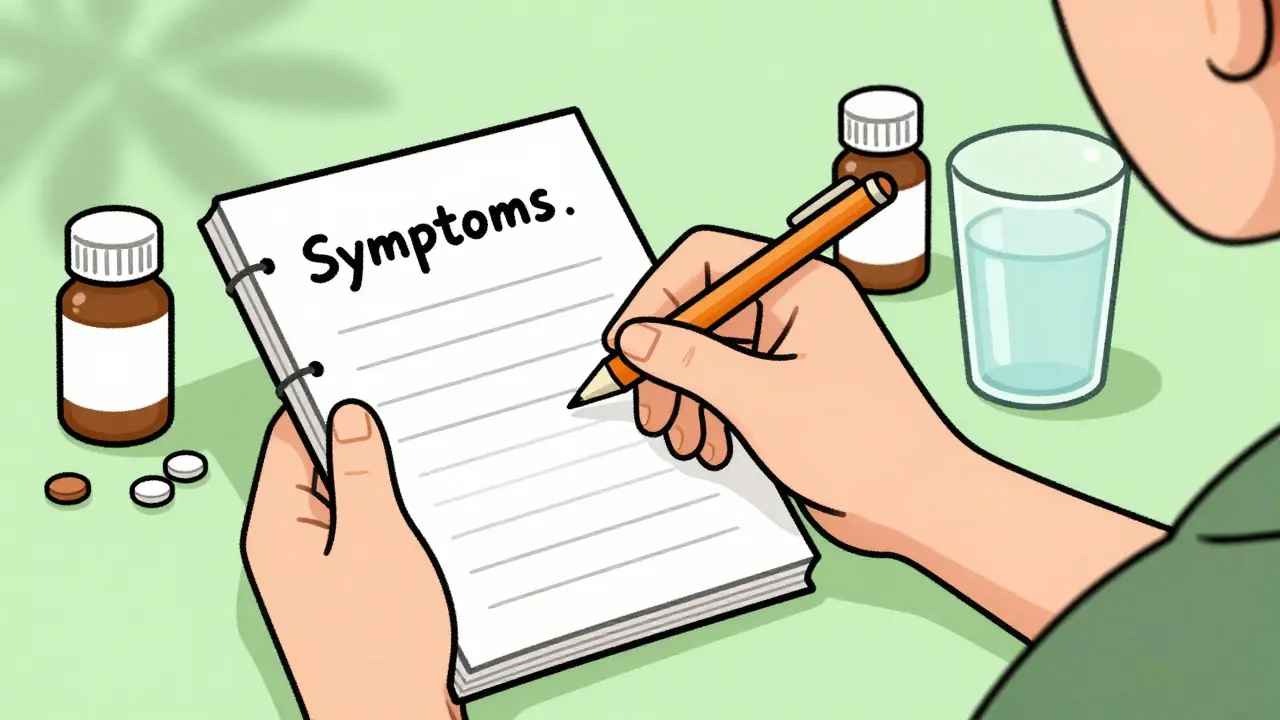
Memory is a terrible record-keeper. We tend to minimize symptoms over time. "Oh, I think I felt dizzy yesterday," we might say, forgetting that it happened five times. To make your advocacy effective, you need data. A study from the University of Michigan Medical School found that patients who used structured tools were 37% more likely to report side effects accurately. Here is how to set up your own tracking system without needing expensive software.
- Use a simple log: You can use a notebook, a notes app, or a dedicated tracker like Medisafe. The key is consistency.
- Record the "What": Describe the symptom clearly. Instead of "I feel off," write "mild nausea after lunch" or "tremors in left hand while holding a cup."
- Note the "When": Time is crucial. Did the symptom start 30 minutes after taking the pill? Or did it happen at bedtime? This helps doctors identify patterns.
- Rate the "How Bad": Use a scale of 0 to 10. Zero is no impact on daily life; ten is incapacitating. This gives your doctor a quick way to gauge severity without you having to explain for ten minutes.
- Track Triggers: Did you eat something specific? Did you miss a dose? Did you take another supplement? Note these variables.
One user on Reddit, 'MedSkeptic87,' shared that bringing printouts of their symptom journal changed everything. Their doctor finally took their dizziness complaints seriously when she saw 37 documented episodes over four weeks. Numbers speak louder than adjectives.
Communication Frameworks That Work
Now that you have your data, how do you present it? Walking into a room and saying "this med is making me crazy" is vague. It invites dismissal. Instead, use proven frameworks. Two stand out for patient advocacy: the "Ask Me 3" method and the SBAR technique.
Ask Me 3 is a communication program developed by the National Patient Safety Foundation to help patients understand their care was designed to simplify complex medical conversations. While originally intended for general understanding, it works brilliantly for clarifying medication concerns. Before you leave the appointment, ask:
- "What is my main problem?" (In this context: What is the biggest risk with this medication?)
- "What do I need to do?" (Specifically regarding the side effect I'm experiencing.)
- "Why is it important for me to do this?" (Why should I continue despite the side effect, or why should I stop?)
For more detailed discussions, try SBAR. Originally used in military and emergency communications, SBAR stands for Situation, Background, Assessment, and Recommendation. It structures your thoughts so you don't ramble.
- Situation: "I am taking [Medication Name] for [Condition]."
- Background: "I started it three weeks ago. I have been taking it at 8 AM daily."
- Assessment: "Since day five, I have experienced persistent dry mouth and mild insomnia. I rated the discomfort at a 6/10 last week."
- Recommendation: "Can we discuss adjusting the timing to evening, or switching to a different formulation?"
Navigating the Appointment: Tips for Success
Even with the best preparation, appointments can go sideways. The American Medical Association’s 2022 survey found that while 78.3% of patients want to discuss side effects, 61.2% feel rushed. Here are practical tips to keep the conversation on track.
Bring the bottles. Don't rely on memory or a written list alone. Bring every container of medication, including supplements and over-the-counter drugs. Doctors can check for interactions instantly. It also serves as a visual cue that you are serious about managing your regimen.
Start strong. Don't save your biggest concern for the end of the visit when time is running out. If the side effect is affecting your quality of life, mention it in the first two minutes. Say, "Before we dive into the routine checks, I wanted to flag a significant side effect from my new prescription."
Request a written plan. Verbal agreements fade fast. Ask for a summary of what you discussed. "So, to recap, we're going to monitor the dizziness for one week, and if it persists, we'll consider a dose reduction. Can you put that in my chart or send me a note?" This creates accountability.

Common Pitfalls to Avoid
Not all advocacy is created equal. Some approaches backfire. Here is what to watch out for.
| Strategy | Why It Works/Fails | Better Alternative |
|---|---|---|
| Vague Complaints | "It feels weird" is subjective and hard to act on. Doctors may dismiss it as placebo or anxiety. | Specific Symptom Logs |
| Stopping Meds Silently | Removes the doctor from the loop. Can lead to rebound effects or lack of monitoring. | Collaborative Adjustment |
| Catastrophizing | Over-reporting minor issues without context can lead to unnecessary alarm or premature discontinuation. | Contextual Reporting (SBAR) |
| Ignoring Supplements | Herbal remedies and vitamins interact with prescriptions. Hiding them prevents full risk assessment. | Full Disclosure |
Dr. Benjamin Chan, Chief Medical Officer at the FDA’s Center for Drug Evaluation and Research, has cautioned that over-reporting minor side effects without clinical context can create unnecessary alarm. The goal is balance. You want to be thorough, not dramatic. Stick to the facts, use your logs, and let the data drive the conversation.
Digital Tools and Resources
You don't have to do this alone. Technology has made advocacy easier. Apps like Medisafe allow you to track doses and symptoms in one place. A 2022 validation study in JMIR mHealth found that 87% of users were able to track side effects systematically using such tools. These apps often generate reports you can export or show directly to your provider.
Also, don't ignore the Patient Information Leaflet (PIL). While only 43.7% of patients read them thoroughly due to complex language, they contain vital information about known side effects. If a symptom you're experiencing is listed there, it validates your concern. If it isn't, that's even more reason to report it, as it might be a rare reaction worth documenting.
Frequently Asked Questions
How often should I review my medication side effects?
Ideally, you should monitor for new symptoms daily for the first two weeks of starting a new medication. After that, a weekly check-in with your log is sufficient unless you notice a change. If you are on multiple medications, review your list monthly to catch any new interactions.
What if my doctor dismisses my side effects?
First, try using the SBAR framework to present your data objectively. If that fails, ask for a second opinion or consult your pharmacist, who often has more time to discuss drug details. You can also report the side effect directly to the FDA via MedWatcher Connect, which adds an official record to your history.
Do over-the-counter drugs count for my safety plan?
Yes, absolutely. Many over-the-counter pain relievers, antacids, and herbal supplements interact with prescription medications. Always include them in your medication list and bring the boxes to your appointments. Hidden interactions are a leading cause of unexpected side effects.
Is it okay to stop a medication if the side effects are unbearable?
Generally, no. Stopping abruptly can cause withdrawal symptoms or rebound effects, especially with beta-blockers, steroids, or antidepressants. If the side effects are truly unbearable, call your doctor immediately to discuss a tapering schedule or a switch to an alternative. Silence is riskier than a phone call.
How long does it take for a new medication to settle in?
It varies by drug. Some side effects fade within a few days, while others, like fatigue or mood changes, might take 2-4 weeks to resolve as your body adjusts. However, if a side effect is severe (e.g., difficulty breathing, rash, swelling), seek immediate care regardless of how long you've been on the med.