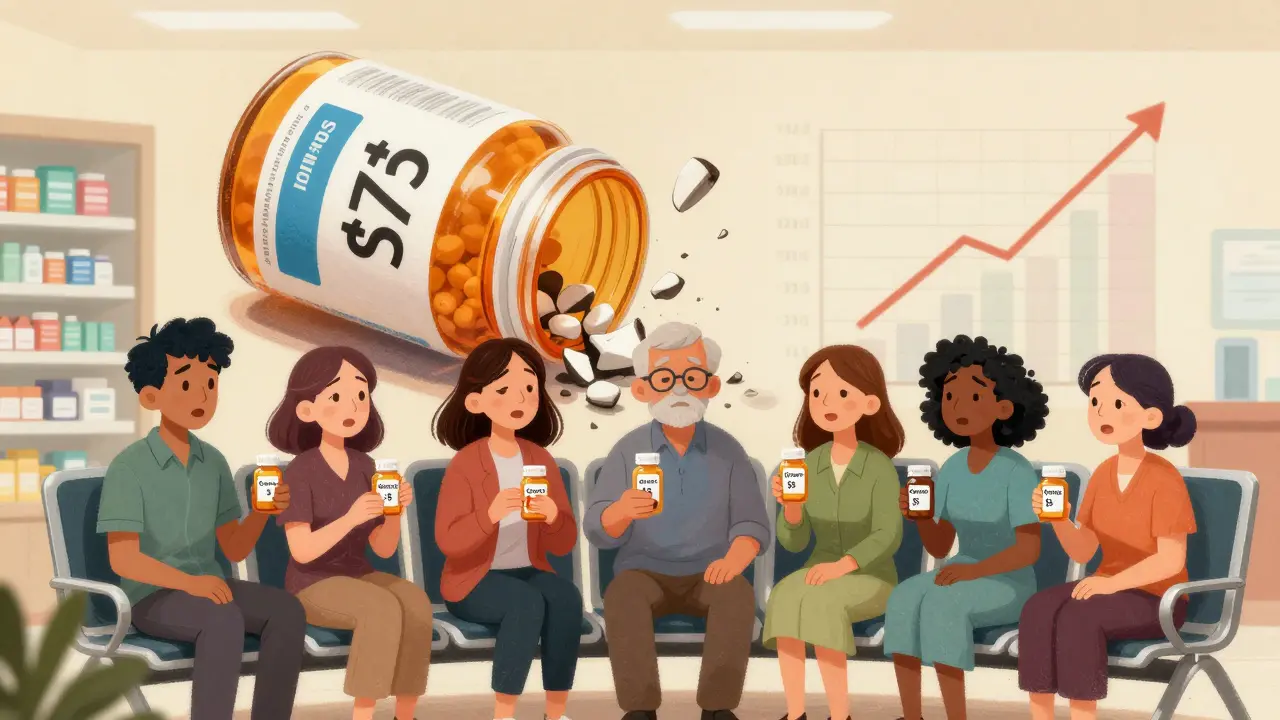
When a patient skips a dose because the pill costs too much, it’s not just a personal choice-it’s a system failure. Every year, generic drug prices save billions in healthcare spending, but their real power lies in what they do for people: they help patients actually take their medicine. And when patients take their meds as prescribed, hospitals see fewer emergencies, doctors see better outcomes, and lives are saved.
Cost Stops People From Taking Their Medicine
It’s simple math: if a pill costs $75, many people won’t fill it. If it costs $5, they will. A 2023 survey of over 2,100 adults found that nearly one in three admitted to skipping doses, delaying refills, or skipping prescriptions altogether because of cost. That’s cost-related nonadherence-and it’s not rare. It’s routine.
Patients don’t ignore their prescriptions because they’re careless. They do it because they’re choosing between medicine and rent, groceries, or bus fare. One Reddit user, u/HeartHealthJourney, shared how switching from brand-name Crestor ($75 copay) to generic rosuvastatin ($5 copay) turned his adherence from missing 3-4 doses a week to perfect compliance for 11 months straight. That’s not luck. That’s price.
Generics Work Just as Well-But Cost Far Less
Generic drugs aren’t cheap because they’re weak. They’re cheap because they don’t need to spend millions on marketing or patent protection. The FDA requires generics to have the same active ingredient, strength, dosage form, and route of administration as the brand-name version. They must also prove they’re absorbed in the body within 80-125% of the brand drug’s rate-meaning they work the same way, in the same amount of time.
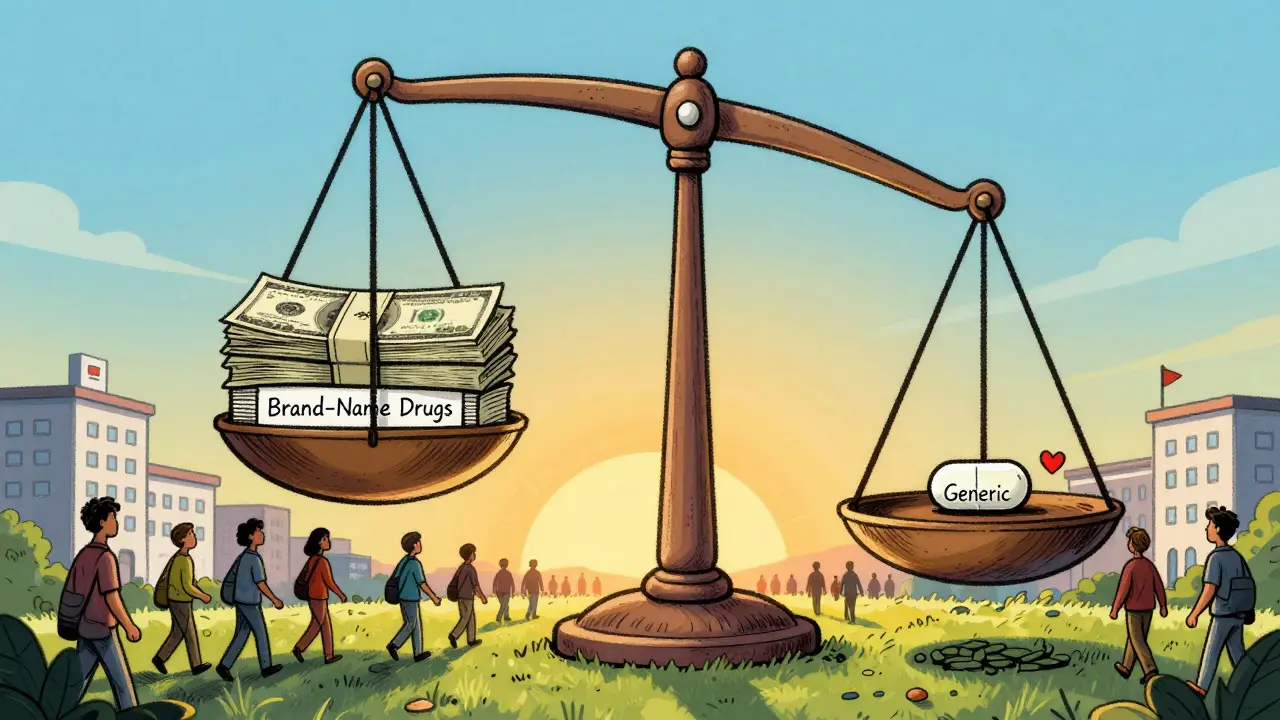
And the savings? They’re massive. Generics cost 80-85% less than their brand-name counterparts. In the U.S., generics make up 90% of all prescriptions filled-but only 23% of total drug spending. Between 2009 and 2019, they saved the healthcare system $643 billion. That’s not a rounding error. That’s a lifeline.
Lower Prices = Higher Adherence-It’s a Direct Link
Studies don’t just suggest this-they prove it. When statins like atorvastatin and rosuvastatin were moved from a higher-cost insurance tier to the lowest tier under Medicare Part D, adherence jumped by 5.9%. For breast cancer patients taking aromatase inhibitors, those on generics had 73.1% adherence compared to 68.4% for those on brand-name drugs. And the gap? It was directly tied to copay amounts.
There’s a clear pattern: every $10 increase in out-of-pocket cost leads to a 2-4% drop in adherence. For GLP-1 drugs used in diabetes, each $10 rise in cost cuts adherence likelihood by 3.7% and bumps emergency room visits up by 5.2%. This isn’t theoretical. It’s measurable. It’s happening right now in clinics, pharmacies, and homes across the country.
What Happens When People Don’t Take Their Meds?
Skipping pills doesn’t just mean a symptom lingers. It means complications. It means hospitalizations. It means death.
Medication nonadherence causes up to half of all treatment failures. It contributes to over 100,000 preventable deaths each year in the U.S. And it adds $100-$300 billion in avoidable healthcare costs annually. That’s more than the entire annual budget of many U.S. states.
Adherent patients, on the other hand, have 15-20% fewer hospital stays. They need fewer lab tests. They avoid complications that lead to surgeries and long-term care. The money saved on hospital bills far outweighs the cost of the drugs themselves. As one 2011 study in Health Affairs put it: adherence leads to lower healthcare use and costs-even when drug spending goes up.
How the System Is Changing to Help
Change is happening, slowly but surely. The Inflation Reduction Act of 2022 capped insulin at $35 a month. By 2025, Medicare Part D will eliminate the coverage gap entirely and cap total out-of-pocket drug spending at $2,000 a year. That alone is expected to improve adherence for 1.4 million Medicare beneficiaries.
Real-time benefit tools (RTBTs) are another game-changer. These systems show doctors the exact cost of a prescription before they write it. In pilot programs, they’ve boosted adherence by 12-15%. One pharmacy program, Magellan’s inforMED, reported a 40% reduction in care gaps and a 2:1 return on investment. That means for every dollar spent on the tool, two dollars were saved in avoided hospital visits and emergency care.
Still, challenges remain. Many patients don’t trust generics. They think “cheaper” means “worse.” That’s why the FDA’s “It’s Okay to Use Generics” campaign matters. It’s not just about price-it’s about perception.
Why This Matters More Than You Think
Americans pay 256% more for brand-name drugs than people in the UK, Canada, Germany, or Japan. Meanwhile, the cost of 48.7% of drug products rose faster than inflation between 2022 and 2023. The average price increase? $590 per drug. That’s not market dynamics. That’s a broken system.
And yet, the solution is already here. Generics work. They’re safe. They’re effective. And they’re affordable. The problem isn’t the medicine-it’s the pricing structure. When insurers put a $100 copay on a life-saving drug, they’re not protecting their budget-they’re gambling with lives.
Therapeutic duplication-prescribing multiple drugs for the same condition-is still costing the system 20-30% more than needed. Medication therapy management programs could fix that. But even without them, just switching patients to generics would make a massive dent.
What Can You Do?
If you’re a patient: Ask if a generic is available. Ask what the cash price is at different pharmacies. Use tools like GoodRx to compare prices. Don’t assume your insurance will tell you the cheapest option-it often doesn’t.
If you’re a provider: Use real-time benefit tools. Talk about cost during appointments. Don’t wait for the patient to bring it up. Ask: “Can you afford this?” It’s a simple question that saves lives.
If you’re a policymaker: Expand formulary tiering. Cap out-of-pocket costs. Fund generic drug approvals. The FDA’s GDUFA III program, which committed $1.1 billion to speed up generic approvals, is a model. More of that. Faster.
It’s Not Just About Money-It’s About Trust
At the heart of this issue is trust. Patients need to trust that their doctor isn’t prescribing something they can’t afford. Pharmacies need to trust that the system will support access. And the system needs to trust that patients will follow through-if they’re given a fair chance.
Lower generic prices don’t just reduce costs. They restore dignity. They reduce shame. They turn “I can’t afford this” into “I can take this.” And when patients can take their medicine, they live longer, healthier lives.
The data is clear. The solutions exist. What’s missing is the will to act-at every level, from the pharmacy counter to Congress.
Do generic drugs work as well as brand-name drugs?
Yes. The FDA requires generic drugs to contain the same active ingredient, strength, dosage form, and route of administration as the brand-name version. They must also prove bioequivalence-meaning they’re absorbed in the body at the same rate and to the same extent as the brand drug, within a strict 80-125% range. Studies show they produce identical clinical outcomes for conditions like high blood pressure, diabetes, depression, and cholesterol.
Why are generic drugs so much cheaper?
Brand-name drug companies spend billions on research, marketing, and patent protection. Once the patent expires, other companies can make the same drug without those costs. Generic manufacturers don’t need to repeat expensive clinical trials-they just need to prove their version works the same way. That cuts production costs by 80-85%, which is passed on to patients.
Does lowering copays really improve adherence?
Yes, consistently. Multiple studies show a direct link: every $10 increase in out-of-pocket cost reduces adherence by 2-4%. When Medicare moved statins from a higher-cost tier to the lowest tier, adherence rose by 5.9%. For diabetes medications, each $10 price increase lowered adherence by 3.7%. Cost is one of the strongest predictors of whether someone takes their medicine.
What if I can’t afford even my generic medication?
Many pharmaceutical companies offer patient assistance programs. Nonprofits like NeedyMeds and Partnership for Prescription Assistance can help you find free or low-cost options. Also, use tools like GoodRx or SingleCare to compare prices across pharmacies-sometimes the cash price at Walmart or Costco is lower than your insurance copay. Talk to your pharmacist or doctor-they may have samples or coupons.
Are there cases where generics don’t work as well?
Rarely. For most medications-including those for high blood pressure, cholesterol, diabetes, and depression-generics perform identically to brand-name drugs. In less than 5% of cases, such as certain narrow-therapeutic-index drugs (like warfarin or thyroid meds), doctors may monitor levels more closely when switching. But even then, generics are still safe and effective. The FDA and medical guidelines support their use in nearly all cases.
How do real-time benefit tools help patients?
Real-time benefit tools show doctors the exact cost of a prescription before they write it-based on the patient’s insurance, pharmacy, and available discounts. This lets them choose a lower-cost alternative on the spot. In pilot programs, these tools improved adherence by 12-15% and reduced care gaps by 40%. They turn surprise bills into informed choices.
What’s being done to make generics more available?
The FDA’s Generic Drug User Fee Amendments (GDUFA III), launched in 2023, is investing $1.1 billion to speed up approvals. This is expected to add over 1,500 new generic drugs to the market by 2027. Medicare’s new $2,000 out-of-pocket cap (starting 2025) and insulin price caps are also expanding access. These policies are designed to keep generics affordable and widely available.
15 Responses
I used to skip my blood pressure meds till I switched to generic. Now I take them like clockwork. No more dizzy spells. No more ER trips. Just quiet mornings and a $5 copay. This isn't rocket science. It's basic human dignity.
The FDA bioequivalence range is 80-125%. That means a generic could be 20% weaker or 25% stronger than the brand. That's not the same. It's mathematically different. People don't understand pharmacokinetics.
In India, we've been using generics for decades. No one dies. No one gets worse. Why is America acting like this is some new miracle? We've known this for years. Your system is broken because you let corporations run medicine like a casino.
I work in a community pharmacy and I see this every single day. A woman once cried because she had to choose between her insulin and her daughter's school supplies. We have the tools. We have the science. What we're missing is the moral courage to fix it. Let's stop pretending this is about budgets. It's about people.
I'm curious about the 5% of cases where generics might have variable outcomes. Can anyone point to peer-reviewed studies that specifically examine narrow therapeutic index drugs like levothyroxine or warfarin in real-world adherence scenarios? I want to see the data beyond the headlines.
I'm a nurse practitioner. I started asking patients 'Can you afford this?' during every visit. It's changed everything. Suddenly, people talk. They tell me about skipping doses, splitting pills, using expired meds. It's not about being nosy. It's about being human. And yes, switching to generics solves 80% of those cases immediately.
In India, we don't have the luxury of brand-name drugs. We use generics because we have to. And guess what? We live. We thrive. We raise families. The idea that cheaper means worse is a Western myth sold by big pharma. Your system is not broken because generics don't work. It's broken because they work too well for the corporations to control.
I've been on statins for 15 years. Switched to generic last year. Same pill. Same results. My cholesterol's stable. My wallet's happy. I don't get why this is even a debate. It's like arguing whether a Ford engine is better than a Toyota one when they both run on petrol.
My mom took her generics for 12 years. Never missed a dose. Never had a problem. She's 82 and still walks her dog every morning. I wish more people knew this wasn't magic. It's just common sense. And kindness.
I just checked GoodRx for my antidepressant. Brand: $142. Generic: $7. I cried. Not because I'm dramatic. Because I realized I was one missed paycheck away from not breathing. 💔
So the system's broken? Wow. Groundbreaking. Next you'll tell me the sky is blue and water is wet. Meanwhile, my insurance still won't cover the generic unless I jump through 17 hoops. This post is just feel-good noise. Real change? That's a whole other ballgame.
LMAO you think generics are the answer? Nah. Big Pharma just made the generics themselves. They own the patents. They own the factories. They just rebranded the same pill. You're being played. The system's rigged. Always has been.
Generics are just the first step. Wait till you find out the FDA approves them based on data from China and India. No one checks the actual pills. They just trust the paperwork. I know a guy whose cousin's neighbor got sick after switching. They buried it. You think this is about health? It's about control.
I read the whole thing. Boring. Everyone knows generics are cheaper. Who cares? Just give me my free Netflix and stop preaching
In the UK, we've had this system for years. Generics are the default. Doctors don't even ask. Patients don't panic. We don't have the same drama. It's just... normal. Maybe we're not so different after all.