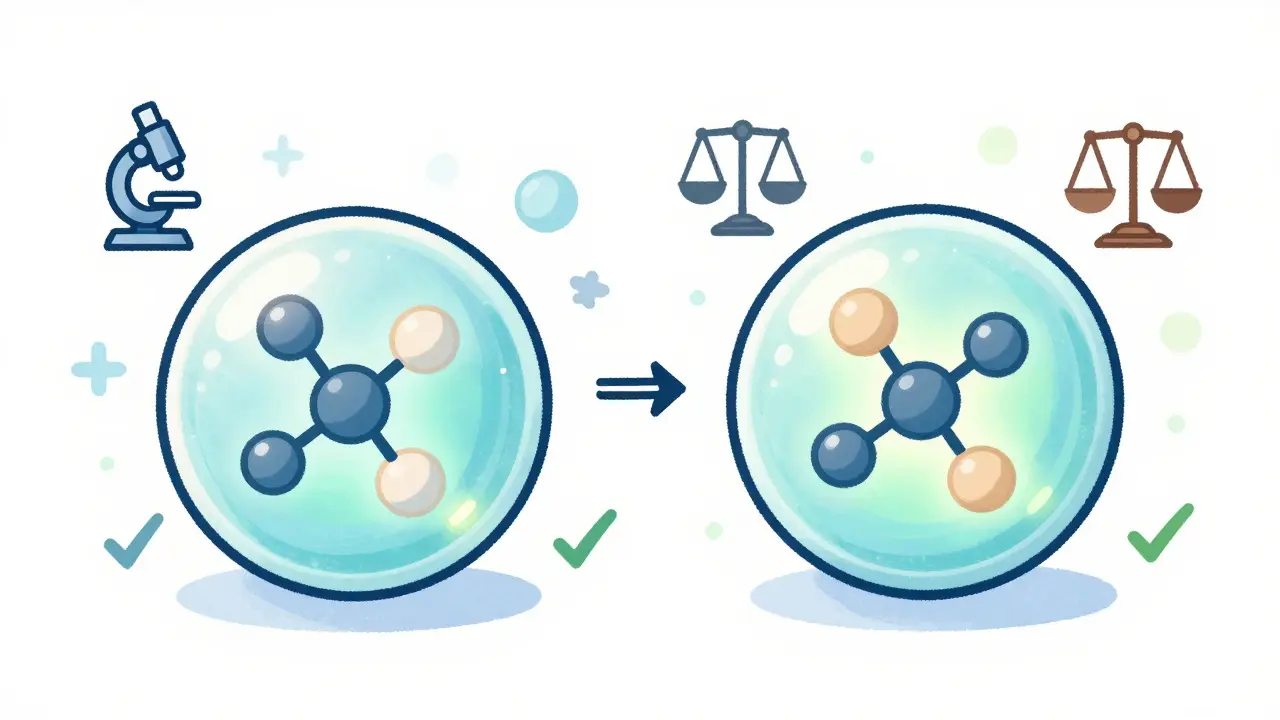
When you pick up a generic pill at the pharmacy, you might wonder: is this really the same as the brand-name drug? The answer isn’t just yes-it’s backed by a rigorous, science-driven system designed to make sure every generic medication works exactly as intended. The FDA doesn’t just approve generics because they’re cheaper. They approve them because they’ve passed the same high bar as the original drugs-sometimes even tested harder.
What Makes a Generic Drug the Same?
It’s not enough for a generic drug to have the same active ingredient. The FDA requires pharmaceutical equivalence: the generic must contain the same active ingredient, in the same strength, same dosage form (pill, injection, cream, etc.), and be used the same way as the brand-name version. That means if the brand is a 50mg tablet taken once daily, the generic has to match that exactly.
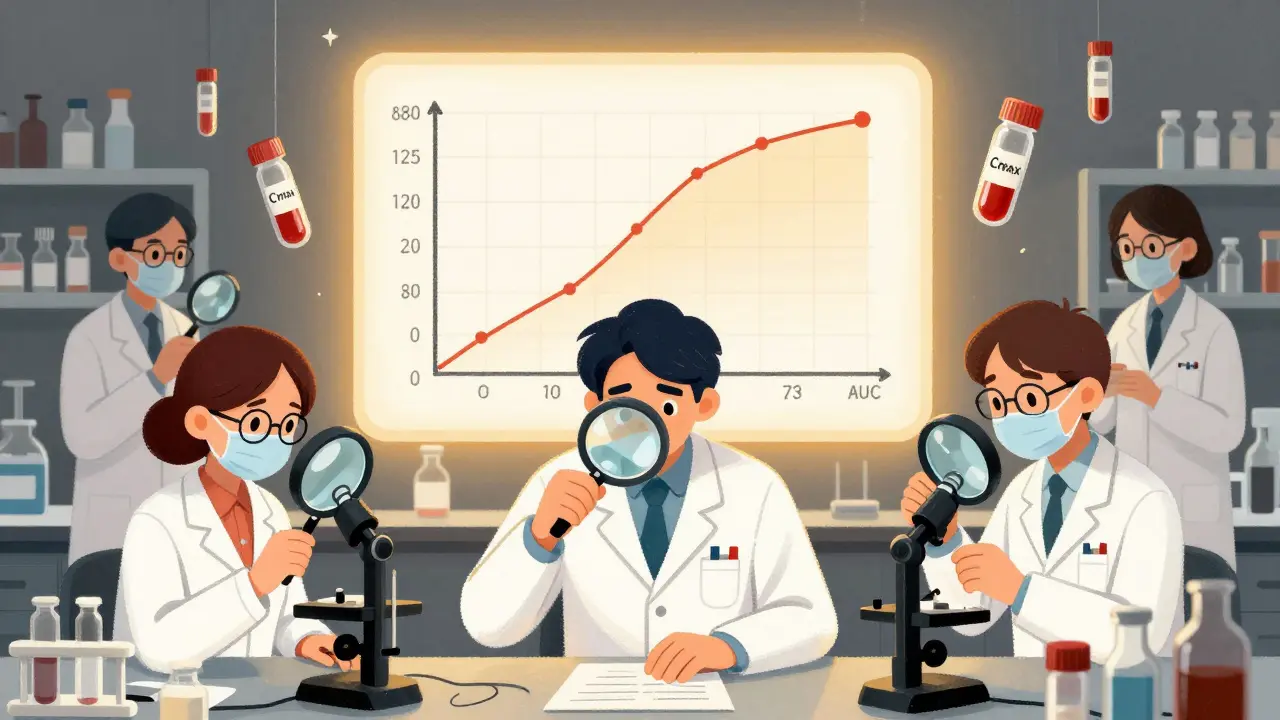
But here’s where it gets deeper. Two pills can look and taste identical and still behave differently inside your body. That’s why the FDA demands bioequivalence. This means the generic must be absorbed into your bloodstream at the same rate and to the same extent as the brand-name drug. The standard? The 90% confidence interval for the ratio of the generic to brand-name drug’s Cmax (peak concentration) and AUC (total exposure) must fall between 80% and 125%. In plain terms: your body gets nearly the same amount of medicine, within a tiny, clinically acceptable range.
This isn’t guesswork. It’s measured in controlled studies with 24 to 36 healthy volunteers. Blood samples are taken over hours to map how the drug moves through the system. If the numbers don’t land in that 80-125% window, the application gets rejected. No exceptions.
The ANDA Process: How Generics Get Approved
Generic manufacturers don’t start from scratch. They file an Abbreviated New Drug Application (ANDA). The word “abbreviated” doesn’t mean less work-it means they don’t need to repeat the massive clinical trials the original drug went through. Instead, they prove equivalence through chemistry, manufacturing, and bioequivalence data.
The ANDA process is strict. Every step is reviewed by the FDA’s Office of Generic Drugs. That includes:
- Proof that the active ingredient matches the brand-name drug’s purity and strength
- Documentation of every ingredient-even the inactive ones like dyes or fillers
- Validation that the manufacturing process consistently produces pills meeting exact specs
- Stability testing showing the drug won’t break down over time
Stability testing alone can take over a year. Manufacturers must store samples at high heat and humidity (40°C/75% RH) for six months and under normal conditions for 12-24 months. If the drug degrades too much, it’s not approved. The shelf life on the bottle? That’s not a marketing claim-it’s science-backed.
On average, the FDA takes about 10 months to review a complete ANDA. In 2022, they approved 892 original ANDAs and issued 478 complete response letters-meaning the application had issues that needed fixing before approval. That’s a rejection rate of nearly 35%. It’s not easy to get through.
Manufacturing: Same Rules, Same Facilities
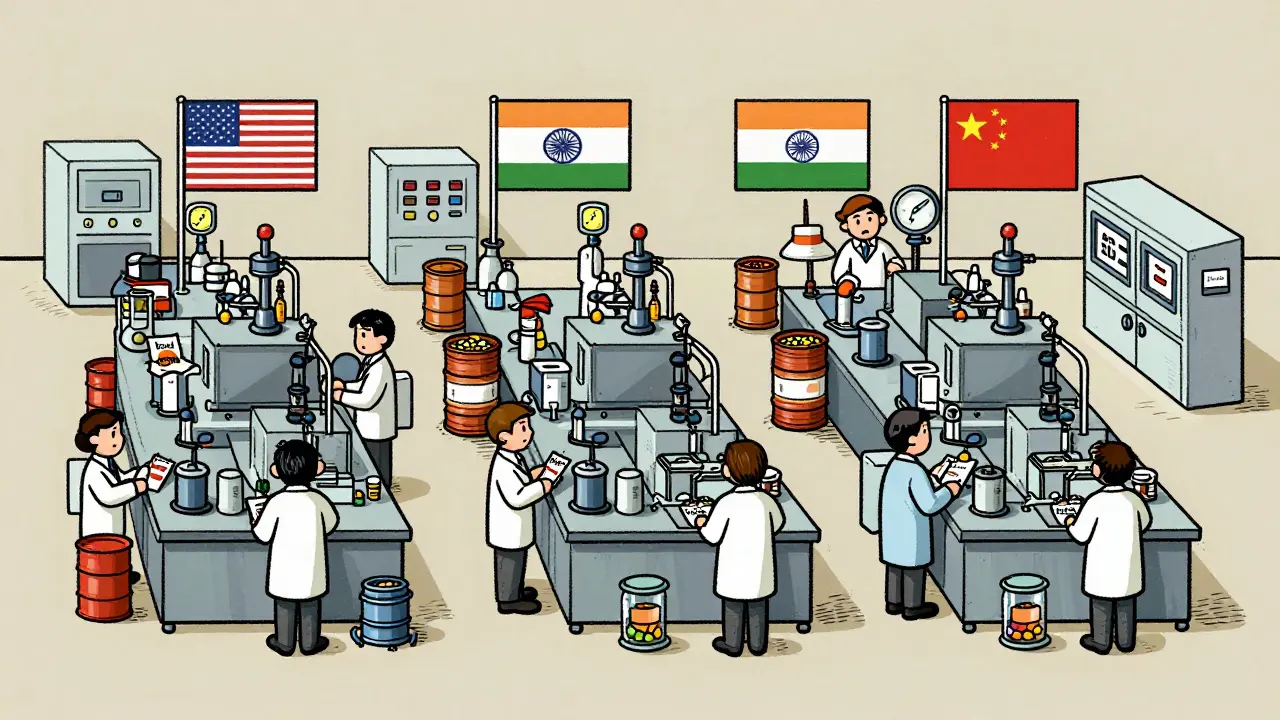
Many people assume generic drugs are made in low-quality factories overseas. That’s a myth. The FDA enforces Current Good Manufacturing Practices (cGMP) under 21 CFR Parts 210 and 211. These rules cover everything-from how raw materials are stored to how machines are cleaned between batches.
And here’s something surprising: about half of all generic drugs in the U.S. are made by the same companies that produce the brand-name versions. In fact, many generics come from the exact same factory, on the same production lines. The only difference? The label.
The FDA inspects over 3,500 manufacturing sites each year-whether they’re in the U.S., India, China, or elsewhere. No country gets a pass. If a facility fails inspection, the FDA can block imports or delay approval. In 2023, the agency shut down several overseas plants for failing to meet cGMP standards. Quality isn’t optional. It’s enforced.
Complex Drugs: When Equivalence Gets Harder
Not all drugs are created equal. For simple pills-like metformin or atorvastatin-bioequivalence is straightforward. But for complex products like inhalers, injectables, or topical creams? It’s a whole different challenge.
Take an asthma inhaler. It’s not just about what’s inside. The spray pattern, droplet size, and how the drug sticks to your lungs all matter. The FDA can’t just measure blood levels and call it good. That’s why they’ve created over 2,143 product-specific guidances for complex generics as of 2023. These documents lay out exactly what tests are needed-sometimes requiring advanced imaging, particle analysis, or even clinical endpoint studies.
Dr. Charles Ganley, former head of the FDA’s Office of Generic Drugs, pointed out in 2019 that “demonstrating equivalence for topical creams or inhalers requires more sophisticated testing than simple blood level measurements.” The FDA has since invested $15.7 million into research to improve these methods. They’ve held 18 public workshops with scientists and manufacturers to tackle these problems.
Still, some complex generics face higher rejection rates. In 2022, the FDA found that 17% of complex drug categories needed additional testing beyond standard bioequivalence. That’s why some patients report differences with certain medications-especially those with a narrow therapeutic index, like levothyroxine or warfarin.
Are Generics Safe? What the Data Says
Over 90% of prescriptions filled in the U.S. are for generic drugs. That’s more than 4 billion prescriptions a year. And the data shows they work.
A 2022 Consumer Reports survey of 1,200 Americans found 89% were satisfied with their generic medications. Sixty-two percent said they chose generics specifically to save money. And they’re not wrong: generics saved the U.S. healthcare system $37 billion in 2022 alone.
But there are exceptions. A 2021 study in JAMA Internal Medicine found that 12.3% of patients switching between different generic versions of levothyroxine had noticeable changes in thyroid hormone levels. That’s why doctors often recommend sticking with one generic brand if you’re on a narrow therapeutic index drug.
On Reddit’s r/pharmacy community, a 2023 thread with over 1,400 responses showed 83% of users reported no difference between generic and brand-name drugs. The remaining 17% mostly mentioned issues with seizure medications or blood thinners. These are the cases where even tiny variations matter.
That’s why the FDA continues to refine its standards. They don’t treat all generics the same. The more complex the drug, the more scrutiny it gets.
Why This System Works
The Hatch-Waxman Act of 1984 created the framework that made all this possible. It gave drug companies a way to protect their patents-but also opened the door for generics to enter the market after those patents expired. The result? Lower prices without sacrificing safety.
Today, generics make up just 23% of total drug spending in the U.S., but they fill over 90% of prescriptions. That’s the power of competition. And it’s not slowing down. The generic drug market is projected to grow to $180.3 billion by 2027.
Dr. Janet Woodcock, former director of the FDA’s Center for Drug Evaluation and Research, put it simply: “FDA-approved generic drugs have the same high quality, strength, purity and stability as brand-name drugs.”
That’s not marketing. It’s regulation. It’s science. It’s thousands of inspections, millions of lab tests, and a system designed to protect patients-not just profits.
Are generic drugs as effective as brand-name drugs?
Yes. The FDA requires generic drugs to meet the same standards for strength, quality, purity, and stability as brand-name drugs. They must also prove bioequivalence-meaning they work the same way in your body. Over 90% of prescriptions in the U.S. are for generics, and studies show they work just as well for most people.
Why do some people say generics don’t work as well?
For most drugs, this isn’t true. But for medications with a narrow therapeutic index-like levothyroxine, warfarin, or some seizure drugs-even small differences in absorption can matter. Some patients report side effects or changes in symptoms when switching between generic versions. That’s why doctors sometimes recommend sticking with one brand or generic version. It’s not that generics are unsafe-it’s that precision matters more in these cases.
Are generic drugs made in the same factories as brand-name drugs?
Yes, often. About half of all generic drugs in the U.S. are made by the same companies that produce brand-name versions. Many are made in the same facilities, on the same equipment. The FDA inspects all of them equally. The difference is just the label and the price.
How does the FDA ensure generic drugs are safe?
The FDA requires generic manufacturers to prove pharmaceutical and bioequivalence, follow strict manufacturing rules (cGMP), and submit detailed stability data. They inspect over 3,500 facilities worldwide each year. Every batch of drug must pass identity, strength, purity, and quality tests before it’s released. If a product fails, it’s blocked from sale.
What’s the difference between pharmaceutical equivalence and bioequivalence?
Pharmaceutical equivalence means the generic has the same active ingredient, strength, dosage form, and route of administration as the brand-name drug. Bioequivalence means the generic is absorbed into your body at the same rate and amount as the brand. One is about what’s in the pill; the other is about how your body uses it.
Can I trust a generic drug from another country?
If it’s sold in the U.S., yes. The FDA requires all generic drugs sold here-no matter where they’re made-to meet the same standards as U.S.-made drugs. The agency inspects foreign factories just like domestic ones. If a facility fails inspection, the FDA can stop imports. Drugs bought online from unregulated sources are a different story-those aren’t FDA-approved.
Why are generic drugs cheaper?
Generic manufacturers don’t have to pay for the original research, clinical trials, or marketing campaigns. They file a streamlined application (ANDA) proving equivalence, which costs far less than developing a new drug. Competition among multiple generic makers drives prices down further. That’s why generics save patients and insurers billions each year.
How long does it take for a generic drug to be approved?
The FDA aims to review a complete Abbreviated New Drug Application (ANDA) in 10 months. But if the application is incomplete or raises concerns, it can take longer. Some complex generics may need additional testing or multiple rounds of review. In 2022, the FDA approved 892 original ANDAs and issued 478 complete response letters, meaning many applications need revisions before approval.
What Comes Next
The FDA’s focus is shifting toward complex generics-drugs that are harder to copy. With biosimilars and non-biological complex drugs on the rise, the agency is investing in new testing tools and working more closely with manufacturers through its Pre-ANDA program. In 2022 alone, they held 1,243 Pre-ANDA meetings to help companies get it right the first time.
For patients, the message is simple: trust the system. Generic drugs are not second-rate. They’re the result of a deliberate, science-based process designed to give you the same medicine at a fraction of the cost. And for most people, that’s exactly what they get.
12 Responses
Let’s be real-most people don’t understand bioequivalence, yet they’ll swear their generic Lexapro ‘doesn’t work’ because their mood ‘feels off.’ The FDA’s 80-125% window isn’t arbitrary; it’s statistically validated across thousands of trials. If you’re claiming a difference, you’re either misattributing placebo effects or you’re one of the 0.3% with extreme pharmacokinetic variance. Stop blaming the system and start understanding it.
It’s fascinating how we trust a pill more when it’s branded, yet we don’t question the science behind it. The body doesn’t care about the label-it only responds to molecular structure and absorption kinetics. Perhaps our fear of generics is less about medicine and more about identity: we associate cost with value, and value with worthiness. But the pill doesn’t know if you paid $2 or $200 for it.
bro i took generic adderall for 3 years and never had an issue. same with my blood pressure meds. the system works. stop listening to reddit lore and trust the science. also, the FDA inspects plants in india like they’re in new jersey. no cap.
Let me break this down for you like you’re five: the FDA doesn’t just slap a stamp on generics because they’re cheap. They make sure every single molecule behaves the same way in your body. That’s not marketing. That’s science on steroids. And yeah, half of them come from the same factory as the brand. Same machine. Same batch. Just a different sticker. You’re not getting second-rate. You’re getting the same thing for 90% less. That’s capitalism doing its job.
Wow, so generics are basically the IKEA version of pharmaceuticals-same parts, different box, way cheaper, and you assemble them yourself? I mean… I get it. But I still kinda feel bad for the guy who spent $2 billion developing the original and now someone else is just slapping on a new label. Still… I’m not paying $500 for a 30-day supply of metformin. So… win-win?
generic = same active ingred. same dose. same way it works. end of story. if u feel diff, its your mind or u switched brands. stick to one. easy.
It is, quite frankly, astonishing that any individual would question the integrity of the FDA’s approval protocols for generic pharmaceuticals, given the rigorous, multi-layered, and meticulously documented processes that underpin each and every approval. The notion that cost reduction equates to compromised quality is not only scientifically baseless-it is an affront to evidence-based medicine.
lol ok so you’re telling me my weird anxiety after switching to generic Xanax is just ‘in my head’? 🤡 I’ve been on brand for 10 years. I know my body. You think I’m lying? The FDA doesn’t care about people who actually use these drugs. They care about corporate profits. #GenericLies
Actually, the 80–125% bioequivalence range is a bit misleading-it’s not ‘nearly the same,’ it’s a statistically acceptable variance for population-level outcomes. But for individuals with narrow therapeutic indices, like those on warfarin, even a 5% shift can be clinically significant. So while the system works for 95% of people, the 5%? They’re the ones getting screwed. And nobody talks about that.
It’s easy to dismiss concerns about generics when you’ve never had a seizure or lost control of your thyroid. But for those of us who rely on absolute consistency, the difference between one generic and another isn’t theoretical-it’s visceral. The FDA’s standards are solid, but they’re designed for populations, not individuals. And that’s where the human cost hides.
Let’s be honest: the FDA’s 10-month review window? That’s a joke. I’ve seen ANDAs sit for 18 months because someone misspelled ‘diluent’ in a document. Meanwhile, people are dying because they can’t get a stable version of levothyroxine. This isn’t science-it’s bureaucratic theater. And the fact that we’re celebrating ‘efficiency’ while patients suffer? That’s the real tragedy.
you people act like the FDA is some holy temple of purity. nah. they’re just a government agency that gets paid to say yes. i’ve seen plants in india with rats running through the warehouse and still get approved. the system’s broken. you think your $3 generic is safe? good luck.