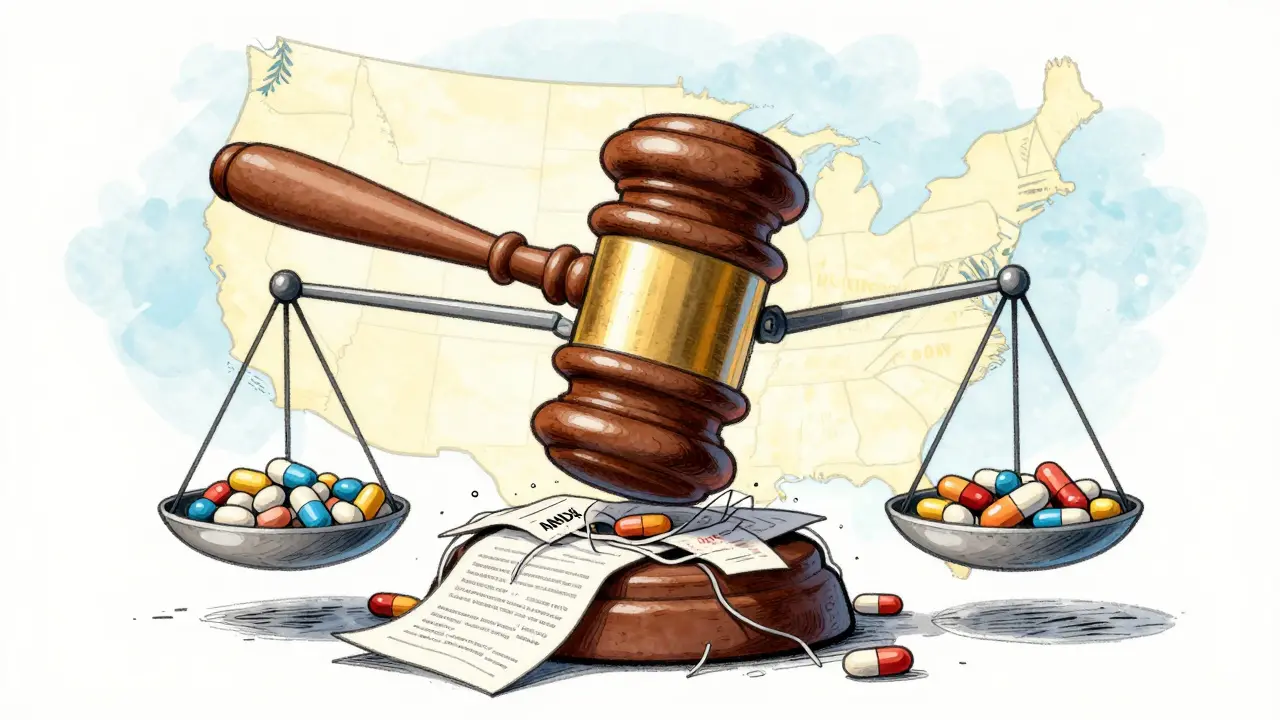
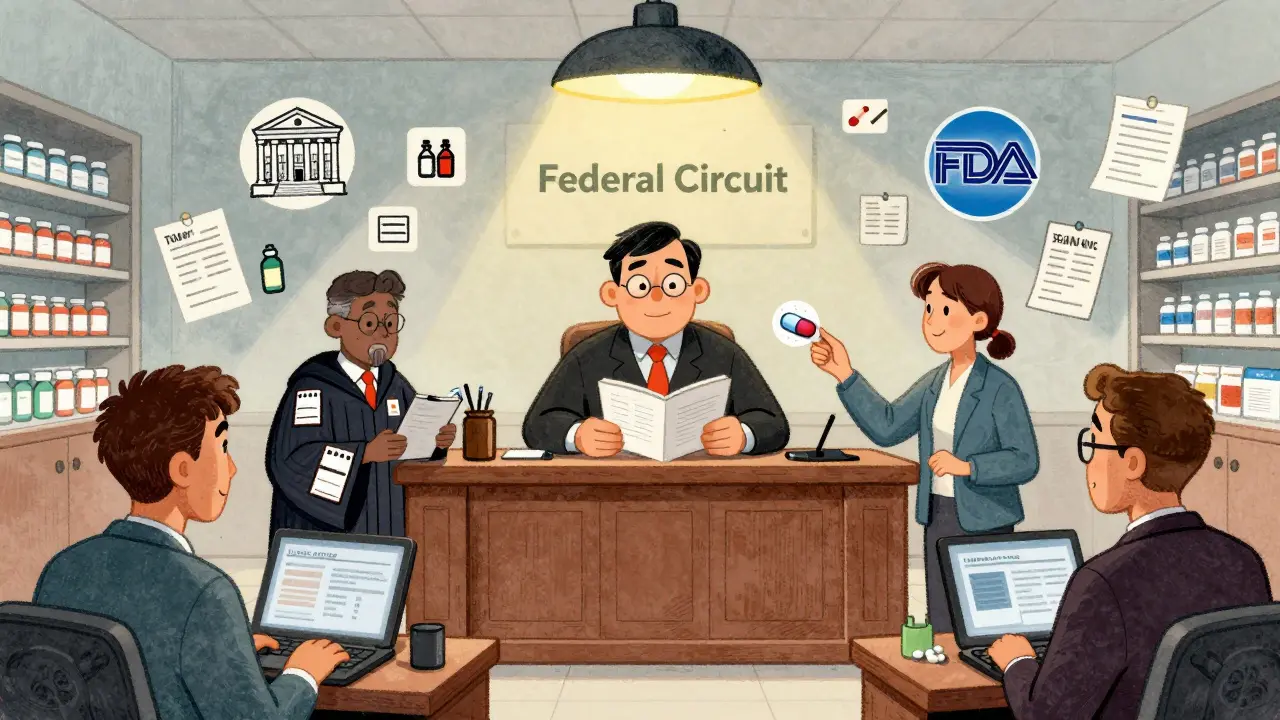
The Federal Circuit Court doesn't just hear patent cases-it controls the entire landscape of pharmaceutical patents in the United States. If you're developing a generic drug, fighting a patent infringement suit, or trying to get a new dosage form approved, this court's decisions directly shape your timeline, costs, and chances of success. Unlike other federal courts that handle a mix of civil and criminal appeals, the Federal Circuit is the only appellate court in the U.S. with exclusive power over all patent cases. That means every pharmaceutical patent dispute, no matter where it starts, ends up here.
Why the Federal Circuit Owns Pharmaceutical Patents
The court’s authority comes from a 1982 law: 28 U.S.C. § 1295(a)(1). It doesn’t matter if the case began in Texas, California, or Illinois. Once it involves a patent, it gets shipped to the Federal Circuit in Washington, D.C. This wasn’t an accident. Congress created the court specifically to fix the mess of inconsistent patent rulings across different regions. Before 1982, a patent could be valid in one state and invalid in another. That chaos made it impossible for drug companies to plan. Now, there’s one rulebook.For pharmaceuticals, this centralization matters even more. The system for approving generic drugs-the Hatch-Waxman Act-relies entirely on patent law. When a generic company files an Abbreviated New Drug Application (ANDA), it’s not just asking the FDA for permission. It’s triggering a legal showdown. The patent holder gets 30 days to sue. And because the Federal Circuit hears every appeal, its rulings become binding precedent across the entire industry.
The ANDA Filing That Changed Everything
In 2016, the court made a decision that still echoes in boardrooms and law firms today. In Mylan v. AstraZeneca, it ruled that filing an ANDA with the FDA creates nationwide personal jurisdiction. Why? Because the FDA application itself proves the company intends to sell the drug in every state. That means a patent holder can sue a generic manufacturer in Delaware-even if the generic company has no office, no warehouse, and no employees there.This opened the floodgates. Between 2017 and 2023, 68% of all ANDA lawsuits were filed in Delaware. Before 2016, it was just 42%. Why Delaware? Because its courts are fast, predictable, and have judges who’ve seen hundreds of these cases. For brand-name drug companies, this is a powerful tool. For generics, it’s a cost multiplier. Legal fees for a single ANDA case jumped from $5.2 million to $8.7 million on average during that period.
Orange Book Rules: What Gets Listed-and What Gets Kicked Out
The Orange Book isn’t just a catalog. It’s the gatekeeper. Officially called Approved Drug Products with Therapeutic Equivalence Evaluations, it lists every patent tied to a brand drug. If a patent isn’t in the Orange Book, a generic company can launch without waiting. But if a patent is listed, the FDA must delay approval for 30 months while litigation plays out.In December 2024, the Federal Circuit clarified the rules in Teva v. Amneal. It said: a patent can only be listed if it actually claims the drug the applicant submitted. Not a related compound. Not a method of making it. Not a vague formulation. The patent must claim the specific drug substance in the product. This shut down a common tactic where companies listed weak or irrelevant patents to block generics. Now, if your patent doesn’t literally say "this drug," it doesn’t belong in the Orange Book. That’s a win for generic manufacturers-and a wake-up call for brand companies trying to stretch their patent portfolios.
Obviousness in Dosing: The Court’s Hard Line
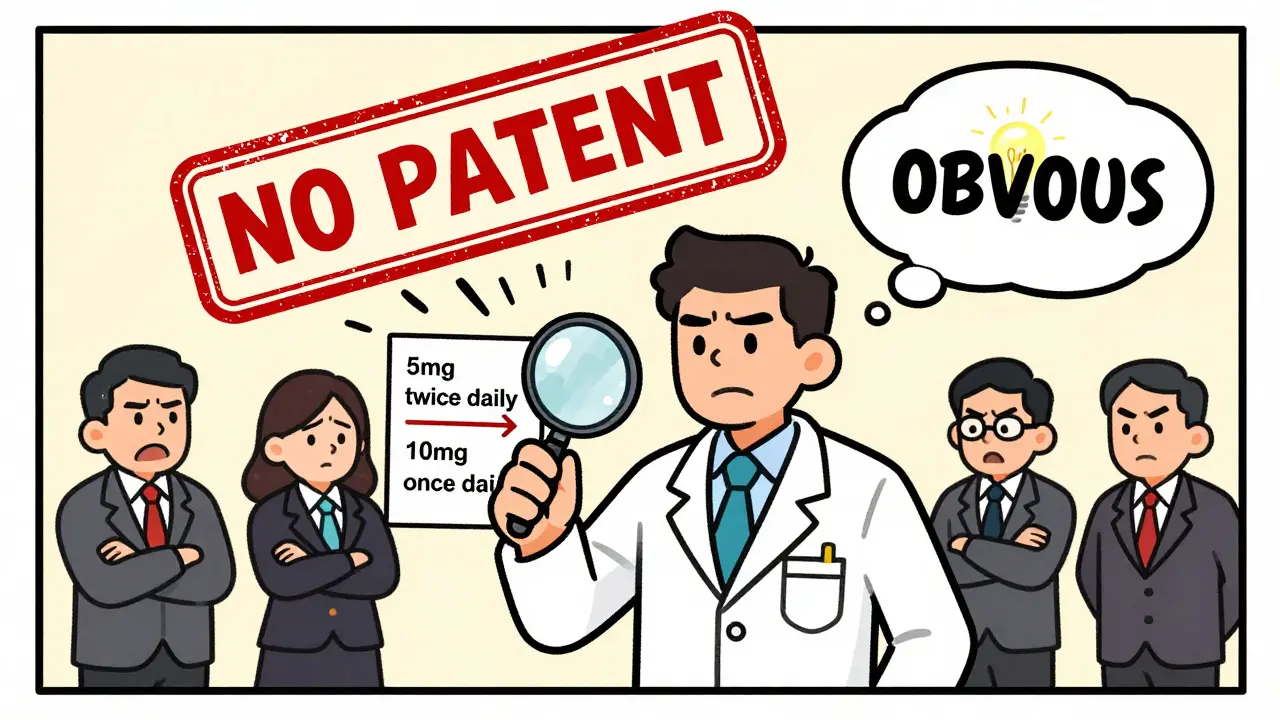
One of the biggest battlegrounds in pharma patents is dosing. Can you patent a new way to take a drug? Like, "take 10 mg once daily instead of 5 mg twice daily"? Most patent offices around the world say yes. The Federal Circuit says: not unless you prove something truly unexpected happened.In April 2025, the court ruled in ImmunoGen v. Mylan that changing a dosing regimen alone doesn’t make a patent valid. Both sides agreed the drug (IMGN853) was already known to treat cancer. The only difference was how often it was given. The court said: if a skilled scientist could reasonably expect the same result with the new dose, it’s obvious. No patent.
This standard has changed how companies file patents. A 2024 Clarivate analysis found that after this ruling, pharmaceutical companies cut secondary dosing patents by 37%. Instead, they’re spending more on developing entirely new compounds. That’s exactly what the court wanted. As Judge Lourie put it: "The patent system isn’t meant to reward minor tweaks." For generics, this means fewer barriers. For innovators, it means you need real breakthroughs, not just tweaks.
Standing: Can You Even Sue Before You Start?
Here’s a twist you won’t find in most legal guides: you might not even have the right to challenge a patent unless you’re already deep into development.In May 2025, the court ruled in Incyte v. Sun Pharma that a company must show "concrete plans" and "immediate development activities" to have legal standing. That means you can’t just file a lawsuit because you’re thinking about making a generic version. You need to have started clinical trials, signed manufacturing contracts, or submitted regulatory documents. The court said: "A party seeking to develop a drug that may infringe a patent has a significant interest in trying to invalidate it before making large investments." But if you’re still in the lab, you’re out of luck.
This has created a catch-22. To challenge a patent, you need to invest. But investing triggers lawsuits. Leading law firms now advise clients to document every step-from lab notebooks to clinical trial protocols-before even filing a challenge. It’s not just legal strategy anymore. It’s risk management.
How the Federal Circuit Compares to the Rest of the World
The U.S. system is unique. The European Patent Office (EPO) routinely grants patents for new dosing regimens. Japan and Canada are similarly more permissive. But the Federal Circuit has drawn a hard line. In 2023, the American Intellectual Property Law Association found the court reversed district court rulings in favor of patent holders in 38.7% of pharmaceutical cases-far higher than the 22.3% rate across all patent cases. That means: if you think a patent is weak, your odds of winning are better here than anywhere else in the U.S.But that strength comes with a cost. Critics say the court has become too insular. Its judges specialize in patents, but not in drugs. Some generic manufacturers report that the court’s rulings are technically sound but ignore real-world drug development. A 2024 American Bar Association survey showed 57% of patent attorneys felt the court’s dosing standards were "too rigid." Yet 33% said they were "appropriately stringent." There’s no middle ground.
What’s Next? The Patent Quality Act of 2025
The court’s decisions are so powerful they’ve sparked political action. In early 2025, Senators Thom Tillis and Chris Coons introduced the Patent Quality Act. Its goal? To fix the standing problem. The bill would allow companies to challenge patents earlier-before they start clinical trials. Judge Hughes, in his concurrence in the Incyte case, openly worried the current rule "stifles generic competition." That’s rare. A judge saying the system might be broken? That’s a sign things are about to change.Meanwhile, the court keeps refining its rules. In February 2025, it ruled that the Patent Trial and Appeal Board can still review expired patents for validity-even if damages can’t be awarded. That keeps the door open for challenges long after a patent’s expiration. And in the biosimilar space, the court has extended the same jurisdiction rules from ANDAs to biologics. That’s a big deal. Biosimilars are the next frontier in drug pricing. The Federal Circuit is already shaping how they enter the market.
Real Impact: Billions at Stake
This isn’t abstract law. It’s about money. The U.S. pharmaceutical market is worth $380 billion in annual sales. Every ruling from the Federal Circuit affects how fast generics can come to market. A 30-month delay? That’s hundreds of millions in lost sales for generics. A 12-month delay? That’s still tens of millions. The court’s rules on jurisdiction, standing, and obviousness directly control how long brand drugs enjoy exclusivity.And it’s working. Since 2020, biosimilar litigation has surged 300%. Since 2025, fewer "evergreening" patents-those designed to extend monopoly life-have been approved. Analysts predict a 15-20% drop in these tactics by 2027. That’s good news for patients. It’s also good news for insurers and pharmacies. But it’s a threat to companies that built their business on patent extensions.
What is the Federal Circuit Court’s role in pharmaceutical patent cases?
The United States Court of Appeals for the Federal Circuit is the only appellate court with exclusive jurisdiction over all patent cases in the U.S., including those involving pharmaceuticals. It hears appeals from district courts and the Patent Trial and Appeal Board, and its rulings set binding legal precedent for every patent dispute in the pharmaceutical industry.
Why does filing an ANDA trigger nationwide jurisdiction?
Filing an Abbreviated New Drug Application (ANDA) with the FDA is seen by the Federal Circuit as a declaration of intent to market the drug across all 50 states. This creates a legal "minimum contact" with every state, including jurisdictions like Delaware that are favorable to patent holders. The court ruled in 2016 that this intent alone is enough to establish personal jurisdiction anywhere in the U.S.
Can you patent a new dosing schedule for an existing drug?
Under the Federal Circuit’s current standard, you can only patent a new dosing regimen if you prove it produces an unexpected result. Simply changing the frequency or amount of a known drug is not enough. The 2025 ImmunoGen decision made it clear that if the prior art suggests the same outcome, the dosing change is obvious and not patentable.
What is the Orange Book and why does it matter?
The Orange Book is the FDA’s official list of patents linked to brand-name drugs. If a patent is listed here, generic manufacturers must wait 30 months before launching their version. The Federal Circuit ruled in 2024 that only patents that "claim the drug"-meaning they directly describe the active ingredient in the product-can be listed. This prevents companies from listing weak or unrelated patents to delay generics.
Do I need to start clinical trials before I can challenge a pharmaceutical patent?
Yes. According to the 2025 Incyte decision, a company must demonstrate "concrete plans" and "immediate development activities" to have legal standing to challenge a patent. This means you need to have begun Phase I clinical trials, signed manufacturing agreements, or submitted regulatory documents. Simply planning to make a generic drug isn’t enough-you have to be actively developing it.
How does the Federal Circuit’s approach differ from the European Patent Office?
The European Patent Office (EPO) often grants patents for novel dosing regimens, even if the drug itself is known. The Federal Circuit, however, takes a stricter view. It requires proof that the new dosing produces unexpected results. This makes it harder to get secondary patents in the U.S., which has led to fewer dosing-related patents being filed and more focus on developing entirely new compounds.
What Should You Do Next?
If you’re a generic manufacturer: document every step of your development process. Don’t wait until you’re sued to gather evidence. Start tracking your clinical trial data, manufacturing decisions, and regulatory submissions now. That’s your armor against jurisdictional and standing challenges.If you’re a brand company: audit your Orange Book listings. Remove any patents that don’t literally claim the drug. Focus your patent strategy on true innovation-not minor changes. And be ready: the Patent Quality Act of 2025 could change the rules again soon.
If you’re a patent attorney: stop treating dosing claims like minor tweaks. Build your arguments around clinical data that shows unexpected efficacy. Use the Federal Circuit’s own standards as your guide. The court isn’t making it harder to patent drugs-it’s making it harder to patent the same drug in a new way.
The Federal Circuit isn’t just a court. It’s the engine of the modern pharmaceutical market. Its decisions don’t just settle lawsuits-they decide who gets to bring life-changing drugs to patients, and how soon.
13 Responses
So let me get this straight-Congress created this court so drug companies could stop generics from ever getting to market? Classic. They call it 'uniformity' but it's really just a monopoly machine. I've seen patents for 'taking a pill with water' get listed in the Orange Book. This isn't law, it's corporate theater. And don't even get me started on Delaware. Why does a state with 100 pharma employees get to decide the fate of 380 BILLION in drug sales? Someone needs to burn this whole system down.
I just read through this whole thing and honestly? I'm impressed. It's rare to see legal stuff explained so clearly. The part about dosing patents really hit me-imagine being told you can't patent a new way to take a medicine you've been on for years. It makes sense, though. If it's the same drug, same effect, just a different schedule... why should one company own that? I hope this opens up more affordable options. People shouldn't have to choose between rent and their meds.
Man this is wild 😅 I didn't even know the Federal Circuit was the ONLY patent court. That's like having one ref for every game in the NFL. And Delaware?? LOL I thought that was just where corporations incorporated. Now it's the patent warzone? I'm lowkey terrified for my future generic meds. But hey, at least they're finally cracking down on Orange Book abuse. That's a win. I'm just glad I'm not a patent lawyer right now. 🙃
This is a meticulously documented overview of a critical but underappreciated pillar of pharmaceutical policy. The Federal Circuit’s jurisprudence has indeed transformed the landscape of market entry for generic and biosimilar products. The standing requirements articulated in Incyte v. Sun Pharma, for instance, reflect a deliberate judicial effort to balance innovation incentives with competitive access. However, the practical consequence-delaying legal challenges until significant capital is already invested-creates a chilling effect on early-stage development. Policy reform, such as the proposed Patent Quality Act, may be necessary to recalibrate this equilibrium.
So basically the court is saying: if you wanna fight a patent, you gotta spend money first? That sounds backwards. Like, you have to risk your whole budget before you can even ask if the patent is legit? That's not justice, that's a trap. And Delaware? Why not just let everyone sue in their own state? This whole thing feels rigged. I just hope cheaper drugs win in the end. 🤞
Let’s examine the economic efficiency of the Federal Circuit’s jurisdictional framework. The 68% concentration of ANDA litigation in Delaware suggests a significant market distortion. Transaction costs are artificially inflated due to forum shopping, and judicial expertise is concentrated in a single venue with limited geographic diversity. The 37% reduction in secondary dosing patents post-ImmunoGen correlates with a measurable decline in incremental innovation. While consumer access improves, the long-term R&D pipeline may suffer. The court’s rigid obviousness standard fails to account for pharmacokinetic variability across populations. This is not innovation-it’s regulatory arbitrage.
OMG I JUST READ THIS AND I CRIED LITERALLY 😭 LIKE WHO KNEW THAT TAKING A PILLS ONCE A DAY COULD BE A PATENT?? AND DELAWARE?? WHY DELAWARE?? I THOUGHT IT WAS JUST FOR CORPORATIONS AND ICE CREAM?? NOW IT'S THE PATENT HELLHOLE?? I'M SCARED FOR MY MEDS AND I DON'T EVEN TAKE ANY 😭😭😭
This whole thing is a scam. You think the courts are fair? Nah. The big pharma boys write the rules and then pay the judges to look the other way. I’ve seen people die because they couldn’t afford their meds while the companies made billions. This court? It’s not about justice. It’s about control. And don’t tell me about 'innovation'-they’re just stretching patents like rubber bands. Wake up. This isn’t law. It’s theft with a gavel.
This is fascinating. I never realized how much one court could shape access to medicine. The Orange Book ruling feels like a turning point-finally, they’re stopping companies from gaming the system with junk patents. But I wonder: if dosing patents are so hard to get now, are companies shifting to entirely new compounds? That’s good, right? More real innovation? Or are they just finding new loopholes? I’d love to see a follow-up on how this affects drug development timelines. Thanks for sharing this-it’s eye-opening.
The federal circuit is a tool of capitalist oppression designed to protect monopoly profits under the guise of intellectual property. The so called innovation is merely the manipulation of legal technicalities to delay generic entry. The haxt-waxman act is a farce. The orange book is a weapon. The standing requirement is a barrier to justice. The entire system is a colonial extraction mechanism disguised as law. The american people are being systematically fleeced. The patent quality act is too little too late. The real solution is abolishing pharmaceutical patents entirely. The people need medicine not monopolies.
Let’s be real-the Federal Circuit is just the legal arm of Big Pharma’s shadow government. You think the 1982 law was about 'uniformity'? Nah. It was a backroom deal between lobbyists and judges to centralize control. Delaware? That’s not a state-it’s a corporate shell. And the Orange Book? It’s a blacklist masquerading as a catalog. They list patents that don’t even mention the drug. Then they sue generics for 'infringing' a patent that describes a metabolite from 1972. And now they’re saying you need to invest before you can challenge? That’s not standing-it’s extortion. The Patent Quality Act? Too late. We need to defund the court. And burn the clerk’s office. 🔥
Bro I just skimmed this and my brain hurt. Why does any of this matter? Can’t we just make cheaper drugs? Why do we need 10 paragraphs about Delaware? I just want my insulin to not cost $600. Can we skip the legal drama and get to the part where people stop dying because they can’t afford their meds? 🙃
Tom Sanders is right. This whole thread is just legal masturbation. We’re arguing about jurisdiction while people die. The court doesn’t care. The FDA doesn’t care. Congress is paid off. The only thing that changes anything is public outrage. So let’s stop talking about patents and start talking about who’s profiting. Who owns the patents? Who owns the court? Who owns the politicians? That’s the real question. And nobody here wants to answer it.