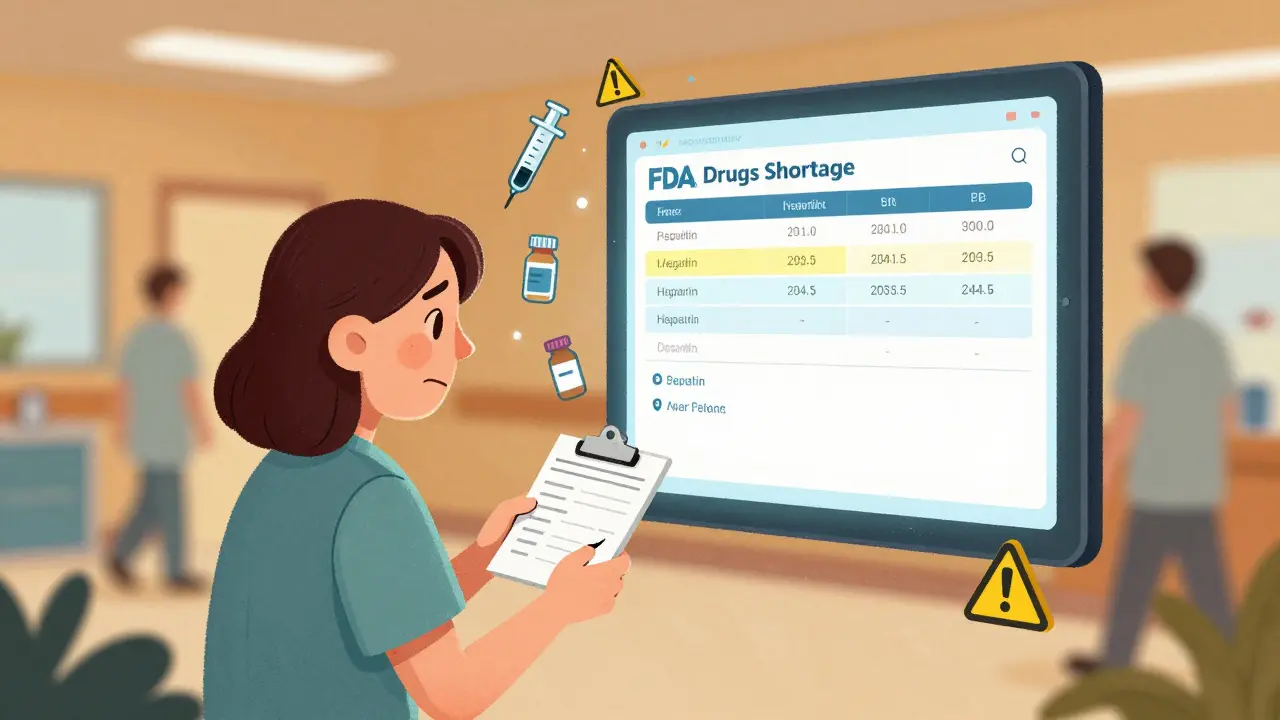
When a life-saving medication runs out, it’s not just an inconvenience-it’s a crisis. For patients relying on insulin, heparin, or antibiotics, a shortage can mean delayed treatment, hospitalization, or worse. That’s why the FDA Drug Shortage Database is an official, real-time tool from the U.S. Food and Drug Administration that tracks which medications are in short supply across the country. It’s not a suggestion. It’s the federal government’s primary system for monitoring drug availability. And if you’re a patient, caregiver, or healthcare provider, knowing how to use it could make a real difference.
What the FDA Drug Shortage Database Actually Shows
The FDA database doesn’t guess. It doesn’t rely on rumors or hospital reports. It pulls data directly from manufacturers who are legally required to notify the FDA when a drug is running low. Since 2012, under the FDASIA law, companies must report potential shortages, and failure to do so can cost them up to $10,000 per day. That’s why this database is the most authoritative source available.
Each entry includes:
- The generic name of the drug
- The exact National Drug Code (NDC) number-this is critical because one drug can have multiple NDCs for different strengths, manufacturers, or packaging
- The company that makes it
- Why it’s short (e.g., manufacturing delays, quality issues, raw material shortages)
- Whether the shortage is still active, resolved, or discontinued
- An estimated timeline for when supply might return
As of July 2024, there were about 298 active shortages on the list. Most of them-58%-are sterile injectables like antibiotics, IV fluids, and chemotherapy drugs. These are the ones that can’t be easily swapped out. A shortage of saline solution, for example, affects hospitals, nursing homes, and home infusion services all at once.
How to Access the Database
You don’t need special training or a login. The database is free and public. Here are the three ways to use it:
- Website: Go to www.accessdata.fda.gov/scripts/drugshortages/default.cfm. This is the most detailed version. You can search by drug name, NDC, or manufacturer.
- Mobile App: Download the free "FDA Drug Shortages" app from the Apple App Store or Google Play. Launched in 2022, it’s been downloaded over 150,000 times. It lets you search, get push alerts when a drug you care about goes short, and even report a shortage you’ve noticed that isn’t listed yet.
- Data Feed: Developers or health systems can access the raw data through data.gov. The dataset updates every week and includes all current and resolved shortages.
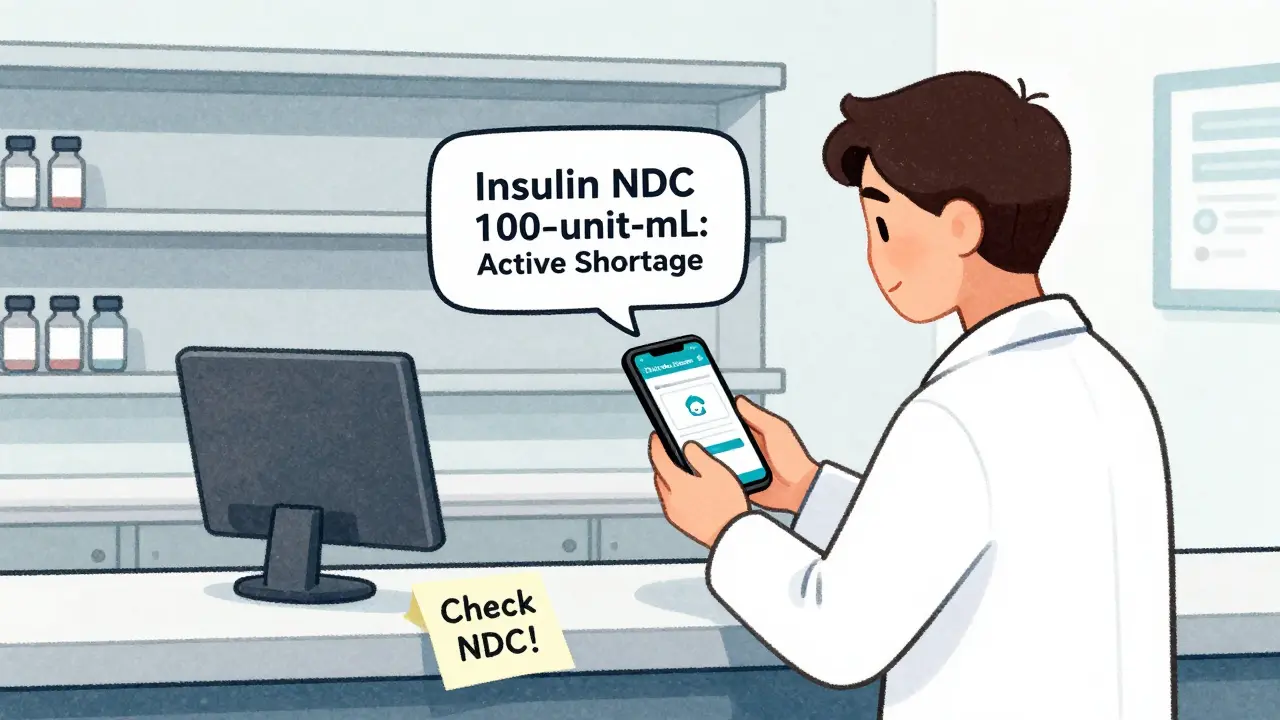
The app is especially useful if you’re a pharmacist or nurse who needs quick access during rounds. You can search for "insulin" and see every formulation that’s affected-not just "insulin," but specifically the 100-unit/mL vial, the 300-unit/mL pen, or the 50-unit/mL syringe. That level of detail matters.
What the Database Won’t Tell You
It’s powerful, but it’s not perfect. The FDA database is reactive, not predictive. It records shortages after they’ve already started. According to Dr. Erin Fox of the University of Utah, about 63% of shortages appear on other lists like ASHP’s before the FDA updates its entry. There’s a lag-usually 7 to 10 days-because manufacturers don’t always report immediately.
Also, the "resolved" status doesn’t always mean the drug is back in full supply. It just means the FDA believes demand is being met. That could mean hospitals are rationing, or patients are getting smaller doses. A 2024 FDA usability study found that 28% of providers misinterpreted this status, assuming full availability when it wasn’t the case.
Another gap: the database doesn’t track compounded alternatives. When a drug is short, pharmacies sometimes make their own version. But only 22% of compounders report these to the FDA, even though they’re encouraged to. So if your pharmacy says they’ve compounded a substitute, the FDA database won’t reflect that.
FDA vs. ASHP: Which One Should You Use?
You’ll probably hear about the American Society of Health-System Pharmacists (ASHP) drug shortage database too. It’s popular among clinicians. But here’s the difference:
| Feature | FDA Database | ASHP Database |
|---|---|---|
| Scope | National shortages only | Includes regional and temporary shortages |
| NDC Coverage | 100% of listed drugs | 82% of listed drugs |
| Reason for Shortage | Technical codes (e.g., "Manufacturing Delay - Quality") | Plain language (e.g., "Factory had a power outage") |
| Clinical Guidance | Limited | Extensive: alternatives, dosing adjustments, patient alerts |
| Update Frequency | Daily | Weekly |
| Best For | Verifying if a shortage is official | Deciding what to do next |
Most professionals use both. They check the FDA database first to confirm a shortage is real. Then they go to ASHP to find out what to give instead. In a 2024 survey, 74% of providers said they checked FDA first, but 92% preferred ASHP for clinical decisions.
How to Use It When You’re in a Tight Spot
Here’s a simple 5-step workflow for checking a drug:
- Search the generic name. Don’t rely on brand names. Search for "metformin," not "Glucophage."
- Check the NDC. If your pharmacy uses a different version (e.g., 500mg tablet vs. 850mg), it might not be affected. The FDA lists each NDC separately.
- Read the reason. If the shortage is due to a raw material issue, other drugs made with the same ingredient might be at risk too. For example, a shortage of a key chemical used in antibiotics could affect multiple drugs.
- Look for extended use dates. Some drugs have FDA approval to be used past their printed expiration date during shortages. You can find this list on a separate FDA page.
- Report if you see something missing. If your hospital is out of a drug and it’s not on the list, email [email protected]. The FDA takes these reports seriously.
Pro tip: Subscribe to the FDA’s email updates. They send summaries every Tuesday and Friday. That way, you don’t have to check manually.
What’s Changing Soon
The FDA is working on upgrades. In July 2024, they added filters for dosage form and manufacturer-finally responding to user feedback. A new feature launching in early 2025 will link the database to wholesale distributor data, so you’ll know if a shortage is happening because of distribution problems, not just manufacturing.
Long-term, they’re testing AI models to predict shortages before they happen. Right now, only 35% of shortages are reported before patients feel the impact. The goal is to get that number below 10% by 2027.
Why This Matters to You
In 2023, the FDA processed over 5,000 shortage reports. That’s more than 13 per day. And it’s not slowing down. Since 2010, shortages have tripled. Sterile injectables are still the biggest problem, but oral medications like thyroid pills and seizure drugs are also increasingly affected.
One success story: In April 2024, the FDA database flagged a shortage of a specific insulin NDC. Within hours, health systems switched to alternatives, avoiding patient harm. But in January 2023, a heparin shortage went unreported for 11 days-leading to delays at 37% of hospitals, according to Johns Hopkins.
This isn’t just about data. It’s about trust. The FDA database gives you a clear, official answer when panic sets in. It cuts through the noise. And when used correctly, it helps you make decisions that keep patients safe.
Is the FDA Drug Shortage Database only for U.S. residents?
Yes. The database tracks shortages within the United States. It doesn’t cover drug availability in other countries, even if the same medication is sold globally. However, international healthcare providers can still use it as a reference, especially if they source medications from U.S. manufacturers.
Can I report a shortage if I’m not a manufacturer?
Yes. Anyone-patients, pharmacists, nurses, or doctors-can report a suspected shortage by emailing [email protected]. The FDA investigates all reports and adds them to the database if confirmed. Your report could help prevent delays for others.
Why does the FDA list some drugs as "resolved" when they’re still hard to find?
"Resolved" means the FDA believes supply is meeting demand-not that every pharmacy has it in stock. This can happen if hospitals are rationing, using alternative formulations, or importing from other sources. The label doesn’t mean full restoration; it means the crisis level has dropped.
Are all drug shortages listed in the FDA database?
No. The database only includes shortages that meet the FDA’s national threshold-where demand exceeds supply across the country. Localized shortages, temporary delays, or issues with non-critical medications may not appear. For those, the ASHP database is more comprehensive.
How often is the database updated?
The FDA updates the database daily. New shortages, resolved status changes, and NDC updates are added every business day. The mobile app syncs automatically, and email summaries are sent twice a week-Tuesdays and Fridays.
Do I need to register to use the FDA Drug Shortages app?
No. You can search and view shortages without an account. However, if you want to report a shortage or turn on push notifications, you’ll need to verify your email address. The app is free and doesn’t collect personal data beyond what’s needed for notifications.
What should I do if I can’t find a drug on the FDA list but my pharmacy says it’s out of stock?
Check ASHP’s database first-it includes more localized issues. If it’s still not listed, email the FDA at [email protected] with the drug name, NDC, and pharmacy location. They may investigate and add it. Also, ask your pharmacy if they’re using an alternative formulation or compound.
What to Do Next
If you’re a patient or caregiver, bookmark the FDA website or download the app today. Set up email alerts. Keep a printed list of your medications and their NDCs-ask your pharmacist for them. If you’re a healthcare provider, train your team. Use the database as your first stop when a drug is missing. Don’t wait for a crisis. Check it weekly.
Drug shortages aren’t going away. But with the right tools, you can stay ahead of them. The FDA database won’t fix the supply chain. But it gives you the facts you need to act-before it’s too late.
11 Responses
I use the FDA app every time my mom’s insulin prescription changes. It’s saved us twice already. No more guessing games at the pharmacy.
Just downloaded the app!! Thanks for the heads up 🙌 I’ve been stressing about my dad’s heparin refill. This is exactly what we needed!
The FDA database is useful but it’s not the whole story. I work in a rural hospital. We’ve had shortages for weeks that never showed up here. ASHP’s regional filters saved us. The FDA lags. Always check both.
As a pharmacist, I rely on ASHP for clinical alternatives but verify everything with FDA. The NDC specificity is non-negotiable. One wrong code = wrong dose = bad outcome. Also, the FDA’s resolved flag is misleading. We call it 'the lie' internally.
You people are missing the real issue. This whole system is a band-aid on a hemorrhage. Manufacturers get fined $10k a day? That’s pocket change. They’re making billions off this. The FDA doesn’t regulate production. They just track the chaos. We need to force domestic manufacturing. No more outsourcing. No more single-source suppliers. This isn’t a database problem-it’s a corporate greed problem.
I read this whole thing and now I’m crying. My brother died because they couldn’t find his chemo. This database would’ve helped. Why wasn’t this easier to find? Why didn’t anyone tell me? This is a national tragedy and nobody talks about it.
I’ve been reporting shortages for years. I emailed the FDA about a shortage of levothyroxine in 2022. They ignored it. Took six months before it showed up. I’m not surprised. This whole thing is a bureaucratic joke. You think they care? They care about headlines. Not patients.
Just want to say thanks to whoever wrote this. I’m a nurse and I’ve been teaching my patients how to use the app. One 72-year-old woman sent me a screenshot of her insulin NDC being flagged. We switched her to a backup before her last refill ran out. This isn’t just data-it’s life-saving. Keep sharing this.
So if the FDA says resolved but you still can’t get it, what do you do? I’m confused. Also, I think they misspell 'NDC' like 50% of the time on their site. Not a big deal but kinda annoying. And why no filter for 'oral meds'? I need my metformin, not IV fluids.
I checked the FDA site and my drug wasnt listed but my doc said it was shortage so i emailed them and they said theyll look into it. also why does the app ask for email if i just want to look? its not like i wanna get spam
I’m from Australia and we don’t have this system here. But I’ve been using the FDA database to help my sister in Ohio. She’s on dialysis and needs specific IV solutions. We’ve been tracking the NDCs together. I didn’t even know this existed until last week. This is incredible. You guys have a lifeline. We’re still flying blind.