
If your eyes feel gritty, burning, or constantly watery-despite using drops-it’s not just being tired. You might have dry eye disease, a condition affecting over 16 million Americans. And while over-the-counter drops help temporarily, they don’t fix what’s really going on. The real solutions-cyclosporine, lifitegrast, and punctal plugs-work differently, at different speeds, and for different reasons. Knowing how they compare can save you months of frustration and wasted money.
How Cyclosporine Fixes Dry Eye at the Root
Cyclosporine, sold as Restasis or Cequa, isn’t a tear replacement. It’s an anti-inflammatory drug that tells your body to start making tears again. For years, doctors treated dry eye like a leaky faucet-you add drops, you fix the drip. But cyclosporine treats the broken pipe: chronic inflammation on the eye’s surface that shuts down tear production.
It’s been around since 2002, and despite newer options, it’s still the most studied. In a 2023 trial with over 800 people, 71.6% showed measurable improvement in corneal damage after just four weeks. That’s not just feeling better-it’s actual healing. But here’s the catch: it takes time. Most people don’t notice real change until three to six months in. That’s why so many quit too soon.
You apply it twice a day, 12 hours apart. No contacts. Wait 15 minutes after putting it in before reinserting them. Some users swear by refrigerating the vials-it cuts the burning sensation that 73% report at first. And yes, it’s expensive: around $590 for a month’s supply. But patient assistance programs cover most insured people. If you’re willing to wait, it’s the only treatment proven to rebuild tear production long-term.
Lifitegrast: Fast Relief, But With a Metallic Taste
If you need relief now, lifitegrast (Xiidra) is your best bet. Approved in 2016, it works by blocking a key inflammatory signal-LFA-1-that causes eye irritation. Unlike cyclosporine, it doesn’t wait months. In clinical trials, nearly half of users felt noticeably better within two weeks.
It’s also twice daily, same as cyclosporine. But here’s the downside: 18% of people stop using it because of a persistent metallic taste. Not all users get it, but enough that doctors now recommend applying it at night. That way, the taste fades while you sleep. One Reddit user wrote, “I noticed less dryness in 10 days. But I had to spit out the aftertaste every time. Worth it?”
Cost is similar to cyclosporine-around $620 a month. But Takeda offers a $0 co-pay for the first month. If you’ve tried cyclosporine and couldn’t tolerate the initial burning, lifitegrast might be easier to stick with. Just don’t expect it to heal your cornea the way cyclosporine does. It’s better for symptom control than long-term repair.
Punctal Plugs: The Simple Mechanical Fix
Punctal plugs are tiny devices-smaller than a grain of rice-inserted into the tear ducts to stop tears from draining too fast. They’ve been around since the 1970s, and they’re still widely used because they work fast. No waiting. No daily drops. Just a five-minute office procedure.
There are two types: collagen and silicone. Collagen plugs dissolve in a week or two. They’re used to test if you’ll respond to plug therapy. Silicone plugs are permanent unless removed. Sizes range from 0.2mm to 0.8mm, and your doctor picks based on how wide your ducts are.
Success rates are high-92% on the first try. But 28% of users report the plug falling out. Others feel discomfort or notice their eyes watering more than before. That’s because plugs don’t fix inflammation. They just hold onto whatever tears you make. If your tear quality is poor, plugs won’t help much. A 2023 Cochrane Review found they only slightly improved tear volume, with no real change in how dry your eyes felt.
Cost: $150-$300 per insertion, not including the office visit. Insurance often covers it. It’s a great option if you’re already using drops and still struggling-or if you hate daily routines. But it’s not a standalone fix for moderate to severe dry eye.

Which One Should You Choose?
There’s no one-size-fits-all. Here’s how top eye specialists break it down:
- Start with cyclosporine if you have moderate to severe dry eye and can commit to daily use for months. It’s the only treatment proven to restore tear production.
- Try lifitegrast if you need quick relief, can’t tolerate cyclosporine’s burning, or have flare-ups that need fast control.
- Add punctal plugs if you’re already on medication but still drying out. They’re best as a team player, not a solo act.
Many patients end up combining them. A 2023 Dry Eye Workshop report found 78% of experts recommend cyclosporine plus plugs for severe cases. That combo gives you both healing and retention.
What No One Tells You About Side Effects
Most patient reviews focus on the good stuff. But the real story is in the dropouts.
With cyclosporine, 26.7% of people in clinical trials stopped because of irritation, redness, or just the hassle. Adherence drops from 63% at three months to just 41% at six months. That’s not because it doesn’t work-it’s because people give up before it kicks in.
Lifitegrast’s metallic taste is more than annoying. It’s a dealbreaker for 42% of users. Some try taking it at night, others rinse their mouth with water after. But if taste is a big issue for you, this might not be the one.
Punctal plugs can extrude, migrate, or cause infection if not placed properly. And while silicone plugs are permanent, they can be removed if needed. But if you’re not careful, you might end up with a plug that won’t come out-and you’ll be stuck with discomfort for months.
What’s Coming Next
The dry eye treatment world is changing fast. A once-daily version of lifitegrast (called Vevye) is in final trials and could be approved by mid-2024. That’s huge-if it works, compliance will jump.
There’s also a new type of plug in Europe called Cyclplug, which releases cyclosporine slowly over time. Early studies show it’s 40% more effective than regular plugs. It’s not available in the U.S. yet, but it’s coming.
And then there’s rebamipide, approved in Japan and under FDA review. It’s a biologic that reduces inflammation and boosts mucus production. If it gets approved, it could replace cyclosporine as the new gold standard.
Real Talk: What Works in Real Life
Look at the numbers: 68% of people on cyclosporine are satisfied after four months. 61% on lifitegrast feel better quickly. 58% with plugs say it helped. But satisfaction isn’t about perfection-it’s about improvement.
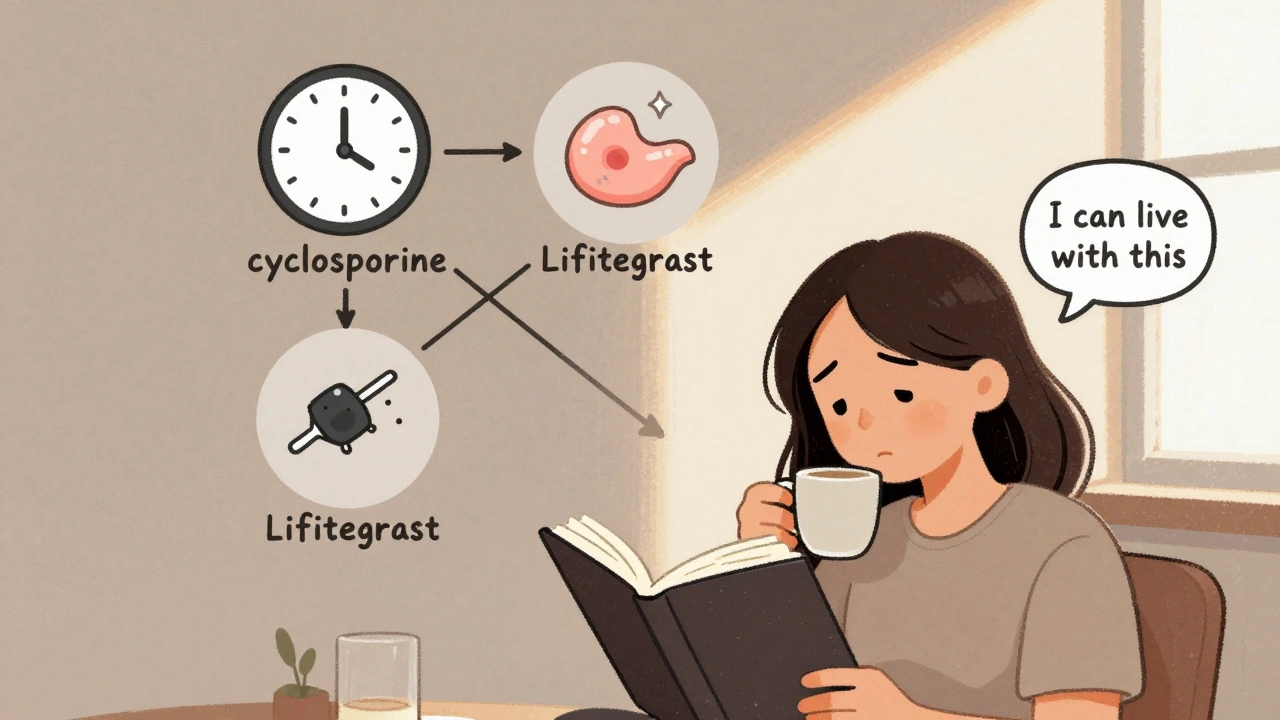
One woman in her 60s told her optometrist: “I used to cry just from opening my eyes. Now I can read my book without burning. I still use drops, but I don’t feel like I’m fighting my eyes every day.” That’s the goal.
Don’t expect miracles. But do expect progress-if you pick the right tool and stick with it. Dry eye isn’t cured. It’s managed. And the best plan is the one you can live with.
How long does it take for cyclosporine to work for dry eye?
Most people start noticing improvement after 3 to 6 months of consistent twice-daily use. Some see early signs of reduced corneal damage within 4 weeks, but full tear production recovery takes time. Stopping early means you won’t get the benefit.
Can I use cyclosporine and lifitegrast together?
Yes, but not at the same time. Doctors often recommend using one in the morning and the other at night, with at least a 15-minute gap between drops. Combining them can improve both inflammation control and symptom relief, especially in severe cases.
Do punctal plugs hurt?
The insertion is quick and usually painless-like a tiny pinch. Most people feel nothing afterward. Some report mild discomfort or a scratchy feeling for a day or two. If you feel persistent pain or notice the plug falling out, contact your doctor.
Is there a cheaper alternative to Restasis or Xiidra?
Generic cyclosporine (0.05%) is now available and costs about half the price of brand-name Restasis. Xiidra still has no generic, but Takeda offers a $0 co-pay coupon for the first month. Also, insurance coverage and patient assistance programs can reduce out-of-pocket costs significantly.
Can I use these treatments if I wear contacts?
Yes, but you must remove your contacts before applying cyclosporine or lifitegrast. Wait at least 15 minutes after the drops before putting them back in. Punctal plugs don’t interfere with contacts at all.
What happens if I stop using cyclosporine?
Your tear production will gradually return to its previous low level. The inflammation will likely come back, and your symptoms will worsen. Cyclosporine doesn’t cure dry eye-it manages it. You need to keep using it to maintain results.
Are punctal plugs permanent?
Silicone plugs are designed to be permanent, but they can be removed by a doctor if needed. Collagen plugs dissolve naturally in 3 to 10 days and are used only for testing. If a silicone plug causes discomfort or moves, it can be safely taken out.
Next Steps: What to Do Now
If you’re struggling with dry eyes:
- Track your symptoms for a week-note when they’re worst, what helps, and what makes them worse.
- Ask your eye doctor for a Schirmer’s test to measure tear production. Scores under 10mm mean you likely need prescription help.
- Discuss cyclosporine first if you’re willing to wait for results. If you need faster relief, ask about lifitegrast.
- If you’re already using drops and still dry, bring up punctal plugs as an add-on.
- Don’t quit early. Give cyclosporine at least 90 days. Stick with lifitegrast for 2 weeks to judge taste and relief.
The goal isn’t to find the perfect treatment. It’s to find the one you can live with-and stick with. Dry eye doesn’t go away. But with the right plan, it doesn’t have to control your life either.
10 Responses
Been on cyclosporine for 5 months now. The first 2 were rough - burning like crazy, felt like sandpaper every time I blinked. But around month 3, something shifted. Not overnight, but slowly. I can read my phone without squinting now. No magic, just patience. Worth it if you can stick with it.
lifitegrast gave me a metal mouth for 3 weeks straight and still didn’t fix my dryness. wasted money
OMG YES to the plug tip!! I got silicone plugs last year and it was a game changer 🙌 I was using 6+ drops a day and now I’m down to 1 at night. The doc said I might feel weird at first but it was literally just a tiny pinch. No pain. No drama. Just relief. If you’re tired of the daily grind, try this first. You’ve got nothing to lose 😊
Cyclosporine isn't healing anything. It's just suppressing inflammation like every other immunomodulator. The real issue is the microbiome disruption from overuse of artificial tears and screen glare. No one talks about that because Big Pharma doesn't profit from probiotic eye drops. The real breakthrough will be when they stop treating symptoms and start fixing root causes - like gut health and blue light exposure
As someone who moved from Nigeria to the US and struggled with dry eyes here - the air is just brutal. I tried everything. Cyclosporine? Too slow. Lifitegrast? Tasted like licking a battery. Plugs? Best decision I made. Didn’t fix everything, but made it bearable. What helped even more was switching to a humidifier and cutting out caffeine. Simple stuff. No magic pills. Just adjustments. And yes, the cost sucks, but if you’re insured, ask for patient programs. They’re there for a reason.
you guys are overcomplicating this. i had dry eyes for 3 years. i started washing my face with warm water every morning and stopped rubbing my eyes. within 2 weeks i felt better. no drops no plugs no prescriptions. your body heals if you stop fighting it
So let me get this straight - you’re telling me I’m supposed to pay $600 a month for a drug that takes six months to work, and even then, I might still have to use drops on top of it? Meanwhile, there’s a $150 procedure that gives instant relief? This isn’t medicine. It’s a subscription model disguised as healthcare. I’m not surprised the industry doesn’t want you to know about plugs. They don’t make money off one-time fixes.
You're all missing the point. Cyclosporine? It's just a repackaged transplant drug. Lifitegrast? A failed cancer immunotherapy that got rebranded. And plugs? They're just foreign bodies that migrate into your lacrimal system and cause granulomas. The real solution? Avoid screens. Reduce stress. Sleep better. None of you are addressing the modern lifestyle causes. You're just buying into pharmaceutical marketing.
Everyone’s acting like this is a medical breakthrough. It’s not. It’s a cycle of placebo and desperation. Cyclosporine’s 71% improvement? That’s based on corneal staining - a metric that doesn’t correlate with how your eyes feel. Lifitegrast’s metallic taste? That’s a red flag for systemic toxicity. And plugs? 28% fall out - meaning they’re not even reliable. You’re not managing dry eye. You’re just buying time until something worse happens.
Hey - just wanted to say to everyone who’s trying these treatments: you’re not alone. I’ve been through all three. Cyclosporine made me cry from the drops (literally). Lifitegrast made me gag. Plugs? Felt like a grain of rice stuck in my eye for a week. But here’s the thing - I’m not worse off. I’m better. Not perfect. But better. And that’s the goal. Don’t compare your month 2 to someone else’s month 6. This isn’t a race. It’s a slow rebuild. Keep going. Even if it’s just one drop a day. You’re still fighting.