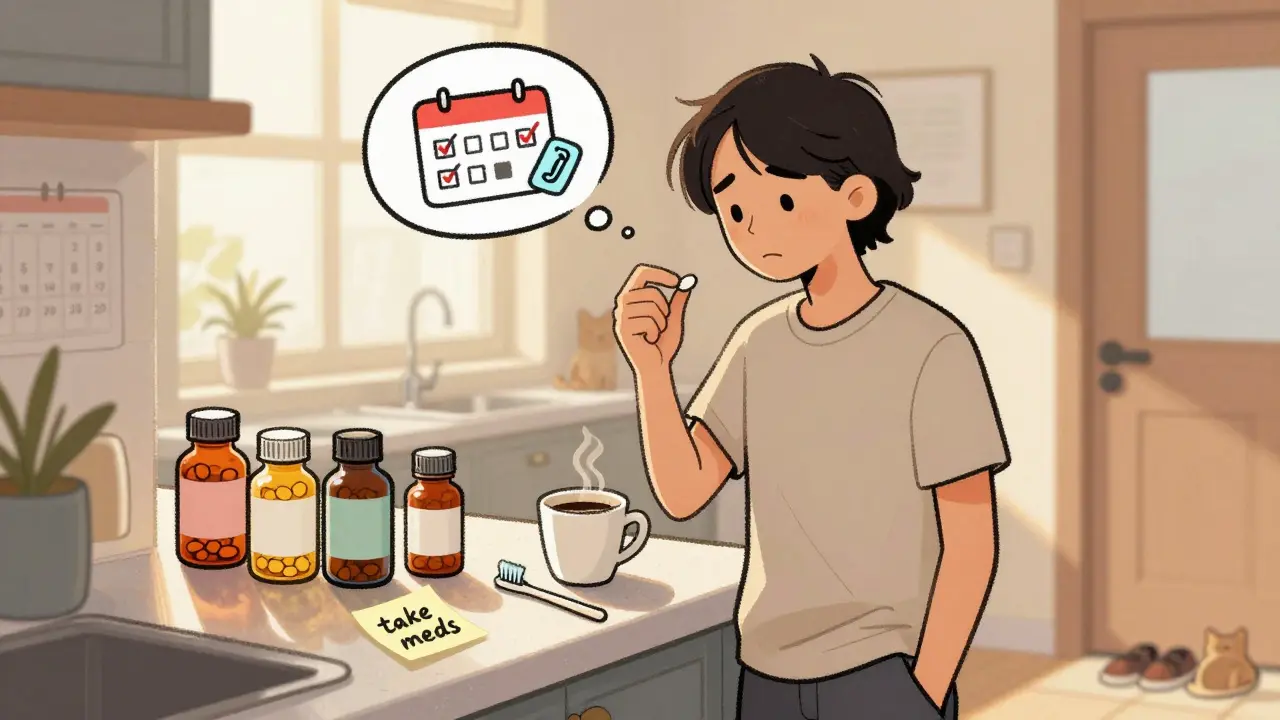
Taking a pill every day for years isn’t just a habit-it’s a lifeline. But for millions of people managing conditions like high blood pressure, diabetes, or rheumatoid arthritis, staying on track with medication becomes harder over time. It’s not laziness. It’s not lack of willpower. It’s the weight of routine, the fear of side effects, the cost of prescriptions, and the emotional toll of living with a condition that never goes away. The good news? There are proven ways to cope-and they don’t require magic, just the right tools.
Why Adherence Falls Apart After the First Few Months
Most people start their medication regimen with good intentions. But by six months, nearly half have skipped doses. By a year, adherence drops even further. Why? Because the initial urgency fades. The symptoms improve, so the medicine feels less urgent. Then come the small frustrations: forgetting pills, juggling multiple drugs, worrying about side effects, or struggling to afford refills.
One study of rheumatoid arthritis patients found only 52.5% were fully adherent after a year. That’s not because they didn’t care-it’s because the system didn’t help them cope. Medication isn’t a one-time fix. It’s a daily negotiation between your body, your life, and your mental space.
The Five Coping Strategies That Actually Move the Needle
Research from 15 studies across chronic illnesses shows five main ways people cope-and not all of them work. Some help. Some hurt. And one? It’s the most powerful tool you’re probably not using.
- Problem-solving / Active coping: This is the #1 strategy that works. It means identifying barriers and fixing them. Need help remembering pills? Set phone alarms. Can’t afford your meds? Ask your pharmacist about generic alternatives or patient assistance programs. Too many pills? Talk to your doctor about combination drugs. In 78% of studies, people who used active coping stayed on track. They didn’t just wait for things to get easier-they made them easier.
- Emotion-focused coping: This isn’t about ignoring feelings. It’s about managing them. Feeling overwhelmed? Journaling. Anxious about side effects? Talk to a counselor. Guilty for skipping doses? You’re not alone. This approach helped 69% of people in studies. It’s not about being positive-it’s about being honest with yourself and finding healthy ways to release the stress.
- Seeking understanding: People who read up on their condition, ask questions at appointments, or join patient groups are more likely to stick with their meds. Understanding why the pill matters-how it prevents a stroke, slows joint damage, or keeps your kidneys working-makes it feel less like a chore and more like self-care.
- Support seeking: Talking to family, friends, or support groups isn’t weakness. It’s strategy. One study showed patients who had someone to remind them or just listen to their frustrations were 30% more likely to stay on track. You don’t have to do this alone.
- Problem avoidance: This is the trap. Ignoring the problem, hoping it goes away, or pretending you don’t need the meds. In half the studies, this led to worse adherence. It might feel easier in the short term, but it’s the fastest path to hospital visits, complications, and higher costs.
What Works Best? The Data Doesn’t Lie
Active coping isn’t just a nice idea-it’s the most effective strategy by far. In studies, patients who actively solved their adherence problems (like using pill organizers, linking doses to daily routines, or setting refill alerts) had significantly better outcomes than those who didn’t.
Take rheumatoid arthritis patients again: those who stuck with their meds had higher scores on active coping and self-encouragement. They didn’t just take pills-they built systems. They said things like, “I take my pill right after brushing my teeth,” or “I keep my meds next to my coffee maker.” These aren’t fancy tricks. They’re simple anchors in daily life.
Meanwhile, problem avoidance-like skipping doses because you’re scared of side effects or too tired to deal-showed up in half the studies as a red flag. It’s not that people were careless. It’s that no one taught them how to handle the fear.
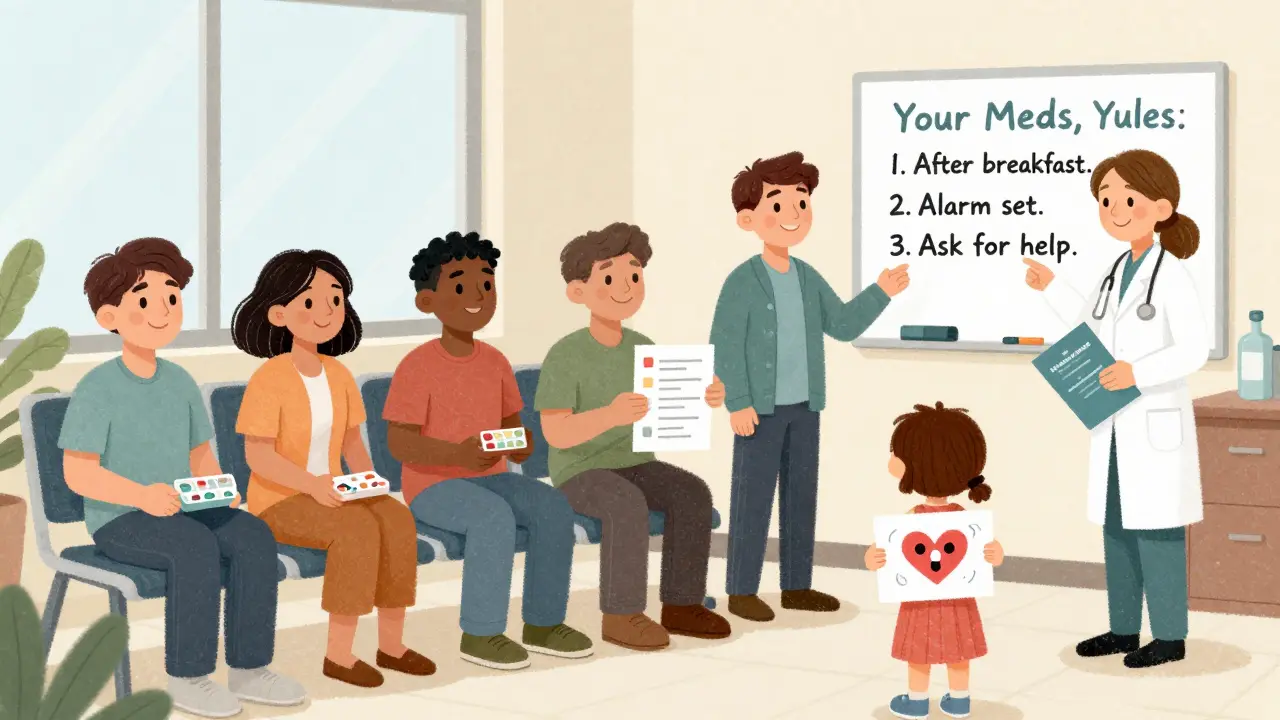
Team-Based Care: When Your Doctor Isn’t the Only One Helping
One of the biggest shifts in chronic care isn’t a new drug-it’s a new team. The CDC found that patients who got team-based care (pharmacists, nurses, social workers, and doctors working together) had an 89% adherence rate after 12 months. That’s compared to just 74% for those who saw only their doctor.
What did that team do differently?
- Pharmacists reviewed all meds and cut out duplicates or unnecessary pills.
- They taught patients how to use pill organizers and refill reminders.
- They checked in by phone-not just when something went wrong, but regularly.
- They helped patients find low-cost options or apply for assistance programs.
This isn’t luxury care. It’s smart care. And it’s available in many clinics across the UK and beyond. Ask your GP if they work with a pharmacist-led adherence program. If they don’t, ask why.
Barriers Nobody Talks About (But Should)
Cost is the elephant in the room. A 2025 survey showed that 1 in 4 UK adults on long-term meds skipped doses because they couldn’t afford them. But it’s not just about price. It’s about complexity. Five different pills at five different times? That’s a full-time job. Side effects like fatigue, nausea, or dizziness make it harder to stay consistent. And let’s not forget the emotional burnout-feeling like your body is betraying you, day after day.
Gender matters too. The same rheumatoid arthritis study found women were 4.5 times more likely to stick with their meds than men. Why? Likely because women are more likely to seek support, ask questions, and prioritize health routines. That doesn’t mean men are less committed-it means the system isn’t designed for them.
Age plays a role too. Older patients tend to be more adherent, not because they’re better at it, but because they’ve had more time to build routines. Younger patients? They’re juggling jobs, kids, social lives-and meds often fall off the list.
How to Build Your Own Coping System (No Fancy Apps Needed)
You don’t need a smart pillbox or a subscription app. Start simple.
- Anchor your dose to a daily habit. Take your pill after breakfast. After brushing your teeth. Before bed. Link it to something you already do every day.
- Use visual cues. Put your pill bottle next to your toothbrush. Leave a sticky note on the fridge. Make it impossible to miss.
- Set one reminder. One phone alarm. One daily alert. Don’t overcomplicate it. Just make sure it goes off.
- Ask your pharmacist for help. They can simplify your regimen, suggest generics, or connect you to free or low-cost programs.
- Find one person to check in with. A partner, a friend, a support group. Just one person who asks, “How’s your meds going?”
That’s it. No apps. No gadgets. Just structure and support.
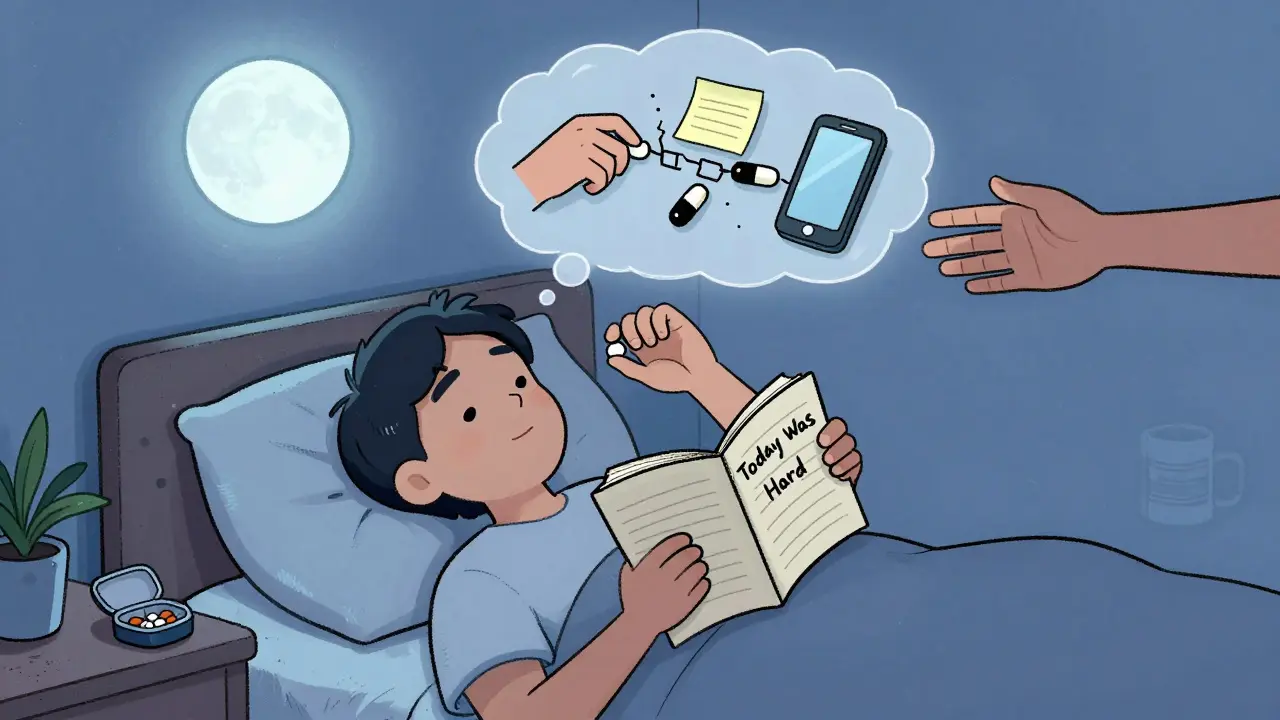
What to Do When You Slip Up
Everyone misses a dose. Sometimes two. Sometimes a week. The key isn’t perfection. It’s what you do next.
Don’t punish yourself. Don’t say, “I’m a failure.” Instead, ask: “What made it hard this time?” Was it travel? A change in schedule? A bad side effect? Write it down. Then fix it. Maybe you need a pill case with compartments. Maybe you need to talk to your doctor about a different medication. Maybe you need to talk to someone about how stressed you feel.
Adherence isn’t about never failing. It’s about getting back on track faster.
What’s Next? The Future of Chronic Medication Care
Researchers are working on tools to predict who’s at risk of nonadherence-and tailor support before it’s too late. Imagine a system that notices you haven’t picked up your prescription in 45 days and automatically texts you: “Need help with your meds? We’ve got options.”
More clinics are starting to screen for coping skills during checkups. Instead of just asking, “Are you taking your pills?” they’re asking, “What’s been hard about taking them?” That shift-from blame to understanding-is changing outcomes.
And the economic impact? Nonadherence costs the NHS an estimated £1 billion a year in avoidable hospital visits and complications. Fixing it isn’t just good for you-it’s good for everyone.
Why do I keep forgetting to take my medication even though I know it’s important?
Forgetting isn’t a character flaw-it’s a design flaw. Your brain isn’t wired to prioritize long-term health over immediate comfort. That’s why linking your pill to a daily habit (like brushing your teeth or eating breakfast) works better than relying on memory. Setting one phone alarm and keeping your meds visible helps too. Most people who succeed don’t remember better-they make it impossible to forget.
Can I stop taking my medication if I feel fine?
No. Feeling fine is often the result of your medication working. Stopping suddenly can cause your condition to flare up, sometimes dangerously. For example, stopping blood pressure meds can lead to a stroke. Even if your symptoms are gone, the underlying issue is still there. Talk to your doctor before making any changes-not because they’re controlling, but because they’re trying to keep you safe.
My meds are too expensive. What can I do?
You’re not alone. Ask your pharmacist for generic versions-they’re just as effective but cost far less. In the UK, you can apply for the NHS Low Income Scheme or use services like RxAssist.org to find patient assistance programs. Many drug manufacturers offer free or discounted meds to those who qualify. Don’t skip doses because of cost. There are solutions. You just need to ask.
Is it normal to feel angry or resentful about having to take meds forever?
Yes. It’s completely normal. Many people feel grief, frustration, or even anger about needing long-term medication. That doesn’t mean you’re weak. It means you’re human. Talking to a counselor, joining a support group, or even journaling your feelings can help. You don’t have to be grateful all the time. You just have to keep going.
How do I know if my coping strategy is working?
Track your adherence for one month. Use a simple calendar-put a checkmark every day you take your meds. If you’re at 90% or higher, you’re doing well. If you’re below 80%, it’s time to adjust. Ask yourself: What’s making it hard? Is it timing? Cost? Side effects? Then change one thing. Small fixes add up.
Final Thought: You’re Not Alone in This
Chronic medication isn’t a failure. It’s a tool. And like any tool, it only works if you know how to use it. The goal isn’t to be perfect. It’s to be consistent. To build a routine that fits your life-not the other way around. Whether you’re taking one pill or five, whether you’re 25 or 75, whether you’re feeling strong or exhausted-there’s a way to make this manageable. You just need the right strategy, the right support, and the permission to ask for help.
8 Responses
People think taking pills is about willpower, but it’s not. It’s about surrendering to the fact that your body is now a machine that needs constant fuel. You’re not lazy-you’re just human. And humans weren’t meant to live like this. But here we are. So stop judging yourself and start building systems. Simple. No fluff.
It is, indeed, a matter of profound existential import that the modern individual is compelled to engage in the daily ritual of pharmaceutical ingestion as a prerequisite for the continuation of biological viability. One cannot help but observe that this phenomenon constitutes a metaphysical paradox: the very substances designed to sustain life have, in their ubiquity, become emblematic of its erosion. The systemic failure to address adherence is not merely logistical-it is ontological.
As a board-certified internal medicine specialist with 18 years in clinical practice, I must say-this article is *almost* comprehensive. 🙄 But you missed the most critical factor: circadian rhythm alignment. Studies from Johns Hopkins (2023) show that timing medication to cortisol peaks improves adherence by 41%. Also-emojis are not clinical tools. 🤦♂️
I’ve been on 7 meds for 12 years. I get it. Some days, I cry because I’m tired of being a patient. But I also have a friend who texts me every Sunday: ‘How’d your week go with the pills?’ Just that one thing kept me going. You don’t need apps. You need someone who sees you, not just your prescription list. You’re not alone. I’m right here with you.
While the article appropriately identifies active coping as a primary behavioral intervention, it fundamentally underestimates the neurocognitive load associated with polypharmacy in chronic disease states. The cognitive burden of executive function depletion-particularly in the prefrontal cortex-is exacerbated by circadian misalignment and pharmacokinetic interference. Without incorporating pharmacogenomic profiling and real-time adherence telemetry via IoT-enabled blister packs, any adherence strategy remains statistically insignificant.
Let me tell you about my cousin in rural Nebraska-he’s got type 2 diabetes, hypertension, and gout. He takes 11 pills a day. No smartphone. No app. But he keeps his meds in a coffee tin next to his favorite chair, and he takes them right after his morning coffee, every single day. He doesn’t know what ‘active coping’ means. But he knows his body. He knows his routine. And he’s been stable for 8 years. Sometimes, the simplest things are the most powerful. No tech needed. Just a tin, a cup of coffee, and a man who refuses to let his illness win.
Oh please. You think setting an alarm is the solution? 😒 People who can’t manage their meds are just weak. My 78-year-old grandma takes 9 pills every day without fail-because she has *discipline*. You don’t need a support group-you need to stop making excuses. This isn’t therapy. It’s medicine. And if you can’t handle it, don’t blame the system. Blame yourself. 💪
Let me tell you something that no one else will say loud enough: the emotional toll of chronic illness is not just a side effect-it’s the main event. I’ve watched my sister spend years crying in the bathroom after taking her pills because she felt like a ghost in her own body. And then one day, she started writing letters to her future self-tiny notes tucked into her pillbox. ‘Today, I chose me.’ That’s not just adherence. That’s rebellion. That’s love. And if you’re still reading this, you’re still fighting. And that’s more than enough.