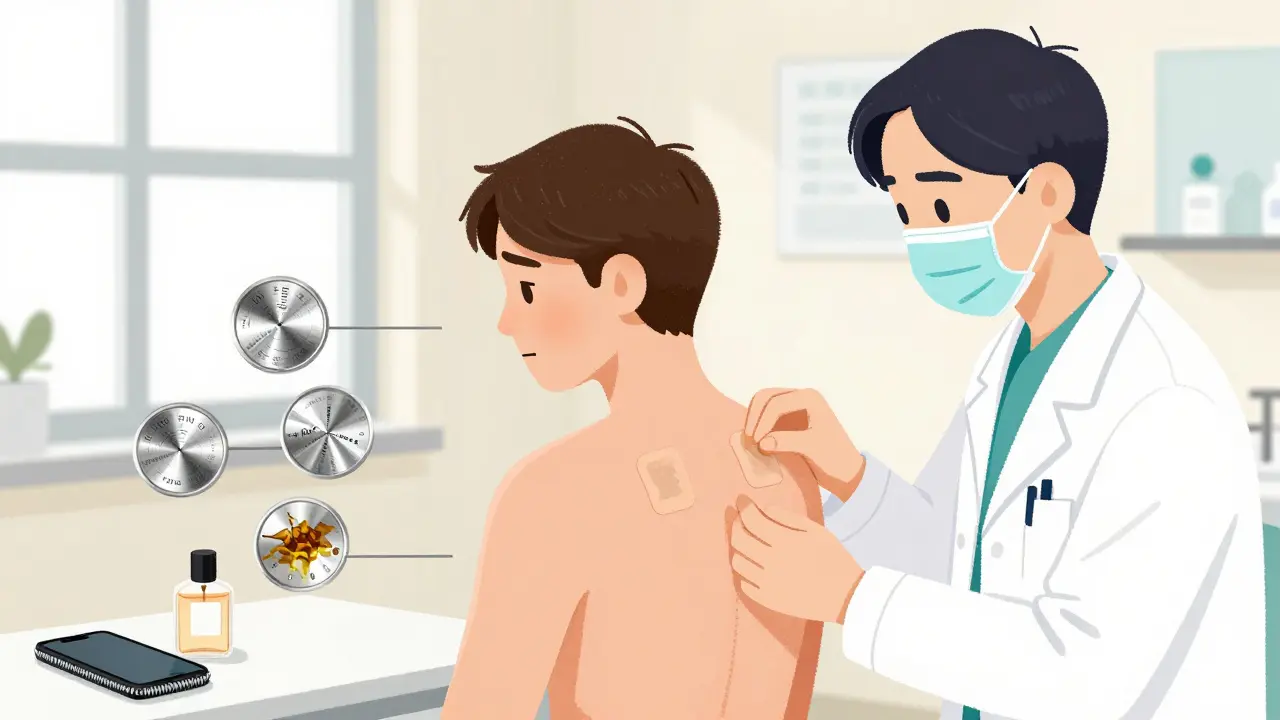
If you’ve had a rash that won’t go away-itchy, red, flaky skin on your hands, neck, or ears-you might not just have dry skin. It could be contact allergy, and the culprit might be hiding in plain sight: your jewelry, perfume, shampoo, or even your jeans. For years, people live with this irritation, trying every cream, avoiding soaps, switching detergents, and still nothing helps. That’s because the real problem isn’t surface-level. It’s your immune system reacting to something touching your skin, and it’s not happening right away. This is allergic contact dermatitis, a delayed reaction caused by T-cells, not histamine. And the only reliable way to find out what’s triggering it? Patch testing.
What Patch Testing Actually Does
Patch testing isn’t like a skin prick test for pollen or peanuts. You don’t get poked or injected. Instead, tiny amounts of common allergens are taped to your back-usually 80 to 150 different substances-and left there for 48 hours. After that, your doctor checks for reactions. Then they check again at 72 to 96 hours, and sometimes even at 7 days. Why? Because contact allergies don’t show up immediately. They build slowly. Your skin doesn’t break out the moment you touch nickel. It takes days. That’s why patch testing is the gold standard. Blood tests? They don’t work for this. Lymphocyte transformation tests are unreliable, especially for fragrances. Only patch testing gives you real, actionable answers.Metals: The Most Common Triggers
Nickel is the biggest offender. It’s in everything: earrings, belt buckles, zippers, watch straps, even some smartphones and laptops. About 18.5% of people tested in North America react to nickel sulfate at the standard concentration of 5% in petrolatum. Cobalt and chromium are next. Cobalt shows up in metal alloys, cement, and some cosmetics. Chromium is in leather, paint, and tools. If you work with metal, handle tools, or wear cheap jewelry, you’re at higher risk. And here’s the thing: once you’re allergic to nickel, you’re often allergic to cobalt too. They’re chemically similar. So a good patch test doesn’t just check for nickel-it checks for both, plus chromium. If you’ve had a rash around your belly button for years and you wear a belt with a metal buckle? That’s probably why.Fragrances: The Hidden Culprits
Fragrances are trickier. You think you’re avoiding perfume, but fragrances are in laundry detergent, body wash, deodorant, hand soap, even unscented lotions. The word “unscented” doesn’t mean fragrance-free-it often means masking chemicals are used to cover up smells. That’s where the problem starts. The European Union requires 26 fragrance allergens to be labeled if they’re above certain levels. But in the U.S., there’s no such rule. And even if you think you’re avoiding fragrance, you might still be exposed. That’s why patch testing doesn’t just use two fragrance mixes (FM I and FM II). Those mixes cover about 70-80% of reactions. But 10-15% of people react to individual chemicals like lyral, hydroxycitronellal, citral, or farnesol-ingredients removed from the mixes because they’re unstable, but still used in products today. Without testing these individually, you’ll miss the cause. One patient in Ohio had hand eczema for 12 years. She avoided perfume, used “natural” products. Turned out, her lotion had farnesol. After avoiding it? Her skin cleared in 3 weeks.How the Test Works-Step by Step
There are three visits, spread over a week. On Monday, your dermatologist applies the patches. Small aluminum discs with allergens are taped to your upper back with Scanpor tape. You can’t get the area wet. No showers, no swimming, no sweating. You wear a loose cotton shirt. No tight clothes. No bending over too much. You go home and wait. On Wednesday, you come back. The patches come off. The doctor looks for redness, bumps, blisters. They grade each reaction: negative, doubtful, weak positive, strong positive, or extreme. But that’s not the end. Many reactions appear later. So you come back Friday. Some clinics even ask you to return on Monday of the next week. A reaction that looks nothing on day two might be a strong positive on day five. That’s why skipping the final reading is a mistake. And if your reaction shows up late? That’s still valid. It’s not a false negative-it’s just delayed.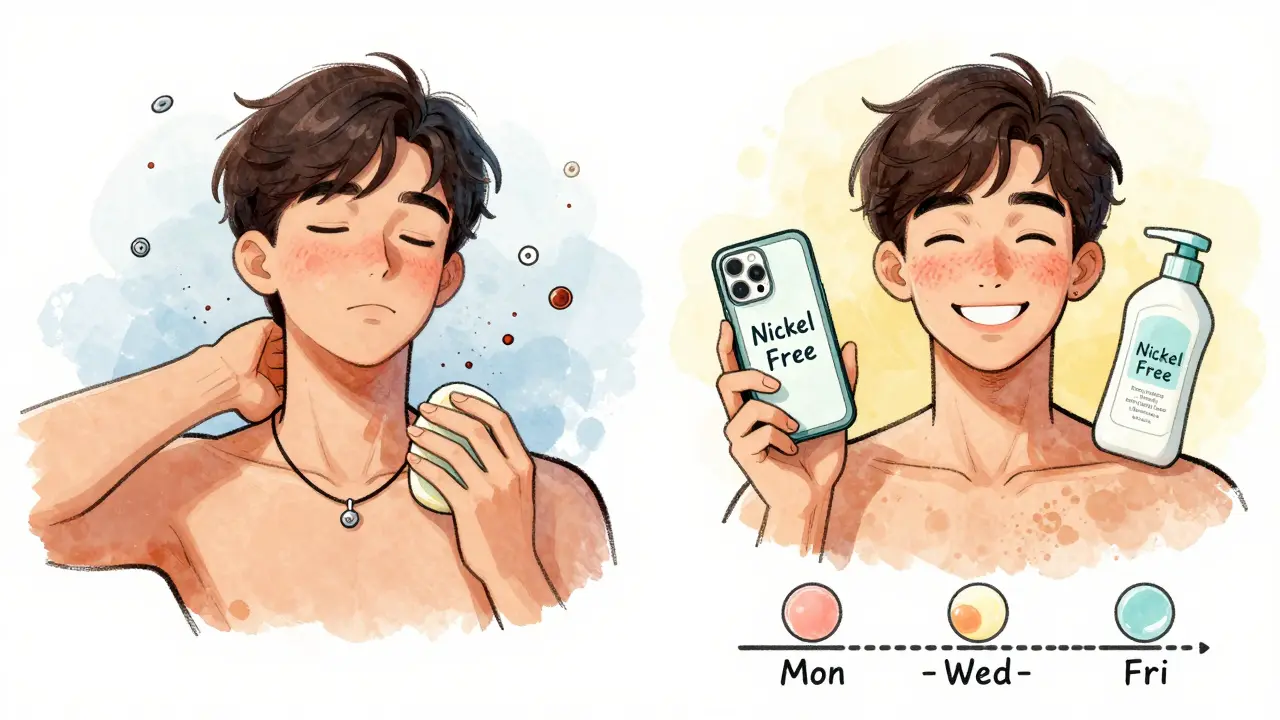
What a Positive Result Means
If you test positive for nickel, you don’t just avoid earrings. You check your phone case, your belt, your kitchen utensils, your glasses frames. You look for “nickel-free” labels. But it’s not always obvious. Some jewelry is plated, and the plating wears off. Some stainless steel contains nickel. You might need to buy titanium or surgical-grade implants. For fragrances, you learn to read ingredient lists. You avoid anything that says “parfum,” “fragrance,” or “aroma.” You switch to fragrance-free laundry detergent, not unscented. You stop using scented candles. You avoid hand sanitizers with added scent. You learn that even “hypoallergenic” products can contain hidden allergens. And you’ll need to be vigilant. One slip-up-a new perfume, a friend’s lotion, a new shirt-can bring the rash back. But here’s the payoff: 60 to 80% of patients who avoid their triggers see complete clearance. That’s not improvement. That’s cure.Why Most People Get It Wrong
Too many dermatologists do only the basic patch test. They use the standard 80-antigen panel but skip the extended fragrance series. They miss the individual chemicals. They don’t read at 96 hours. They don’t ask about laundry detergent. They don’t check for chromium in leather. That’s why so many patients go years without answers. A 2023 study found that comprehensive testing-using both fragrance mixes and 15+ individual chemicals-identified causes in 68.7% of cases. Limited testing? Only 42.3%. That’s a huge gap. And it’s not just about the test. It’s about the interpretation. A weak positive might be irritation, not allergy. A red spot could be from sweat, not nickel. Only board-certified dermatologists trained in patch testing can tell the difference. If your doctor doesn’t specialize in contact dermatitis, ask for a referral.What to Expect After the Test
Getting your results can be overwhelming. You’ll get a list: “Positive: Nickel, Fragrance Mix I, Myroxylon pereirae.” Now what? You’ll need a follow-up. Most people need at least one more visit to learn how to avoid these things. You’ll learn how to read labels. You’ll learn that “natural” doesn’t mean safe. You’ll learn that some products labeled “for sensitive skin” still contain the same allergens. You’ll learn to ask for Material Safety Data Sheets (MSDS) from manufacturers. You’ll learn to test new products on a small patch of skin first. And you’ll learn to keep a diary. What did you touch? When did the rash start? That’s how you catch new triggers. One nurse in California traced her chronic hand dermatitis to nickel in surgical instruments. She switched to nickel-free tools. Her skin never flared again.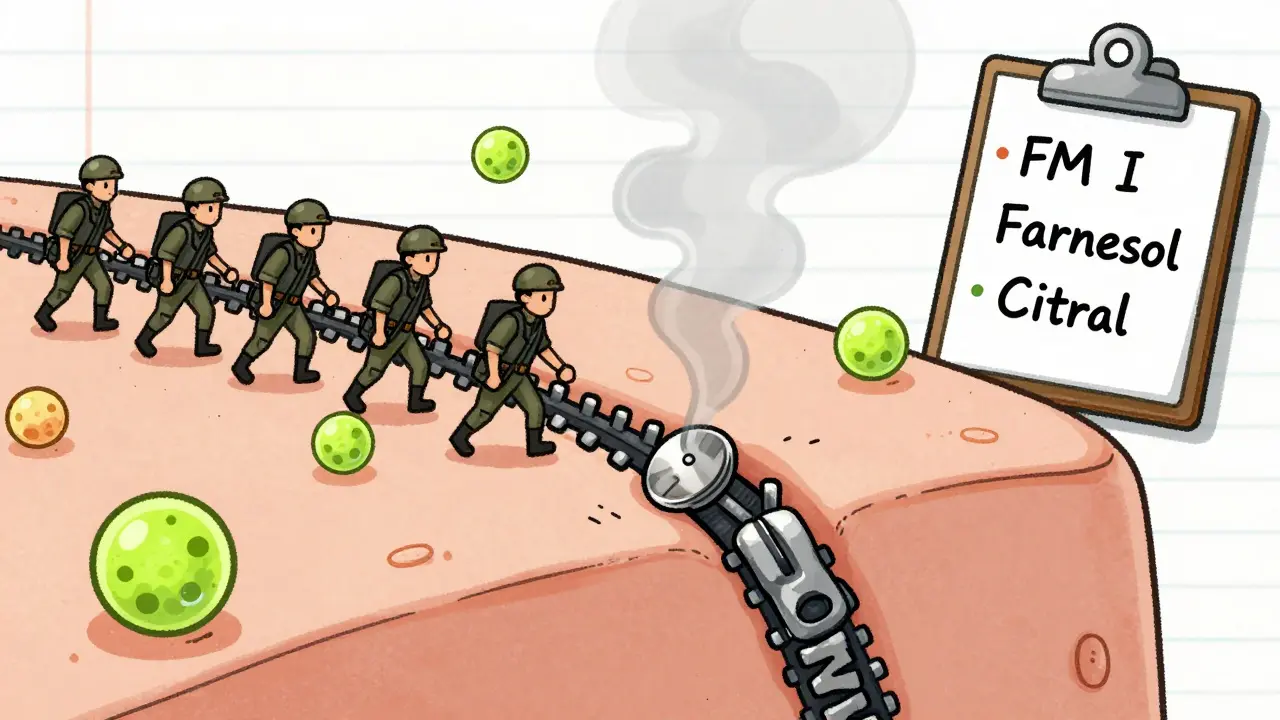
Limitations and Risks
Patch testing isn’t perfect. You can’t test every chemical-there are tens of thousands. Even the biggest panel covers only 150. You might still have a reaction to something not on the list. False positives happen in 5-10% of cases, often from irritation. That’s why interpretation matters. And false negatives? They’re rare, but they happen. If you’re still symptomatic after a negative test, don’t give up. Try again with a different clinic. Maybe you need a more comprehensive panel. Or maybe you need photopatch testing if your rash only shows up in sunlight. And yes, the test is inconvenient. No showers for two days. No exercise. Itchy skin. But 87% of people who’ve done it say it was worth it. On Reddit, people write: “Life-changing.” “Finally, I know why my hands cracked.” “I haven’t had a flare in 18 months.” That’s the real value.What’s Changing in 2026
The field is evolving. In 2023, the North American Contact Dermatitis Group added eight new fragrance allergens to their test panel-citral, farnesol, and others that are rising in use. The European series now includes 32 fragrance markers. Research is exploring peptide-based blood tests for metal allergies, but they’re not ready yet. The big push now is for better labeling. The U.S. FDA is considering rules similar to the EU’s, requiring fragrance allergens to be listed. But until then, it’s up to you. And up to your doctor to test properly.Can I do patch testing at home?
No. Patch testing requires standardized allergens, controlled application, and expert interpretation. Over-the-counter kits or DIY methods are unreliable and can cause serious irritation or false results. Always see a board-certified dermatologist trained in patch testing.
How long does the patch test take?
The full process takes about a week. You’ll have three visits: application on day one (Monday), first reading on day three (Wednesday), and final reading on day five or seven (Friday or Monday). The patches stay on your back for 48 hours minimum, and you must avoid water and sweating during that time.
Is patch testing painful?
No, it’s not painful. The patches are taped on gently and don’t pierce the skin. You might feel mild itching or burning if you react, but that’s normal. Some people find the 48-hour restriction on showering or exercise uncomfortable, but the test itself doesn’t hurt.
Can I get a false negative on patch testing?
Yes, but it’s rare. False negatives happen if you stop using topical steroids before the test, if you test too soon after a flare, or if the allergen isn’t included in the panel. Some people react only to chemicals not in standard series. If your symptoms continue after a negative test, ask about extended fragrance testing or photopatch testing.
How accurate is patch testing for fragrances?
It’s the most accurate method available, but only if done right. Testing only with fragrance mixes misses 10-15% of cases. For full accuracy, you need both fragrance mixes (FM I and FM II) plus at least 15 individual fragrance chemicals like lyral, hydroxycitronellal, and citral. Comprehensive testing finds causes in nearly 70% of fragrance-related dermatitis cases.
What should I avoid before patch testing?
Stop using topical steroids on your back at least two weeks before the test. Avoid oral steroids and immunosuppressants if possible. Don’t sunbathe or use tanning beds for at least a week. And don’t apply lotions or creams to your back the day before. Your skin needs to be clean and normal for accurate results.
Can children get patch tested?
Yes, but it’s less common. Children under 12 rarely need it unless they have chronic eczema that doesn’t respond to standard treatment. The test is safe for kids, but they need to be able to sit still for 48 hours without scratching or removing patches. Pediatric dermatologists handle these cases differently and often use smaller panels.
How much does patch testing cost?
Cost varies by clinic and insurance. In the U.S., it typically ranges from $300 to $700. Many insurance plans cover it if you have chronic contact dermatitis and a referral from a dermatologist. Always check with your provider. The cost is often worth it-avoiding the allergen can save you thousands in creams, doctor visits, and lost productivity over time.
9 Responses
People treat allergies like they're optional inconveniences. They're not. Your immune system is literally waging war on your belt buckle. And no, you can't just 'get used to it.' This isn't a personality flaw. It's biology.
I had no idea that 'unscented' didn't mean fragrance-free... I've been using that stuff for years. I'm gonna check my detergent right now. Thanks for the clarity. This makes so much sense now.
OMG I just remembered my hand eczema started after I switched to that 'natural' lavender lotion 😭 I thought it was better for me!! I'm booking a patch test tomorrow!! 🙌✨
This is so helpful. I’ve had rashes for years and thought it was just dry skin. I’ll talk to my dermatologist next week. Thank you for sharing this.
My phone case is probably the culprit. I never thought about that.
So let me get this straight - we're supposed to trust a dermatologist who tapes glue to your back with a bunch of chemicals... and somehow that's the gold standard? Meanwhile, Big Pharma's still selling you 'hypoallergenic' soap that smells like a chem lab. Welcome to modern medicine.
The pathophysiological mechanism underlying allergic contact dermatitis is mediated by CD4+ T-cell-mediated delayed-type hypersensitivity (DTH) responses, specifically through the activation of memory T-lymphocytes against haptenated skin proteins. This is distinct from IgE-mediated urticaria, which explains the absence of histaminergic response and the delayed clinical manifestation. The diagnostic specificity of patch testing arises from its direct in vivo exposure to antigenic haptens, circumventing the limitations of serological assays, which lack sensitivity for low-molecular-weight xenobiotics such as nickel salts and fragrance terpenoids.
They didn't test for farnesol in my first panel. I had to push for it. Took 18 months to get answers. Don't settle for the basic panel.
Bro, I used to think my back rash was from my backpack... turns out it was the nickel in the zipper. Now I wear cotton shirts only. No more cheap jeans. Life changed. Patch test if you’re still scratching. Worth every penny.