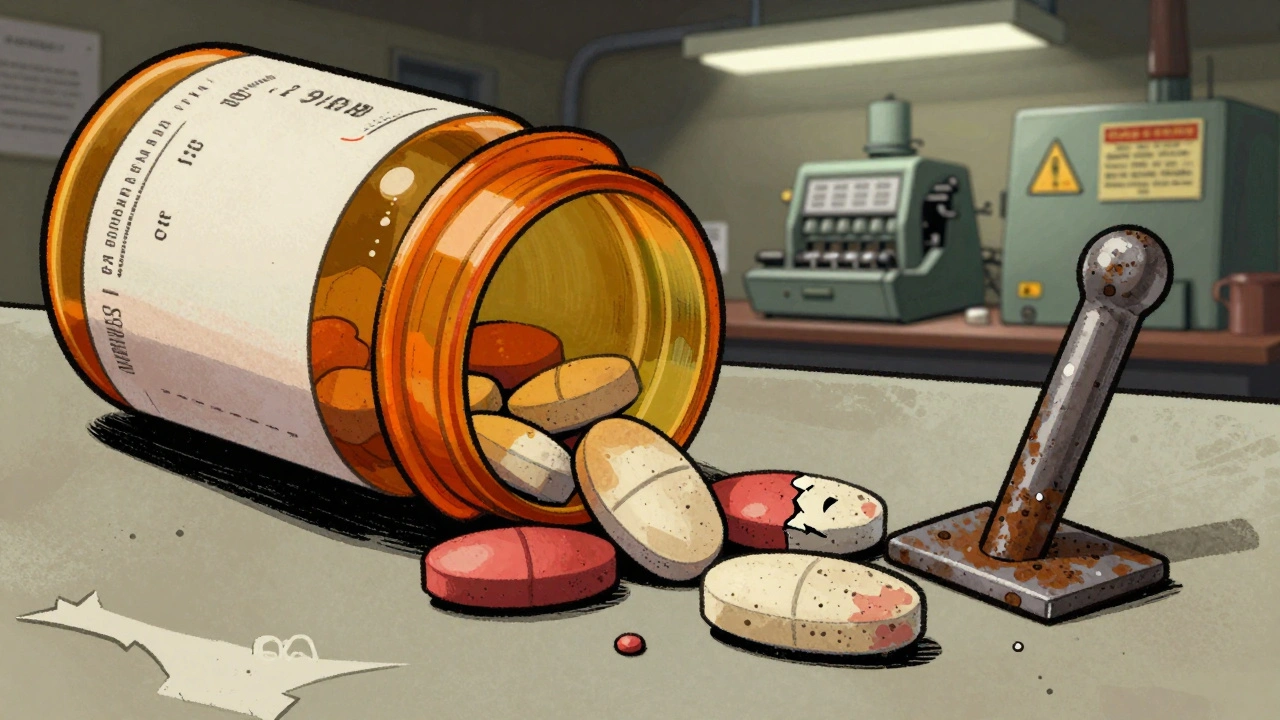
When you pick up a generic pill at the pharmacy, you expect it to work just like the brand-name version. But behind that simple tablet or capsule, there’s a complex manufacturing process that often fails - and when it does, it can put your health at risk. Between 2019 and 2023, generic drugs had 3.2 times more manufacturing quality issues than their branded counterparts, according to FDA inspection data. These aren’t rare glitches. They’re systemic problems rooted in outdated equipment, cost-cutting, and weak oversight.
What Counts as a Quality Defect?
A quality defect isn’t just a broken tablet. It’s anything that changes how the drug behaves in your body. The FDA classifies these into three levels:- Critical defects: Dose accuracy off by more than 5%. This means you might get too much or too little of the active ingredient. For drugs like levothyroxine or warfarin, even a 10% variation can cause serious side effects.
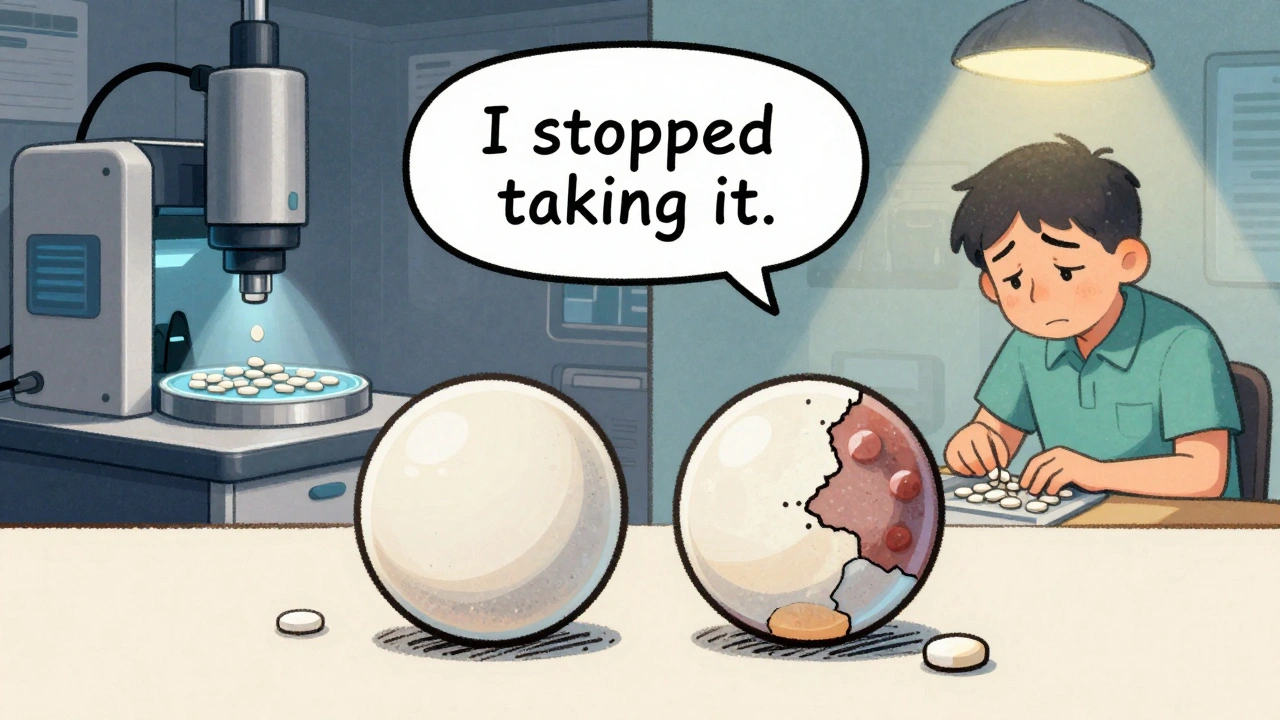
- Major defects: Cosmetic flaws that erode trust - like mottled coloring, chipping, or uneven surfaces. Patients report these often. One pharmacist in Ohio told a patient their generic metformin looked "like it had been stepped on." The patient stopped taking it, and their blood sugar spiked.
- Minor defects: Small deviations that regulators may accept if documented. But even these add up. A batch with slightly sticky tablets might pass inspection, but the next batch could crack during shipping.
These defects aren’t random. They follow patterns tied to how the drug is made.
Top 5 Manufacturing Defects in Generic Drugs
1. Capping and Lamination
These are the most common defects in tablet production. Capping happens when the top of the tablet splits off. Lamination is when layers peel apart. Both occur when compression force is too high - over 15 kN - or when the granules are too dry (moisture below 2%). Hydrophobic ingredients like ibuprofen or atorvastatin are especially prone. At production speeds above 40 rotations per minute, lamination spikes. Many generic plants still use 20-year-old tablet presses that can’t adjust pressure fast enough to keep up.
2. Weight Variation
Each tablet must contain the same amount of active ingredient. The USP <905> standard allows weight variation under 5%. But when granule flow rates drop below 0.5 grams per second - often because of poor mixing or clogged hoppers - batches fail. In 2023, Vici Health Sciences found that 12.7% of defective generic batches had inconsistent weights. This isn’t just a lab issue. Patients on blood thinners or epilepsy meds have been hospitalized after switching to a batch with uneven dosing.
3. Punch Sticking
When the active ingredient sticks to the metal punch during compression, it causes uneven tablets and machine downtime. This happens most with APIs that melt easily - those with melting points below 120°C - when moisture levels rise above 4%. Common culprits include antibiotics like amoxicillin or antidepressants like sertraline. Ejection forces jump by 300-500 N, stressing equipment and increasing defect rates. One manufacturer in India had to shut down a line for two weeks after 80% of their sertraline tablets stuck to the punches.
4. Particulate Contamination in Injectables
Injectables are the most dangerous. A single speck of glass or fiber in an IV bag can cause strokes or organ damage. Sterile injectables have an 8.7% defect rate - the highest among all dosage forms. The problem? Shared production lines. Many generic makers use the same facility for multiple drugs. A batch of heparin might be made on a line that previously handled insulin. Cleaning protocols are often rushed to save time. The FDA found that 62% of injectable shortages between 2013 and 2017 were due to contamination.
5. Mottling and Discoloration
Uneven coloring might look harmless, but it often signals poor blending. If the active ingredient isn’t mixed evenly with fillers, some tablets have too much drug, others too little. This is especially common in multi-layered or extended-release pills. Patients notice it. They call their pharmacist. They worry. And sometimes, they stop taking the medication.
Why Do Generic Drugs Have More Problems?
It’s not that generic manufacturers are negligent. It’s that the system pushes them to cut corners.
- Price pressure: Generic drugs make up 90% of prescriptions but only 23% of drug spending. To survive, companies slash costs. Quality assurance budgets drop to 8-10% of production costs - half of what branded companies spend.
- Aging equipment: Many facilities use machinery from the 1980s. Calibration is outdated. Sensors don’t detect micro-variations. One plant in Pennsylvania still uses manual weight checks - inspectors pick up 10 tablets every hour. Automated systems can check 1,200 tablets per minute with ±5% accuracy.
- Shared facilities: A single plant might produce 20 different generics. Cross-contamination is a constant risk. Cleaning validation is often done with swabs that miss invisible residues.
- Regulatory gaps: The FDA inspects only 10-15% of foreign generic plants annually. Many are in India and China, where oversight is inconsistent. In 2023, 57% of generic manufacturing facilities failed FDA inspections - compared to 28% for branded ones.
Dr. Scott Gottlieb, former FDA commissioner, put it bluntly: "The relentless price pressure on generics has compromised the reliability of our drug supply."
Real-World Impact: What Patients and Pharmacists Are Seeing
Behind the data are real people.
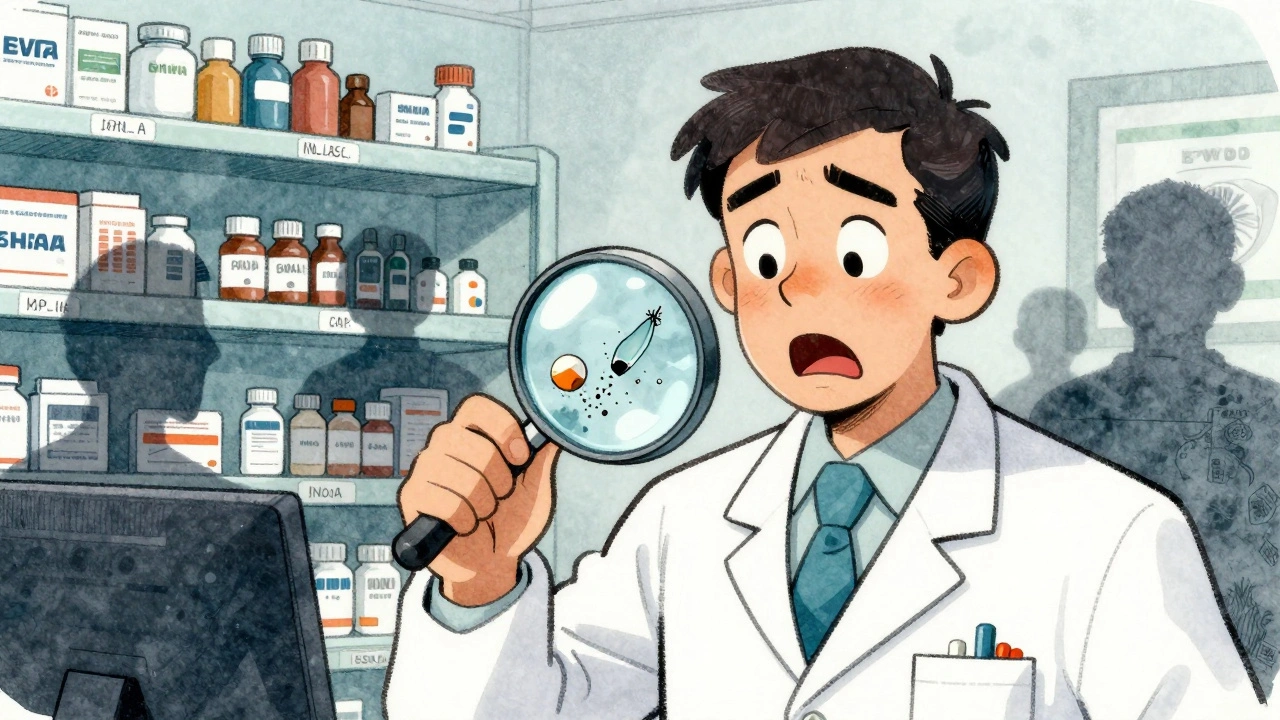
A 2023 survey of 1,247 pharmacists found that 68% had seen quality issues in the past year. Forty-two percent reported patients complaining about tablet appearance. Twenty-nine percent said patients noticed different effects - like a generic levothyroxine causing fatigue where the brand version didn’t.
On Reddit’s r/pharmacy, a January 2024 thread titled "Generic drug quality getting worse?" had 287 comments. One pharmacist wrote: "Received a batch of metformin ER that crumbled in the bottle. Patients called saying it tasted bitter and made them nauseous. We had to pull the whole lot."
The FDA’s MedWatch system logged 1,842 adverse events in 2023 tied to visible defects - chipped, cracked, or discolored pills. Three hundred twenty-seven of those reports came from patients who stopped taking their meds because they didn’t trust the product.
What’s Being Done - and What’s Not
The FDA launched its Emerging Technology Program in 2023 to help manufacturers switch from batch processing to continuous manufacturing. This reduces defects by 65%. So far, 47 generic companies have joined. But most haven’t. The cost? Up to $10 million per line. Smaller firms can’t afford it.
AI-powered visual inspection systems are now detecting defects as small as 0.1 mm with 92% accuracy - far better than human inspectors, who miss up to 30% of flaws. Sandoz and Dr. Reddy’s are using them. But many plants still rely on workers staring at tablets under fluorescent lights for hours.
The 2024 Drug Supply Chain Security Act now requires track-and-trace for high-risk generics. Early results show a 22% drop in counterfeit-related issues. But that doesn’t fix poor manufacturing - only fake drugs.
The real problem? Investment. The Generic Pharmaceutical Association estimates it would take $28.7 billion to upgrade all U.S. generic manufacturing facilities to modern standards. Annual investment? Just $1.2 billion.
What You Can Do
You can’t control how your drug is made. But you can protect yourself.
- Watch your pills: If your generic looks different - color, shape, markings - ask your pharmacist. Don’t assume it’s the same.
- Track side effects: If you feel worse after switching to a generic, talk to your doctor. It might be the drug, not your condition.
- Check recalls: Visit the FDA’s drug recall page. If your generic is listed, stop taking it.
- Ask about the manufacturer: Some brands - like Teva - have lower rejection rates. Others average 3-4 times more failures. Your pharmacist can tell you who made your pill.
- Stick with brand if needed: For critical drugs like thyroid meds, seizure control, or blood thinners, the cost difference might be worth the safety margin.
Generic drugs saved the U.S. healthcare system hundreds of billions. But if quality keeps slipping, that savings turns into risk. The system needs more than inspections - it needs investment, modern tech, and a commitment to safety over speed.
Are generic drugs less effective than brand-name drugs?
Legally, generics must be bioequivalent - meaning they deliver the same amount of active ingredient into your bloodstream at the same rate. But bioequivalence doesn’t guarantee identical performance. Manufacturing defects like uneven dosing, poor coating, or contamination can cause differences in how the drug works. Between 2015 and 2020, 7.3% of generic applications failed bioequivalence tests due to manufacturing inconsistencies, not formulation issues.
Why do some generic pills look different from others?
Different manufacturers use different inactive ingredients - fillers, binders, colors - which affect appearance. But if your pill suddenly changes color, shape, or texture, it could signal a new batch with quality issues. Always check the imprint code and compare it to your previous prescription. If it looks off, ask your pharmacist.
Can generic drug defects cause serious harm?
Yes. Critical defects like weight variation or contamination can lead to overdose, underdose, or infection. In 2018, a batch of contaminated generic heparin caused 81 deaths and 788 hospitalizations. Even non-critical defects like mottling or chipping can lead patients to stop taking their medication - worsening their condition. Over 1,800 adverse events linked to visible defects were reported to the FDA in 2023 alone.
Which generic drug manufacturers have the best quality records?
Teva, Mylan, and Sandoz have consistently lower batch rejection rates - under 1% in 2023. Smaller manufacturers average 3-4% rejection rates. The FDA’s inspection database shows that facilities with continuous manufacturing and AI-based inspection systems have defect rates 65% lower than those using older batch methods. Ask your pharmacist which manufacturer supplies your prescription.
How can I find out if my generic drug was recalled?
Check the FDA’s Drug Recalls page, updated daily. You can search by drug name, manufacturer, or lot number. If your pharmacy didn’t notify you, it’s your responsibility to check. Many recalls are for specific batches - not all generics from that company. Look up the lot number on your bottle and compare it to the recall list.
What’s Next?
The FDA’s 2024-2027 plan aims to cut quality-related shortages by 30% through incentives for modern manufacturing. But without real funding, that goal won’t be met. The gap between what’s needed and what’s spent is growing. Until manufacturers invest in better equipment, training, and oversight, patients will keep facing unpredictable risks - even for the cheapest pills on the shelf.
9 Responses
Let me guess - you’re one of those people who thinks ‘generic’ means ‘cheap trash.’ Newsflash: if your thyroid med doesn’t work, it’s not because the FDA is out to get you. It’s because you’re too cheap to pay $200 for a brand-name pill that’s basically the same thing. Stop whining and get over it. 😒
I’m not even gonna lie - I stopped taking my generic metformin after the pills turned green. My blood sugar went through the roof. Now I pay extra for the brand. Screw ‘saving money’ when your kidneys are on the line. 🇺🇸
bro i just found out my generic zoloft looks like a crayon that melted in my pocket 😭 my doc said it’s fine but i swear i feel like i’m on a different drug now. also why does the new batch taste like burnt plastic??
This is so eye-opening. I had no idea that something as simple as tablet sticking could cause such a cascade of problems. The fact that plants are still using 20-year-old machines while AI can detect defects smaller than a grain of salt… it’s insane. I wonder how many people are quietly suffering because their meds aren’t working right, and no one connects the dots. Maybe we need a public database of which manufacturers have the lowest rejection rates - like a Consumer Reports for pills. 🤔
There is a fundamental moral failure here, and it is not merely a technical one. We have commodified human health to the point where the cost per pill dictates the integrity of the entire pharmaceutical supply chain. When a patient is forced to choose between rent and their blood pressure medication, and then that medication is rendered unreliable due to cost-cutting measures that are not only unethical but statistically dangerous - we are not just failing as a society; we are actively participating in a systemic betrayal of the most vulnerable among us. The FDA’s 10% inspection rate is not oversight - it is negligence dressed in bureaucratic language. And yet, we applaud ourselves for being ‘fiscally responsible.’
I’ve been a pharmacist for 22 years. I’ve seen generics go from ‘good enough’ to ‘barely acceptable.’ It’s not about the companies being evil - it’s about the system rewarding speed over safety. I had a patient once who cried because her generic warfarin made her bruise like a grape. She switched back to brand and her INR stabilized in two weeks. No one wants to admit this, but sometimes, the extra $15 a month saves you a trip to the ER. We need to stop pretending that all pills are created equal. They’re not. And pretending they are is dangerous.
in india we make 40% of the world's generics and yes, some factories are old but also some are top notch. problem is big pharma doesn't care where it comes from as long as it's cheap. i work in a lab that exports to usa - we have 3 lines, one is old, one is mid, one is new with ai vision. guess which one gets the most orders? the cheap one. sad but true.
Oh wow. So the problem isn’t that generics are bad - it’s that Americans are too lazy to demand better. You want safe drugs? Pay for them. Stop expecting luxury healthcare on Walmart prices. The FDA is a joke. Let the market decide. If your pill crumbles, stop buying it. Simple. No one’s holding a gun to your head. 😎
So let me get this straight - we’re supposed to trust a $0.10 pill made in a factory that hasn’t been updated since the Clinton administration… but we panic when a TikTok influencer says a vitamin is ‘toxic’? 🤡