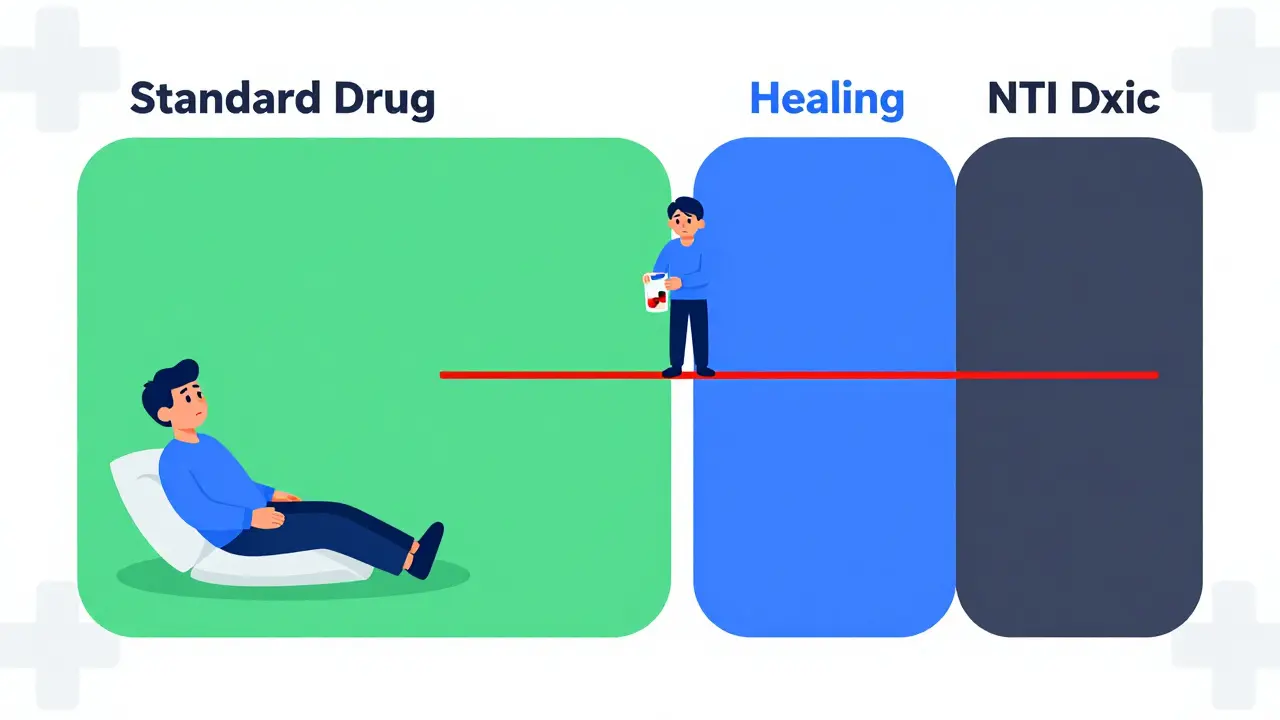
Imagine taking a medication where the difference between a healing dose and a toxic one is razor-thin. For drugs with a Narrow Therapeutic Index (NTI), this isn't just a theoretical risk-it's daily reality. When generic versions of these critical medications enter the market, regulators can't rely on standard testing methods. Instead, they demand rigorous bridging studies to prove that the generic performs identically to the brand-name original in every patient's body.
These studies are the safety net for patients relying on life-sustaining drugs like warfarin or levothyroxine. Without them, minor variations in how your body absorbs the drug could lead to dangerous spikes or drops in blood concentration. This article breaks down why NTI generics require such intense scrutiny, how these bridging studies work, and what it means for drug development and patient care.
What Defines an NTI Drug?
To understand the need for specialized bridging studies, you first need to know what makes an NTI drug different from a standard medication. Most drugs have a wide "therapeutic window." This means there is a large gap between the dose that works and the dose that causes harm. You might take a bit more or less than prescribed, and your body handles it fine.
NTI drugs do not have this luxury. The U.S. Food and Drug Administration (FDA) defines an NTI drug using specific pharmacometric criteria. A key metric is the Therapeutic Index. If this index is ≤ 3, the drug is considered high-risk. In practical terms, this means:
- The maximum effective dose is no more than two times higher than the minimum toxic dose.
- The lowest and highest safe concentrations in the blood are very close together.
- Doses often need to be adjusted in tiny increments (less than 20%).
- Patients usually require routine monitoring, such as regular blood tests.
Common examples include Warfarin (a blood thinner), Phenytoin (for seizures), Digoxin (for heart failure), and Levothyroxine (for thyroid issues). Warfarin is often used as the prototype for regulatory guidelines because its variability can lead to severe bleeding or clotting if levels aren't precise.
Why Standard Bioequivalence Isn't Enough
For most generic drugs, proving "bioequivalence" is straightforward. Manufacturers run a study showing that their generic version delivers the same amount of active ingredient into the bloodstream as the brand-name drug within a standard range of 80% to 125%. This margin accounts for normal biological variation between people.
But for NTI drugs, that 80-125% range is too wide. A 25% increase in absorption for a drug like digoxin could push a patient from a stable state into toxicity. Therefore, regulatory agencies have tightened the acceptance criteria significantly.
| Parameter | Standard Generic Drugs | NTI Generic Drugs |
|---|---|---|
| Bioequivalence Range (90% CI) | 80.00% - 125.00% | 90.00% - 111.11% |
| Quality Assay Limits | 90% - 110% | 95% - 105% |
| Study Design Complexity | Two-way crossover | Fully replicated four-way crossover |
| Average Development Cost | $1.5 - $2.5 million | $2.5 - $3.5 million |
The tighter range of 90-111.11% ensures that the generic behaves almost identically to the reference product. This precision is non-negotiable for patient safety.
The Role of Bridging Studies in NTI Development
Bridging studies are clinical investigations designed to show that data from one population or region applies to another. For NTI generics, these studies serve a dual purpose: they confirm bioequivalence and ensure that ethnic or regional differences in metabolism don't affect drug performance.
The International Council for Harmonisation (ICH) outlines several strategies for these studies. For NTI drugs, the gold standard is a single-dose, fully replicated, four-way crossover design. Here’s how it works:
- Four Periods: Instead of comparing two drugs once, participants receive both the test (generic) and reference (brand) drugs twice each.
- Replication: This repetition allows statisticians to separate individual variability from actual drug differences.
- Reference-Scaled Average Bioequivalence (RSABE): This advanced statistical method adjusts the acceptance limits based on the variability of the reference drug. If the brand-name drug varies significantly between patients, the generic is allowed slightly more flexibility, but still within strict bounds.
This approach was formalized in FDA guidance documents starting in 2012 and updated through 2019. It addresses the fact that NTI drugs often have high within-subject variability. Without replication, a standard study might fail simply due to noise, not because the drug is ineffective.
Regulatory Landscape and Global Standards
Regulatory bodies worldwide recognize the unique risks of NTI drugs. The FDA has been particularly proactive, expanding the list of drugs requiring stringent testing from 12 to 27 products in recent years. However, harmonization remains a work in progress.
In Europe, the European Medicines Agency (EMA) issued a position paper in 2022 stating that NTI drugs cannot waive specific bioequivalence requirements based on product similarity alone. Dr. Philip K. Robinson of the FDA noted in a 2020 white paper that "even minor differences in pharmacokinetics can have clinically significant consequences," reinforcing the need for rigorous data.
While the International Generic and Biosimilar Medicines Association (IGBA) proposed waiving some bridging studies under certain conditions in 2018, this remains controversial for NTI drugs. Regulatory agencies maintain that robust clinical data is essential. Currently, only about 6% of generic approvals involve NTI drugs, despite them representing 14% of small molecule drugs. This gap highlights the high barrier to entry.
Challenges in Developing NTI Generics
Developing an NTI generic is harder, slower, and more expensive than creating a standard generic. According to a 2022 survey by the Generic Pharmaceutical Association (GPhA), 78% of manufacturers find NTI development "significantly more challenging."
Here are the primary hurdles:
- Complex Study Designs: The four-way crossover design increases study duration by 40-50% and requires twice as many subjects as standard studies. Recruitment becomes difficult because healthy volunteers must commit to longer periods with multiple dosing sessions.
- High Rejection Rates: Between 2018 and 2022, 37% of complete response letters for NTI generics cited inadequate bridging study design as the main reason for rejection, compared to just 12% for non-NTI drugs.
- Specialized Expertise: Only 35% of generic manufacturers have in-house expertise for NTI development. Companies need pharmacokinetic modeling specialists and statisticians trained in RSABE methods.
- Time and Cost: Development takes 3-5 years versus 2-3 years for standard generics. Bioequivalence studies alone cost $2.5-3.5 million, adding 30-50% to total development expenses.
Dr. Elena Rodriguez of Teva Pharmaceuticals noted that the increased complexity substantially raises costs, which can deter smaller companies from entering the market. This lack of competition keeps prices higher for patients who need these critical medications.

Future Directions and Technological Advances
The industry is looking toward new technologies to streamline NTI generic development without compromising safety. One promising area is Physiologically-Based Pharmacokinetic (PBPK) modeling. These computer simulations predict how drugs move through the body based on physiological parameters.
In a 2022 pilot study, the FDA reported promising results using PBPK models for warfarin generics. While clinical data remains essential for now, experts believe that advances in modeling could reduce the need for extensive bridging studies by 2027. The FDA’s Complex Generic Drug Products Pilot Program has already reduced review times by 25% for participating applications.
Global harmonization efforts continue through the ICH, with updates to guideline E18 targeting ethnic factors in NTI drug development. The goal is to create a unified standard that speeds up approvals while maintaining the highest safety benchmarks. As Dr. Sally Sepehrara of the FDA stated, "For the foreseeable future, robust clinical data will remain essential for NTI drug approval."
Conclusion
Bridging studies for NTI generics are not just bureaucratic hurdles; they are vital safeguards. By enforcing tighter bioequivalence ranges and complex study designs, regulators ensure that patients receive generic medications that perform identically to their brand-name counterparts. While these requirements increase development costs and timelines, they protect lives by preventing dangerous fluctuations in drug levels. As technology evolves and global standards align, we may see faster access to affordable NTI generics, but the commitment to precision will never waver.
What is the difference between NTI and non-NTI drugs?
NTI (Narrow Therapeutic Index) drugs have a very small margin between the effective dose and the toxic dose. Non-NTI drugs have a wider therapeutic window, meaning small variations in dosage or absorption are less likely to cause harm. NTI drugs require stricter bioequivalence testing (90-111.11%) compared to non-NTI drugs (80-125%).
Why are bridging studies necessary for NTI generics?
Bridging studies ensure that a generic NTI drug performs identically to the brand-name version across different populations and regions. Because NTI drugs have high variability and low margins for error, standard bioequivalence tests are insufficient. Bridging studies use complex designs like four-way crossovers to account for individual metabolic differences and ensure patient safety.
How much more expensive is it to develop an NTI generic?
Developing an NTI generic is estimated to be 30-50% more expensive than a standard generic. Bioequivalence studies alone cost approximately $2.5-3.5 million for NTI drugs, compared to $1.5-2.5 million for non-NTI drugs. This is due to the need for larger sample sizes, longer study durations, and specialized statistical analysis.
What is Reference-Scaled Average Bioequivalence (RSABE)?
RSABE is a statistical method used for highly variable NTI drugs. It scales the acceptance limits for bioequivalence based on the variability of the reference (brand-name) drug. This allows for a fair comparison when the reference drug itself shows significant variation between patients, ensuring the generic is not unfairly rejected due to natural biological noise.
Can PBPK modeling replace clinical bridging studies?
Not yet. While Physiologically-Based Pharmacokinetic (PBPK) modeling shows promise and may reduce the need for some clinical trials by 2027, regulatory agencies like the FDA currently maintain that robust clinical data is essential for NTI drug approval. PBPK is viewed as a complementary tool rather than a full replacement at this stage.