
Medication Absorption Simulator
CONCERTA
MethylphenidateADDERALL XR
Mixed Amphetamine SaltsYou take your morning pill, eat a bacon and egg sandwich, and head out the door. Or maybe you skip breakfast entirely because you’re running late. If you are on extended-release medication, that simple choice about food might be quietly sabotaging your day. It is not just about feeling full or hungry; it is about whether the drug actually works when you need it to.
For millions of people taking daily prescriptions, especially for attention-deficit/hyperactivity disorder (ADHD), the timing of breakfast relative to their dose creates measurable differences in how the body absorbs the medicine. A pivotal study published in PubMed by Auiler et al. in 2002 revealed that high-fat breakfasts can drastically lower early drug exposure for certain formulations. This isn’t a minor blip; it’s a significant pharmacological shift that can leave you struggling with focus or symptoms by mid-morning.
The Science Behind Food and Drug Absorption
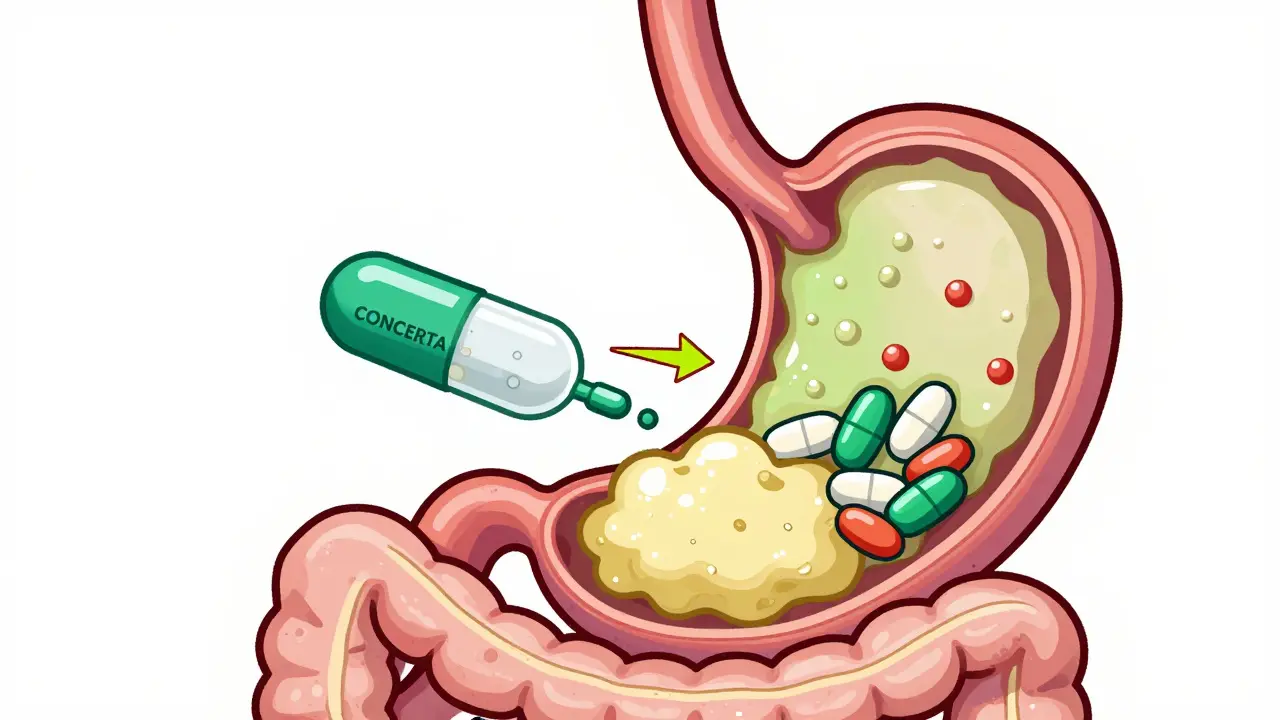
To understand why breakfast matters, we have to look at what happens inside your stomach. When you eat, particularly a meal rich in fats and proteins, your body changes its rhythm. Gastric emptying time-the speed at which food leaves your stomach and moves into the small intestine-slows down significantly. Solid food typically takes between two and five hours to clear the stomach.
This delay is crucial for extended-release medications. These drugs are designed to dissolve slowly, releasing their active ingredients over many hours. But if a heavy meal sits in your stomach longer, it traps the medication there. The drug cannot reach the small intestine, where most absorption happens, until the food moves along. Additionally, food alters gastric pH and stimulates bile secretion, both of which can change how quickly a pill dissolves.
The FDA recognizes this complexity. Their guidance for food-effect studies requires testing medications against a standardized high-calorie breakfast containing 800 to 1,000 calories total, with significant portions coming from fat. This rigorous testing reveals whether a drug’s performance depends on an empty stomach or remains stable regardless of what you ate.
Not All Extended-Release Pills Are Created Equal
Here is where things get tricky for patients. Different medications use different technologies to release their drugs, and these technologies react differently to food. The Auiler study compared two major ADHD medications: CONCERTA, which contains methylphenidate, and ADDERALL XR, which contains mixed amphetamine salts.
The results were starkly different. CONCERTA uses an osmotic-controlled release system known as OROS. Imagine a tiny capsule with a laser-drilled hole. As water enters the tablet, it pushes the medication out through that hole at a constant rate, like a slow-drip IV. This mechanical process is largely independent of what is happening in your digestive tract. The study showed less than 5% variation in drug levels whether subjects ate or fasted.
In contrast, ADDERALL XR relies on beads coated with polymers that dissolve at different rates. When subjects consumed a high-fat breakfast before taking this medication, their early drug exposure dropped by approximately 30% to 40%. This means that during the critical first eight hours of the day-often school or work hours-the medication was significantly less effective simply because of a meal.
| Medication / Class | Release Mechanism | Impact of High-Fat Breakfast | Recommended Timing |
|---|---|---|---|
| CONCERTA (Methylphenidate) | OROS (Osmotic Pump) | Minimal (<5% variation) | Consistent routine (with or without food) |
| ADDERALL XR (Amphetamine) | Extended-Release Beads | Significant (30-40% reduced early exposure) | 30 mins before or 2 hours after meals |
| Levothyroxine (Thyroid) | Immediate Release | 25-50% reduced absorption | Empty stomach, 30-60 mins before food |
| Semaglutide (GLP-1 Agonist) | Injection | N/A (Absorption unaffected by oral food) | At least 30 mins before first food |
Why Consistency Beats Perfection
If you cannot avoid eating breakfast before your dose, does that mean the medication is useless? Not necessarily. The biggest enemy is inconsistency. Dr. Richard A. Friedman, a professor of clinical psychiatry at Weill Cornell Medical College, noted that inconsistent food timing creates inconsistent symptom control. This variability is particularly damaging for children trying to maintain academic performance or adults managing complex workloads.
Imagine taking your medication on an empty stomach on weekends but with a heavy breakfast on weekdays. Your body experiences wildly different drug levels depending on the day. This leads to "weekend crashes" or unexpected spikes in side effects. The goal is not necessarily to fast forever, but to establish a predictable pattern. Whether you always eat before dosing or always wait until after, sticking to one method stabilizes your blood plasma concentrations.
User experiences highlight this reality. On Reddit’s r/ADHD community, users frequently report switching formulations specifically to accommodate their eating habits. One user described moving to CONCERTA because their focus would crash by 10 AM on school days when they ate breakfast, whereas it worked perfectly on weekends when they fasted. Another teacher noted that taking her medication with breakfast allowed her to function without having to choose between eating and focusing.
Beyond ADHD: Other Medications Affected by Food
While ADHD stimulants dominate the conversation around morning dosing, other common medications are sensitive to food timing too. For instance, Levothyroxine, a thyroid hormone replacement, suffers up to 50% reduced absorption if taken with food. Patients are advised to take it on an empty stomach, waiting at least 30 to 60 minutes before eating anything.
Conversely, some medications benefit from specific timing unrelated to food effects on absorption. Statins like simvastatin and pravastatin are often more effective when taken in the evening because the body produces cholesterol primarily at night. However, newer statins like atorvastatin have long half-lives and work regardless of timing. Blood pressure medications also show flexibility; the British Heart Foundation’s TIME trial found no significant difference in cardiovascular outcomes between morning and evening dosing for most hypertensive patients, suggesting convenience may trump strict timing for this class.
Building a Routine That Works
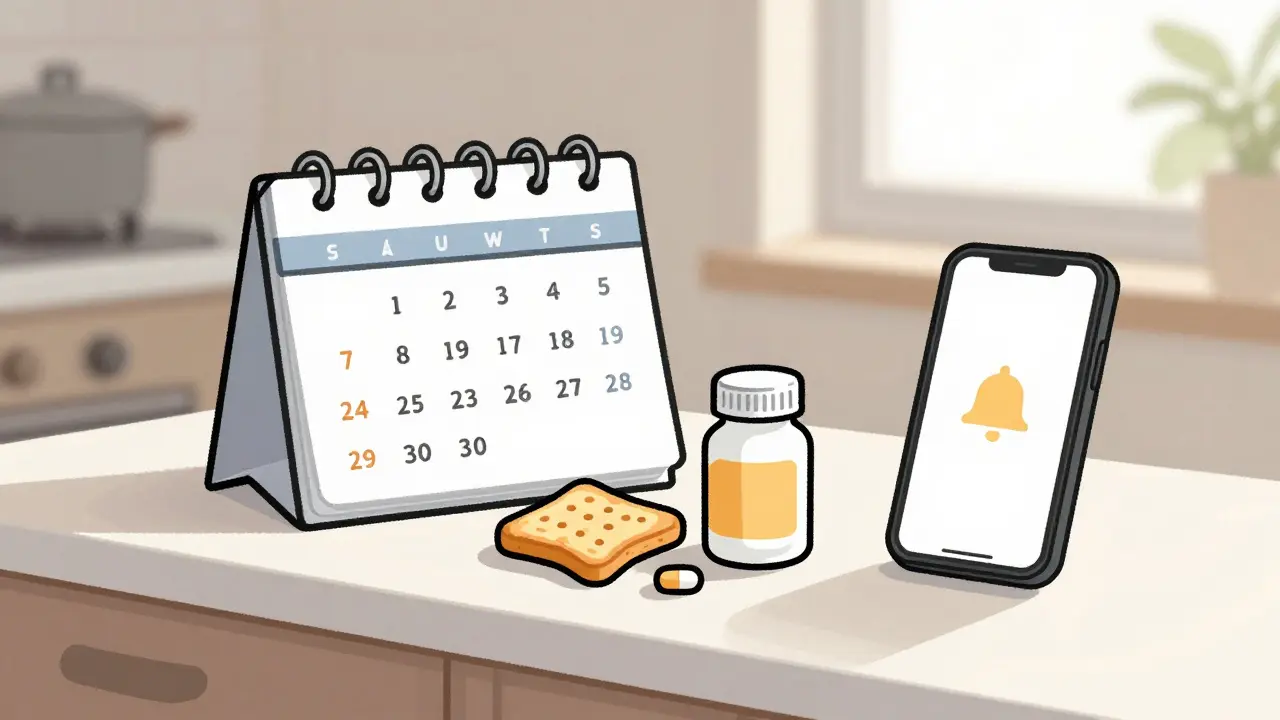
So, how do you implement this knowledge without disrupting your life? First, check your medication’s label or ask your pharmacist about its food sensitivity. If you are on a formulation like ADDERALL XR that shows significant food effects, aim for consistency. If you must eat, consider a low-fat snack (100-200 calories) rather than a full high-fat breakfast, as fat is the primary driver of delayed gastric emptying.
For those who experience nausea on an empty stomach-a common side effect of stimulants-pairing the dose with a small, bland carbohydrate-based snack (like toast or crackers) can help mitigate discomfort while minimizing the impact on absorption. Avoid heavy proteins and fats immediately before or after dosing if your medication is food-sensitive.
Tracking your symptoms can reveal hidden patterns. Use a simple scale to rate your focus or energy hourly for a week. Note what you ate and when you took your medication. You might discover that your current routine is causing mid-day slumps that could be fixed with a slight adjustment in timing.
The Future of Personalized Timing
Pharmaceutical companies are increasingly aware of these issues. The market for extended-release medications reached $148.7 billion globally in 2022, and developers now routinely include food-effect studies in new submissions. In fact, 92% of novel extended-release CNS drugs submitted to the FDA between 2018 and 2022 included specific food-effect data, a massive increase from previous years.
This trend favors formulations like CONCERTA that offer consistent performance regardless of diet. Market data suggests that medications demonstrating minimal food effects are capturing larger shares of the pediatric ADHD segment. Looking ahead, personalized medicine may refine this further. Early research suggests that genetic factors, such as CYP2D6 metabolizer status, might influence how individuals respond to food effects, potentially allowing for genetically-informed timing protocols in the near future.
Digital health tools are also stepping in. Apps like MedMinder now include medication-specific food timing reminders, helping users maintain the consistency required for optimal efficacy. By leveraging technology and understanding the science, you can turn your morning routine from a source of variability into a pillar of reliable health management.
Can I take my ADHD medication with a high-fat breakfast?
It depends on the specific medication. For CONCERTA, a high-fat breakfast has minimal impact due to its osmotic release mechanism. However, for ADDERALL XR, a high-fat breakfast can reduce early drug exposure by 30-40%, leading to poorer symptom control in the morning. If you must eat, try to keep the meal low in fat or take the medication 30 minutes before eating.
Why does food affect some medications but not others?
Food affects gastric emptying time and stomach pH. Medications that rely on dissolving in the stomach or moving quickly to the small intestine (like bead-based systems) are slowed down by food, especially fats. Medications using mechanical release systems, like the OROS pump in CONCERTA, push the drug out at a constant rate regardless of digestion speed, making them less sensitive to food.
What should I do if I feel nauseous taking my medication on an empty stomach?
If your medication is sensitive to food, avoid heavy, high-fat meals. Instead, pair your dose with a small, low-fat, carbohydrate-based snack like plain toast, crackers, or a banana. This can settle your stomach without significantly delaying gastric emptying or reducing drug absorption.
Is it better to take medication every day at the same time, even if I eat differently?
Consistency in timing is important, but consistency in food intake is equally critical for food-sensitive medications. Taking your pill at 8 AM daily but eating a heavy breakfast on weekdays and fasting on weekends will cause fluctuating drug levels. Aim for a consistent routine regarding both time and food context.
How much does a high-fat breakfast really reduce medication effectiveness?
For ADDERALL XR, studies show a 30-40% reduction in early drug exposure (the first 8 hours) when taken after a high-fat breakfast. For CONCERTA, the variation is less than 5%. For thyroid medication like Levothyroxine, absorption can drop by 25-50%.