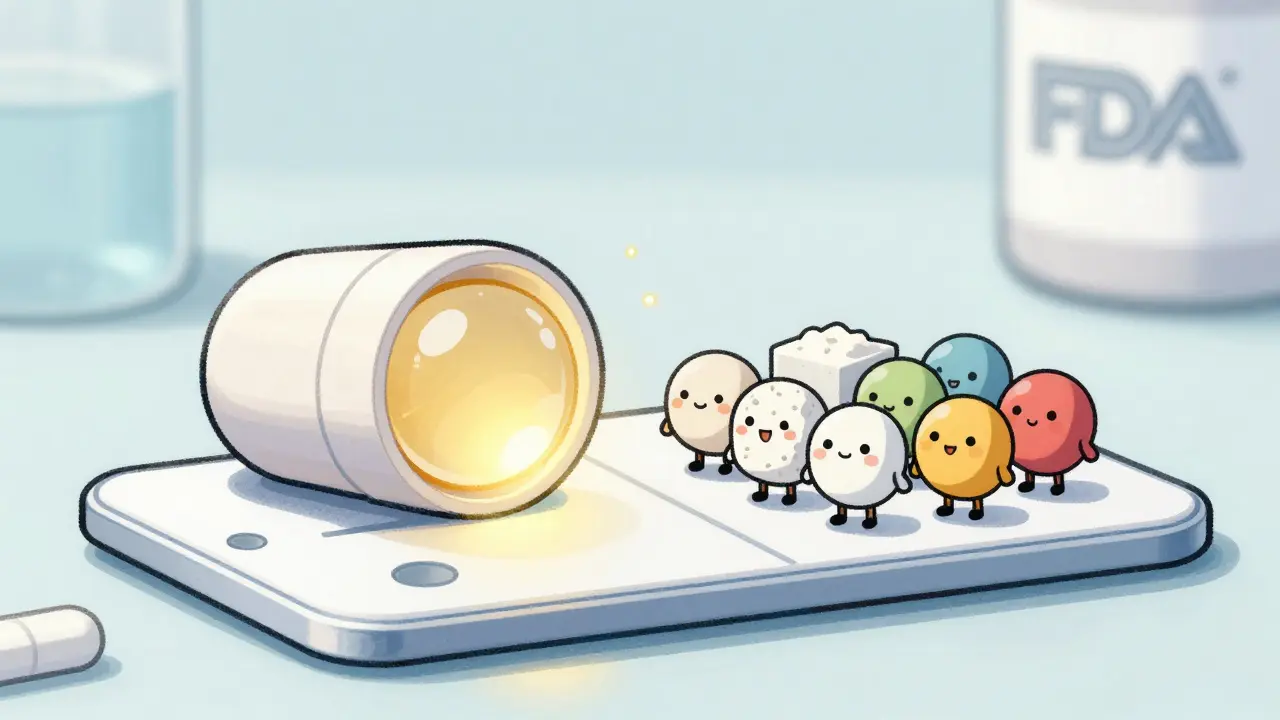
When you pick up a pill, you might think it’s just one thing: the medicine. But what’s inside that tablet or capsule is actually two very different kinds of ingredients - and the difference isn’t just technical. It can affect how well your medication works, whether you have side effects, and even if it’s safe for you at all.
What Exactly Is an Active Ingredient?
The active ingredient is the part of the drug that actually does the work. It’s the reason you’re taking the pill. In Tylenol, that’s acetaminophen. In Advil, it’s ibuprofen. In Lipitor, it’s atorvastatin. These substances are designed to interact with your body’s biology - to block pain signals, lower cholesterol, or fight infection.
The U.S. Food and Drug Administration (FDA) defines active ingredients as components that have a direct effect on your body’s structure or function. That means they must go through years of testing to prove they’re both safe and effective before they can be sold. Only about 10% of drug candidates make it through this process. The rest fail because they don’t work as intended or cause too many side effects.
Active ingredients are tightly controlled. Every batch must meet exact standards for purity and strength. If a pill contains 500mg of acetaminophen, it can’t have 480mg or 520mg. That precision matters. Too little won’t help. Too much can be dangerous.
What Are Inactive Ingredients - And Why Are They Even There?
Inactive ingredients, also called excipients, are everything else in the pill. They don’t treat your condition. But without them, most medications wouldn’t work at all.
Think of them as the support crew. They help shape the pill, hold it together, make it easier to swallow, and keep it stable over time. For example:
- Fillers like lactose or microcrystalline cellulose give bulk to the pill. If the active ingredient is just a few milligrams, you’d need a tiny, crumbly speck to swallow - impossible to handle. Fillers make it the right size.
- Binders like gelatin or starch glue the ingredients together so the pill doesn’t fall apart in your hand or in the bottle.
- Lubricants like magnesium stearate keep the medicine from sticking to the machines during manufacturing.
- Coatings like hydroxypropyl methylcellulose make pills easier to swallow and sometimes control how fast the active ingredient is released.
- Preservatives like parabens stop bacteria and mold from growing in liquid medicines or creams.
- Flavors and colors make the medicine taste better or look more appealing - especially for kids or people who take pills daily.
The FDA keeps a public database of over 1,000 inactive ingredients used in approved medications. These are generally recognized as safe (GRAS), meaning they’ve been used for decades without major issues. But here’s the catch: “inactive” doesn’t always mean harmless.
The Surprising Truth About “Inactive” Ingredients
A 2021 study from the University of California, San Francisco, and Novartis shook up the pharmaceutical world. Researchers tested 639 commonly used inactive ingredients against over 3,000 human proteins - the same targets that drugs are designed to hit.
What they found? About 14% of these so-called inactive ingredients showed biological activity. That means they weren’t just sitting there. Some were binding to proteins involved in inflammation, metabolism, or nerve signaling.
Take D&C Red 7 calcium lake - a red dye used in some pills. It showed strong binding to a protein linked to liver function. Propyl gallate, a preservative found in capsules, interacted with enzymes tied to hormone regulation. These weren’t random findings. They were consistent, repeatable, and occurred at concentrations found in real medications.
Dr. Brian Shoichet, who led the research, put it plainly: “Many excipients are inert. But a good number may have previously unappreciated effects.”
This isn’t just academic. If an inactive ingredient interacts with your body’s biology, it could:
- Interfere with how your active ingredient works
- Trigger side effects you didn’t expect
- Make your medication less effective over time
The FDA took notice. In 2022, they launched the Excipient Safety Initiative - a $4.2 million project to better understand these hidden effects. Now, for drugs taken long-term or in high doses, manufacturers are being asked to test excipients more carefully.
When Inactive Ingredients Cause Real Problems
Even without biological activity, some inactive ingredients cause direct reactions in people.
Lactose, a common filler, affects about 65% of the global population who can’t digest it properly. If you’re lactose intolerant, taking a pill with lactose might give you bloating, cramps, or diarrhea - even if the active ingredient is perfectly safe.
Gluten is another hidden issue. Some pills use wheat starch as a binder. For someone with celiac disease, even a tiny amount can damage the gut lining. About 15% of people in the U.S. avoid gluten for health reasons.
Sulfites, used as preservatives in injectable drugs, can trigger asthma attacks in people with sensitivity. That’s why some inhalers and IV bags now carry warnings.
And then there’s dye. Red 40, Yellow 5, and other artificial colors are linked to hyperactivity in children and allergic reactions in adults. The European Union requires warning labels on foods with these dyes - but pills? Often, no warning at all.
According to FDA data from 2020 to 2022, about 0.5% of all reported adverse drug reactions were caused by inactive ingredients - not the active ones. That might sound small, but with billions of pills taken every year, that’s tens of thousands of people experiencing avoidable side effects.
Why This Matters for You
If you’ve ever switched from a brand-name drug to a generic and felt different - less effective, more side effects - the culprit might not be the active ingredient. It could be the excipients.
Generics must contain the same active ingredient in the same amount. But they can use different fillers, binders, or coatings. That small change can alter how quickly the medicine dissolves or how well your body absorbs it.
Take fenofibrate, a cholesterol drug. One version with a special surfactant increased absorption by 35% compared to older versions. That’s not a minor difference - it’s the difference between your cholesterol dropping or staying high.
That’s why pharmacists now check inactive ingredients when switching prescriptions. In 2022, nearly one in five medication changes in the U.S. were made not because the active ingredient wasn’t working - but because the patient couldn’t tolerate the filler or dye.
What You Can Do
You don’t need a chemistry degree to protect yourself. Here’s how to take control:
- Read the label. On over-the-counter drugs, active and inactive ingredients are listed on the back. On prescriptions, they’re in the package insert. Look for terms like lactose, gluten, sulfites, or artificial colors.
- Ask your pharmacist. If you have allergies, intolerances, or sensitivities, ask: “Is there a version of this without [lactose, dye, etc.]?” Pharmacists can often find alternatives.
- Check the FDA’s Inactive Ingredient Database. It’s free and public. Search by ingredient name or drug product to see what’s allowed in different forms - oral, injectable, topical.
- Track your reactions. If you notice new symptoms after switching medications, write them down. Note the brand, the generic, and the date. Bring it to your doctor. You might be the first to spot a pattern.
More countries are starting to take this seriously. Australia now requires doctors to prescribe by active ingredient - not brand name - to help patients avoid hidden excipients. The U.S. is catching up. Between 2017 and 2022, prescriptions focused on active ingredients rose by 37%.
The Future of Medication
The old idea that “inactive” means “harmless” is fading. The next generation of drugs will be designed with personalized excipients in mind. Imagine a pill made without lactose for someone who’s intolerant, or with a coating that avoids allergens - all tailored to your body.
Artificial intelligence is already being used to predict how excipients might interact with human proteins before a drug even hits the market. Pharmaceutical companies are screening their ingredients like they’re new drugs.
Eventually, we might stop calling them “inactive.” Terms like “functional excipients” or “biologically assessed additives” might replace the misleading label. The goal? No more surprises. Just safe, effective medicine - inside and out.
Next time you take a pill, remember: it’s not just one ingredient doing the work. It’s a team. And sometimes, the quiet ones - the ones you never thought about - are the ones making the biggest difference.
15 Responses
This blew my mind. I had no idea that the filler in my pills could be making me bloated. I switched from brand to generic last year and started having stomach issues-now I get it. I’m going to check my meds tonight.
Thanks for sharing this!
As a pharmacist, I see this every day. Patients blame the drug when it’s often the lactose or the dye. We have to dig into the package insert to find alternatives. It’s not in the training, but it should be. I keep a list of excipient-free versions on my phone now. Saves so many people from unnecessary suffering.
Pro tip: Look for ‘USP’ or ‘NF’ listed ingredients-they’re standardized and safer.
Okay, I’ve been taking this generic version of my blood pressure med for two years and I’ve had this weird fatigue I couldn’t explain. I just checked the label-new one has FD&C Yellow No. 5, which I’ve read is linked to anxiety in sensitive people. I’m calling my doc tomorrow to switch back. This isn’t just about allergies-it’s about how your body reacts to things you never thought mattered. I’m so glad someone finally put this out there. I’ve been Googling ‘why do I feel weird after meds’ for years and never got this answer.
Also, the FDA database is actually super easy to use. Just type in the ingredient name. No jargon. I wish more people knew about it.
Let’s be clear: the pharmaceutical industry has been lying to you for decades by calling these substances ‘inactive.’ It’s not negligence-it’s corporate malfeasance. They know these excipients interact with proteins, yet they don’t test them because it’s cheaper not to. The FDA’s ‘Excipient Safety Initiative’? A PR stunt. $4.2 million for a problem affecting millions? Pathetic. You think your ‘generic’ is the same? It’s not. It’s a different chemical cocktail designed to maximize profit, not your health. Stop trusting labels. Demand full disclosure or stop taking pills altogether.
In India, we’ve always known this. Our grandmothers would say, ‘The medicine is not the medicine-the carrier is the carrier.’ We’ve had lactose intolerance for generations, but no one spoke about it because the pills were cheap and available. Now, with more awareness, some pharmacies offer gluten-free and dye-free versions. But the real issue is access. In rural areas, you get what’s available, not what’s safe. This isn’t just a Western problem-it’s a global one. We need global standards, not just FDA updates.
I’ve been avoiding dyes since my kid had a reaction to red 40 in a children’s vitamin. Now I check every pill. It’s a pain, but worth it. My pharmacist even ordered me a special version of my thyroid med without the coloring-no extra cost. Just ask. They want you to be healthy too.
The entire premise of this post is fundamentally flawed. To label excipients as ‘inactive’ is a linguistic simplification, not a scientific falsehood. The term ‘inactive’ refers to pharmacodynamic irrelevance, not biochemical inertness. To conflate biological activity with therapeutic intent is a category error. The 14% binding rate observed in the Shoichet study is statistically insignificant in vivo due to pharmacokinetic dilution, first-pass metabolism, and protein binding saturation. The real issue isn’t excipient toxicity-it’s the public’s pathological misunderstanding of pharmacology. This post fuels pseudoscientific fearmongering under the guise of ‘empowerment.’
As someone who’s worked in global health, I’ve seen people in Nigeria and rural India die because they couldn’t get a version of their meds without gluten or lactose. This isn’t just about convenience-it’s equity. We need to push pharma to make multiple formulations, not just the cheapest one. And we need to educate doctors globally, not just in the U.S. This is a human rights issue. If you’re allergic to something in your medicine, you shouldn’t have to hunt for it like a secret code.
What’s fascinating is the epistemological shift here: we’re moving from a model of ‘active ingredient = medicine’ to ‘the entire formulation = pharmacological entity.’ This reframes drug development from a reductionist paradigm to a systems biology one. The excipient isn’t a vehicle-it’s a co-actor. The implications for personalized medicine are profound. Imagine AI-driven excipient profiling based on your microbiome, genetic polymorphisms, and metabolic profile. The future isn’t just tailored drugs-it’s tailored matrices. We’re on the cusp of a new pharmacopeia.
This is the kind of info you wish you’d known years ago. I used to think generics were just cheaper versions of the same thing. Turns out, my migraines started after switching to a generic version with a different coating. Switched back and they vanished. I’m telling everyone I know to check their labels. You’re not being paranoid-you’re being smart. Keep sharing stuff like this. We need more awareness, not less.
Wait, so you’re saying I’ve been getting stomach cramps from my allergy meds because of the corn starch? But I’ve been told corn starch is ‘safe.’ Who made that call? The FDA? The manufacturer? A guy in a lab who didn’t even eat breakfast that day? And why aren’t we told this on the bottle like we are with food? This is insane. I’m not taking anything without a full ingredient list printed on the outside. And if you’re not doing that, you’re basically gambling with your body. I’m not being dramatic-I’m being done.
They’re lying to you. Every single one of them. The FDA? Compromised. Big Pharma? Greedy. Your doctor? Probably didn’t even know. That ‘inactive’ label is a lie to protect profits. I’ve been researching this for five years. I’ve found studies where excipients caused liver damage in rats at normal human doses. They suppress the data. They bury the papers. And now you’re reading this on Reddit because no one else will tell you. Wake up. Your pills are not harmless. They’re a gamble. And you’re losing.
It is imperative that patients be afforded full transparency regarding pharmaceutical excipients. The current regulatory framework fails to mandate clear, accessible labeling of non-active components. While the FDA’s database exists, it is neither user-friendly nor widely disseminated. Healthcare providers must be educated to routinely discuss excipient content during medication counseling. Furthermore, insurance providers should cover alternative formulations when medically indicated. This is not a matter of personal preference-it is a clinical necessity.
I’ve been taking a generic version of my antidepressant and felt off for months. Finally switched back to brand and felt like myself again. Didn’t know why until now. Turns out the new one had titanium dioxide. I read it causes inflammation in some people. Never would’ve connected it. Thanks for this. I’m checking all my meds now.
In Nigeria, many people take pills without knowing what’s inside. Some pharmacies sell unregulated generics. I’ve seen people with diabetes take pills with sugar fillers and end up in the hospital. We need community health workers to teach people how to read labels. This isn’t just science-it’s survival. Thank you for making this clear. We need more of this in Africa too.