
When you're pregnant and dealing with a headache, fever, or back pain, the last thing you want is to guess whether your medicine is safe. You’re not alone. Many pregnant people avoid taking anything at all-even acetaminophen-because of mixed messages online, scary headlines, or well-meaning but outdated advice. But here’s the truth: acetaminophen is still the safest, most reliable option for pain and fever relief during pregnancy. NSAIDs like ibuprofen and naproxen? Not so much-especially after 20 weeks.
Acetaminophen: The Go-To Choice for All Three Trimesters
Acetaminophen (also called paracetamol) has been used safely in pregnancy for over 70 years. It’s the only over-the-counter pain reliever that doctors recommend across all trimesters when used as directed. It works to lower fever and ease pain without affecting blood clotting or the baby’s kidneys like NSAIDs do.
The standard dose is 325 to 1,000 mg every 4 to 6 hours, with a maximum of 4,000 mg per day. Many people find 500 mg every 6 hours is enough for mild to moderate pain. There’s no need to wait until the pain is unbearable-untreated fever above 100.4°F can increase miscarriage risk by 1.5 times, and high fever in the first trimester raises the chance of neural tube defects by up to 2.3 times. If you’re running a fever, taking acetaminophen isn’t risky-it’s protective.
Large studies involving nearly 100,000 mother-child pairs found no link between acetaminophen use and autism, ADHD, or intellectual disability in children. The adjusted odds ratios were all close to 1.0, meaning no meaningful difference in outcomes. That’s not to say research has stopped. A major NIH study tracking 10,000 pregnancies through 2027 is looking at long-term effects, especially with chronic use. But so far, the data overwhelmingly supports its safety.
Some headlines have claimed acetaminophen might disrupt hormones. That’s based on small lab studies or theories-not real-world outcomes. Major medical groups like the American College of Obstetricians and Gynecologists (ACOG), the Society for Maternal-Fetal Medicine, and the American Academy of Pediatrics all agree: the benefits of treating pain and fever far outweigh any unproven risks.
NSAIDs: When They’re Dangerous-and When They’re Not
NSAIDs like ibuprofen (Advil, Motrin), naproxen (Aleve), and diclofenac (Voltaren) are effective for inflammation and pain. But during pregnancy, they come with serious, time-sensitive risks.
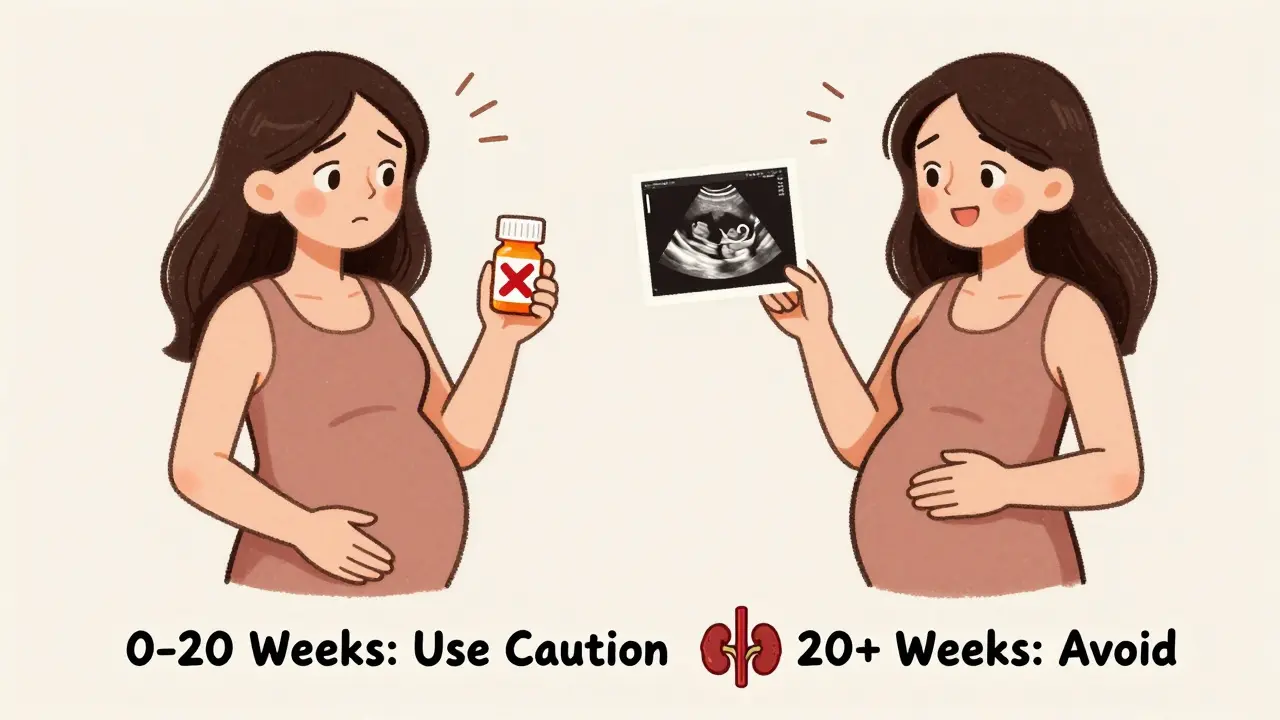
Since October 2020, the FDA has required all NSAID labels to warn against use after 20 weeks of pregnancy. That’s a big shift from the old guideline of avoiding them only after 30 weeks. Why the change? Because after 20 weeks, NSAIDs can cause the baby’s kidneys to stop working properly. This leads to low amniotic fluid (oligohydramnios), which can happen in as little as 48 hours. Studies show 1 to 2% of babies exposed to NSAIDs after 20 weeks develop this condition, compared to just 0.1% in unexposed pregnancies.
If you accidentally take an NSAID after 20 weeks, don’t panic-but stop immediately and call your provider. An ultrasound can check amniotic fluid levels. If levels are low, stopping the drug often lets them bounce back. But if you keep taking it, the risk of complications rises.
After 30 weeks, there’s another danger: NSAIDs can cause the fetal ductus arteriosus-a blood vessel that bypasses the lungs before birth-to close too early. This can lead to serious heart problems in the newborn. The risk is low (0.5-1%), but it’s real.
There’s one exception: low-dose aspirin (81 mg) prescribed for preeclampsia prevention. That’s still safe and recommended. But don’t confuse it with regular aspirin or other NSAIDs. If you’re unsure what’s in your medicine, read the Drug Facts label. About 30% of cold and flu products contain NSAIDs, and 38% of these still don’t clearly state the 20-week warning.
What About the First Trimester?
Some people worry that taking any medication in the first trimester-when organs are forming-could cause birth defects. But acetaminophen doesn’t work that way. Multiple large studies show no increase in congenital anomalies with acetaminophen use during the first 12 weeks. In fact, not treating fever or severe pain can be riskier. High fever during this time is linked to heart defects, cleft lip, and neural tube defects. If you have the flu, a bad sinus infection, or a migraine, acetaminophen helps protect your baby by bringing your temperature down.
NSAIDs in the first trimester? The data is less clear, but most experts avoid them unless absolutely necessary. Some studies suggest a small increase in miscarriage risk with high doses, though it’s hard to separate that from the underlying illness. Bottom line: if you need pain relief before 20 weeks, acetaminophen is still your best bet. Save NSAIDs for emergencies and only with your provider’s approval.
How to Use Acetaminophen Safely
Even safe medications can be risky if misused. Here’s how to use acetaminophen correctly during pregnancy:
- Start with the lowest effective dose-usually 500 mg.
- Take it only when needed, not daily unless advised by your provider.
- Don’t exceed 4,000 mg in 24 hours.
- Avoid combination products like cold and flu syrups that contain acetaminophen plus other ingredients.
- Don’t use it for more than 3-5 days in a row without checking in with your doctor.
- Check all labels: if you’re taking more than one medicine, make sure you’re not doubling up on acetaminophen.
Many people think, “If a little is good, more must be better.” That’s not true. Overdosing on acetaminophen can cause liver damage-even in healthy people. Pregnant people aren’t more sensitive to this, but their bodies are already under extra stress. Keep it simple: one pill, every 6 hours, only when you need it.
Why So Much Confusion?
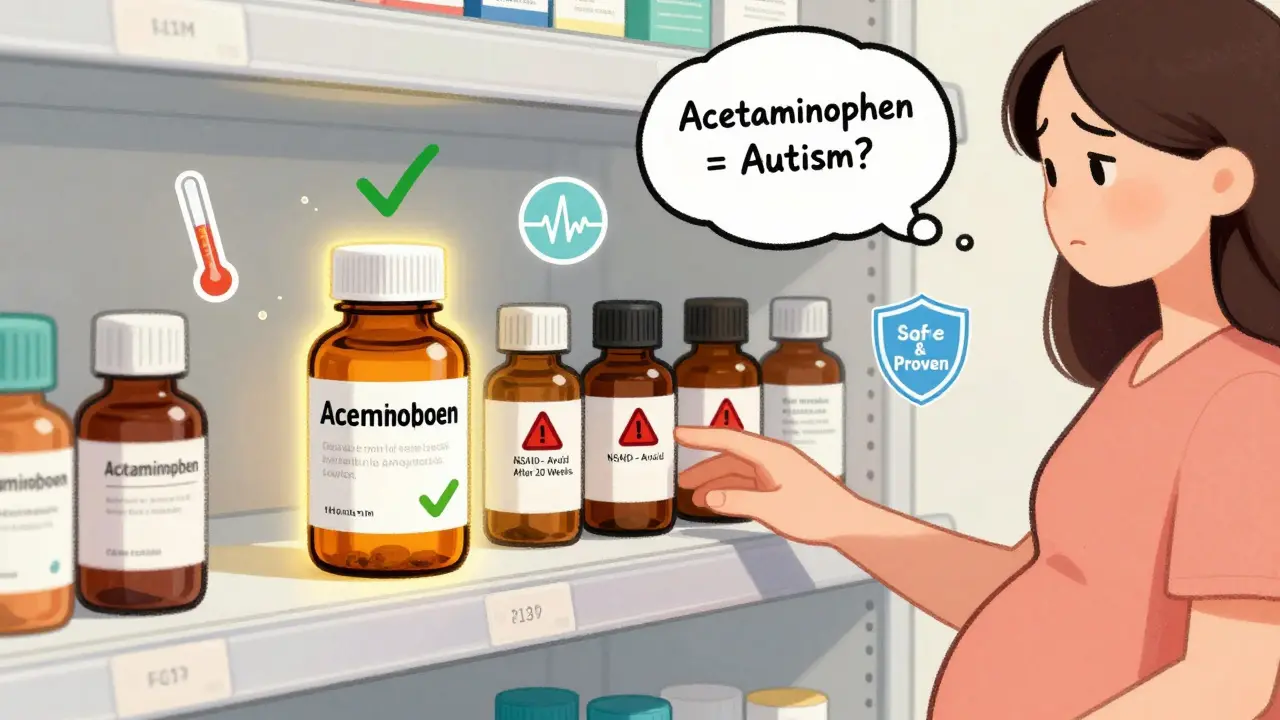
You’re not crazy for feeling unsure. A 2023 survey found 68% of pregnant people avoid all pain meds due to fear. Forty-two percent specifically avoid acetaminophen because of social media rumors linking it to autism. But correlation isn’t causation. Just because a child has autism and the mother took acetaminophen doesn’t mean one caused the other. The same studies show no increased risk when you control for other factors like genetics, maternal health, and environment.
Doctors are seeing more patients who’ve stopped prescribed acetaminophen because of Reddit threads or Instagram posts. One patient told her OB she’d been in pain for days because she was afraid to take the medicine her doctor recommended. That’s not bravery-it’s dangerous. Pain and fever don’t disappear on their own. They can harm you and your baby.
Also, labeling on OTC meds is still messy. Even though the FDA required clearer warnings on NSAIDs since 2021, nearly 4 out of 10 products still don’t say “avoid after 20 weeks” clearly. Always read the active ingredients. If you see “ibuprofen,” “naproxen,” or “ketoprofen,” put it back.
What to Do If You’ve Taken an NSAID After 20 Weeks
If you took ibuprofen or naproxen after 20 weeks and didn’t know it was risky:
- Stop taking it right away.
- Call your provider. They’ll likely schedule an ultrasound to check amniotic fluid levels.
- Don’t panic. Most cases of low fluid improve within days of stopping the drug.
- Keep track of fetal movements. If you notice a big drop in kicks, go in immediately.
There’s no need to blame yourself. Many people take NSAIDs early in pregnancy without realizing they’re pregnant. The key is to catch it early and act.
Final Takeaway: Safe Pain Relief Is Possible
Pregnancy doesn’t mean you have to suffer. Acetaminophen is safe, effective, and essential for many pregnant people. NSAIDs are not. The science is clear: treat fever and pain with acetaminophen. Avoid NSAIDs after 20 weeks. Use them before 20 weeks only if your provider says so, and never for more than 48 hours without monitoring.
The real danger isn’t acetaminophen. It’s the fear that keeps you from using it. Untreated pain and fever carry real risks-for you and your baby. You deserve relief. You deserve to feel better. And with the right information, you can get it safely.
Is acetaminophen safe during all three trimesters of pregnancy?
Yes, acetaminophen is considered safe for use in all three trimesters when taken at recommended doses (325-1,000 mg per dose, up to 4,000 mg daily). Major medical organizations including ACOG and the AAP confirm its safety based on decades of research. It’s the only over-the-counter pain reliever recommended for use throughout pregnancy.
Can I take ibuprofen while pregnant?
Avoid ibuprofen and other NSAIDs after 20 weeks of pregnancy. Before 20 weeks, they may be used occasionally and only under medical supervision. After 20 weeks, they can cause fetal kidney problems, low amniotic fluid, and premature closure of a critical blood vessel. Even short-term use carries risk, so acetaminophen is always the preferred choice.
Does acetaminophen cause autism or ADHD in babies?
No. A large 2023 study of nearly 100,000 mother-child pairs found no significant link between acetaminophen use during pregnancy and autism, ADHD, or intellectual disability. The odds ratios were nearly 1.0, meaning no increased risk. While some small studies have raised theoretical concerns, they don’t reflect real-world outcomes. Leading health organizations agree the benefits of treating pain and fever outweigh unproven risks.
What should I do if I took an NSAID after 20 weeks?
Stop taking the NSAID immediately. Contact your healthcare provider, who may recommend an ultrasound to check your amniotic fluid levels. In most cases, fluid levels return to normal within days of stopping the medication. Monitor your baby’s movements closely. If you notice fewer kicks, seek care right away. Don’t blame yourself-many people take NSAIDs without knowing they’re pregnant or unaware of the updated guidelines.
Are all cold and flu medicines safe during pregnancy?
No. About 30% of over-the-counter cold and flu products contain NSAIDs like ibuprofen or naproxen. Always read the active ingredients list. Look for products that contain only acetaminophen and avoid anything with “ibuprofen,” “naproxen,” “aspirin,” or “ketoprofen.” Combination products can easily lead to accidental overdose or exposure to unsafe ingredients.
Can I take acetaminophen for a headache every day during pregnancy?
It’s not recommended. While acetaminophen is safe for occasional use, taking it daily or for more than 3-5 days in a row without medical advice increases the risk of liver strain and may mask an underlying condition. If you’re having frequent headaches, talk to your provider. It could be dehydration, stress, high blood pressure, or another issue that needs attention.
11 Responses
So many people are terrified of acetaminophen like it’s some kind of secret toxin, but the data just doesn’t back that up. I’ve been pregnant twice and took it every time I had a migraine-no issues, no regrets. The real danger is untreated fever. I had a 102°F fever at 8 weeks and panicked for days until my OB told me to just take the damn Tylenol. Baby’s now 3 and hitting all milestones. Don’t let fear override science.
From a clinical pharmacology standpoint, the pharmacokinetic profile of acetaminophen in pregnancy demonstrates negligible placental transfer variability, and hepatic metabolism remains intact due to CYP2E1 enzyme homeostasis. The FDA’s 2020 NSAID warning was based on robust fetal renal perfusion data-oligohydramnios risk escalates exponentially post-20 weeks due to prostaglandin-mediated vasoconstriction of the fetal renal arterioles. Acetaminophen remains the only COX-1/2-sparing analgesic with Level A evidence for trimester-spanning use. Misinformation on social platforms reflects a profound deficit in evidence-based health literacy.
Let’s be real-acetaminophen isn’t ‘safe,’ it’s just the *least bad* option. The NIH study tracking 10k pregnancies? That’s not proof, it’s a hypothesis with a 2027 expiration date. And don’t get me started on how many OTC labels still don’t say ‘avoid after 20 weeks’-that’s not negligence, that’s corporate malpractice. Also, why are we still using ‘acetaminophen’ instead of ‘paracetamol’? It’s 2024, not 1955.
I just want to say-I’ve been there. I was so scared to take anything, even when I had a fever that made me shake. I thought I was being ‘natural’ by suffering through it. I didn’t realize that untreated fever was actually hurting my baby more than the medicine ever could. My OB said, ‘You’re not protecting your baby by being brave-you’re risking them.’ That hit me hard. I started taking 500mg every 6 hours, and within a day, I felt human again. If you’re reading this and you’re scared-please, just take the Tylenol. Your baby deserves a mom who feels okay.
lol at people who think ‘natural’ means ‘no meds’. you’re not a tree, you’re a mammal. acetaminophen is literally the most studied drug in pregancy history and you’re still scared? also, i’ve seen 3 people in my OB’s office cry because they didn’t take it and ended up in the ER with sepsis. just… take the pill. 🤷♂️
They say acetaminophen is safe but what about the 2022 study in JAMA that showed epigenetic changes in cord blood? And why are they still pushing it when Big Pharma owns the FDA? I know a woman who took it every day and her son has autism-he’s nonverbal. Coincidence? I think not. And NSAIDs? They’re just hiding the truth. I read on a forum that amniotic fluid drops because the government wants to control population growth. I’m not paranoid-I’m informed.
bro i took ibuprofen at 22 weeks by accident and my wife freaked out but we called the doc and they did an ultrasound and fluid was fine. just stop taking it and breathe. no need to turn this into a horror movie. also, tylenol is your friend. no drama. just medicine.
Why are we even having this conversation? In America, we have the best medical science in the world. If the FDA says acetaminophen is safe, then it’s safe. Stop listening to Reddit and Instagram influencers. If you’re from another country, maybe you don’t know how rigorous our drug approvals are. Take the medicine. Stop being paranoid. Your baby needs you healthy.
As a practicing obstetrician in Mumbai, I’ve seen patients avoid acetaminophen due to cultural myths-‘it weakens the baby’s bones,’ ‘it causes infertility later.’ These are baseless. I’ve prescribed it to over 500 pregnant patients with zero adverse outcomes. The real issue is access: many women in rural India can’t get acetaminophen at all, so they suffer. We need better education, not fear. The science is clear: treat fever. Protect the baby.
yo i used to be a total acetaminophen hater till i got hit with a flu at 16 wks and ended up in the hospital with a fever that wouldn’t break. doc gave me tylenol and i felt like a new person. my kid’s 2 now and he’s a total chaos gremlin but no autism, no delays, just pure toddler energy. also, never trust a cold med that doesn’t spell out the ingredients-i once took one that had naproxen hidden in the ‘nighttime relief’ version. yikes. read the tiny print, folks.
Acetaminophen? How quaint. The real issue is that we’ve reduced maternal healthcare to a pharmacological checklist while ignoring systemic factors-stress, nutrition, environmental toxins, sleep deprivation. The fact that we’re debating whether a single OTC drug is ‘safe’ speaks volumes about how broken our prenatal care system is. But hey, at least we’ve got a pill for that.